State Champ Radio
 Latin
Page: 15
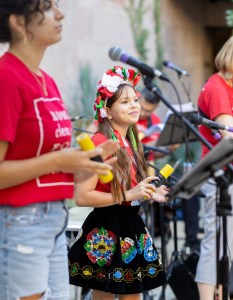
Backed by science and heart, Moms Clean Air Force, a nonprofit environmental advocacy group whose goal is to protect clean air and children’s health — and EcoMadres, their Latino community outreach program — educates families about why they should care about climate disruption, air pollution and toxic chemicals, and engages them in taking action to preserve their futures — all with the help of music.
With data that Latinos in the United States are disproportionately impacted by climate change, an initiative called EcoMusica was born.
Trending on Billboard
As part of EcoMusica, SonTierra, a multi-ethnic ensemble of Latino musicians whose name means “we are the Earth,” perform tunes that offer hope and encourage listeners to reach out to legislators and leaders. The music played at outreach events incorporates a number of Latin music styles: cumbia, banda, bolero, merengue, balada and Andean folk.
They will be performing at the annual EcoMadres Summit in Las Vegas on Sept. 12, Moms Clean Air Force tells Billboard Family.
Who is SonTierra? With an age range of about 11 to 64 years old, the multi-generational band includes Edgar East (Panamanian), Edgar Solís (Mexican), Gabriela Valdivia (U.S.-born; Brazilian mother, Mexican father), Karen Stein (Colombian), Leo Roldán (Argentinean), Marián Vivas (Venezuelan), Stephanie Rivera (Cuban), Valentina Weihe (U.S.-born; Mexican mother, Puerto Rican father), Valery Figueroa (Venezuelan) and Víctor Lara (Mexican).
“I wanted SonTierra to include youth and children at a professional, quality level because we are working for their future,” Stein, both a performer and the group’s manager, shares in an interview with Billboard Family. “And if we’re going to gain trust with Latino communities, we don’t just have to come in and sing at them. We have to sing with them. Including people of various generations and of various ethnicities, it is important to make Latino communities feel like, ‘Oh, we could be [a part of this].’ They can identify with someone on stage.”
The collective of musicians released a 12-track, mostly Spanish-language (with some English, on a few bilingual songs) album of originals and covers, titled EcoMadres, on Earth Day 2023. The album is available to stream on SoundCloud.
Stein had a hand in penning nine of the dozen songs, all of which address climate change, air pollution, ecosystem destruction, environmental justice, taking action and finding hope.
EcoMadres tunes include “Mama,” which she says was written inspired first by her musician mother who sang to her, and then by Mother Earth, with the lyrics “Hoy este arrullo es para la madre tierra/ Que tiene fiebre, que tiene fiebre y no la escuchan, no la escuchan/ En su agonía, en su agonía” (“Today this lullaby is for Mother Earth/ She has a fever, she has a fever/ And we aren’t hearing her agony”).
Other album tracks include “Corrido p’al Congreso” (“A Corrido for Congress”), a message to the U.S. government in mariachi style with corrido and ranchera rhythms, and “Legado” (“Legacy”), written from the perspective of children looking ahead to their future, in the style of bolero. “El pico del tucán (“The Toucan’s Peak”) is set to a cumbia beat and tackles a tough topic: solving “the dilemma between what humans want and what the earth needs to continue to sustain us.”
Born and raised in Colombia, Stein is the Iowa field coordinator for Moms Clean Air Force and EcoMadres. Her heart and roots are in music.
She grew up on a rural farm. On a call with Billboard Family, she cites she’s from and her mother as the reasons she’s a musician.
“The location where we grew up was so isolated, [with] no electricity, so there were very few distractions. I grew up paying a lot of attention to sounds,” including the sounds of nature, animals, and the men on the farm milking the cows, says Stein. “They’d talk to the cows and oftentimes they would sing to the cows. They would just hum,” sometimes to pop music and sometimes to traditional songs.
Meanwhile, her mother was a trained classical pianist who “ended up in this godforsaken corner of Colombia,” Stein jokes. “Of course she hauled a piano down into the farm, right?”
As a young child, Stein would pick up her mom’s knack for music.
“She discovered that since I was young I was able to carry a tune, and so she would harmonize with me since I was very, very little, and that trained my ear to maintain a melody,” says Stein.
Her family ended up moving to Costa Rica, where Stein had music lessons and sang with the Costa Rican Symphony Choir, and she was awarded a scholarship to attend Grinnell College in Iowa. Before she uprooted, she learned as much as possible in traditional guitar technique from the enclave of Latin-American artists who were living in San José at the time. “It was at a time when there were a lot of military dictatorships in Latin America, in the early to mid ’70s,” she recalls. “Costa Rica was a politically neutral country. A lot of the artists who were outspoken against governments, they were musicians. They were theater people. They were writers. They ended up in Costa Rica. I had a lot of mixed feelings about the States because of the United States’ involvement in supporting some of these governments that were making artists escape. But I was at the same time fascinated. It was just, you know, everybody wants to try to understand this country.”
“That’s the beginning of why I consciously connected to music,” she says, “though I studied biology and French. And as soon as I got my master’s in the sciences and horticulture, I decided to switch back to music and become a full-time musician. Those are the roots: rural upbringing and political. The timing of political upheaval in Latin America put me in the path of a deep connection with a large variety of Latin music styles.”
“It’s been home again to go [back] to music,” says Stein, who’s the founder and director of Artes Latinas, a consortium of several different ensembles.
Since 2019, she’s been involved with Moms Clean Air Force, who eventually asked her to join the EcoMadres initiative.
“This is a powerful group of women,” Stein tells Billboard Family, adding that they act on just the right balance between “the heart and the brain.” “I think it has to do with our work being centered on children. I mean, it keeps us vulnerable. We’re not afraid of being vulnerable as human beings while we’re being purposeful and organized and professional in our environmental work. The combination is very powerful.”
Stein says, “The Latino community, whether they still speak Spanish at home or not, or Portuguese … Whatever region or country — you know how diverse Latin America is, it’s incredibly diverse … But regardless of where we’re from, there’s one thing that we respond to, and that is music. In a visceral way.”
EcoMusica’s use of live performance at community outreach events concerning climate crisis has become “a tool to build trust in the Latino community,” she explains.
“This is a tool to start reaching the Latino and Latina community a little more widely than we had been, because that was also on the mind of Moms Clean Air Force at the time. How do we expand? How do we make our program relevant to Latino and Latina communities who are disproportionately affected by these things that we’re working on, the air pollution and the environmental justice issues and climate effects?”
The team’s hope is that the music naturally resonates with those most impacted by climate crisis.
As Stein points out, the group can “recognize the other reality is that the communities that are most impacted by the climate crisis and by pollution are people who for whom acting on climate is a luxury.”
“We have to understand this,” she says. “They’re not at the level of being able to devote 10 hours a week to fighting climate crisis. No, they just stopped at the supermarket and bought 30 bottles of bottled water feeding the problem that we’re having, because they’re afraid of the water pollution coming from their faucet. They just came home from working three jobs. How do we get them to sign a petition? The trust has to come first.”
Stein emphasizes that the environmental justice work they’re collectively doing “resonates with every member” of SonTierra, and praises each musician’s contributions.
Gabi Valdivia, the youngest member of SonTierra, performs with the group at the 2024 EcoMadres Summit in Phoenix, Arizona.
Courtesy of EcoMadres
“I want to say that what stands out to me is how remarkable every individual in the group is, and how honored I am to have them there because they’re not just good musicians,” says Stein. “And I’m talking about the 11-year-old girl. And I’m talking about this 18-year-old young woman and the 22-year-old young woman, and then us geezers … The rest of us are seasoned touring musicians. But each one of us has a purpose for being in SonTierra.”
Stein adds, “I would like to tell all the communities who read this: You don’t have to be Latino or Latina if you want to bring us to your community because you want to work on climate issues or environmental justice issues as a field organizer for EcoMadres and Mom’s Clean Air Force. If they want to invite SonTierra to the community, it doesn’t have to be a Latino community. It can be any community. It can be an African American community. It can be an African community. It can be an Asian community. It can be, you know, the Methodist Church in New York City.”
Those who wish to learn more, or to join Moms Clean Air Force’s fight against climate disruption, can find resources and learn about action points at the organization’s official website.

Nezza, a Latin pop singer of Colombian-Dominican origin who grew up in the Bay Area of California, was invited to perform the U.S. national anthem at this weekend’s Dodgers vs. Giants game at Dodger Stadium in Los Angeles. Instead of singing in English, as she was apparently instructed to do, Nezza performed a Spanish-language rendition of the national anthem — “para mi gente [for my people],” she said on Sunday (June 15).
The vocalist, dancer and content creator, whose full name is Vanessa Hernández, posted a videoonsocialmedia, showing her perspective of what happened at the L.A. event.
“We are gonna do the song in English today. I’m not sure if that wasn’t relayed,” an off-camera voice can be heard telling Nezza, whose crestfallen expression and body language show the singer’s dismay. The clip goes on to show footage of Nezza on the baseball field, overcome with emotion as she belts the last line of “The Star-Spangled Banner” — “El Pendón Estrellado” — en español.
Trending on Billboard
“Para mi gente,” Nezza wrote in the caption, “I stand with you. Yesterday was easily one of the scariest days of my life. I sang ‘El Pendon Estrellado’ the OFFICIAL Spanish star spangled banner (commissioned by President Roosevelt) at the Dodgers game after being told I couldn’t. And I’m so proud that I did.”
“Stay safe. Stay strong. I love you,” said Nezza, who is expected to release her debut full-length album this year.
In a follow-up video uploaded to TikTok, she spoke to the camera and reflected on the experience, her teary eyes still red: “Bear with me, ’cause I’m still very shooken up and emotional.” Of the Spanish translation of the national anthem, “El Pendón Estrellado,” she explained, “It was officially commissioned in 1945 by the U.S. State Department as a part of President Franklin Roosevelt’s good neighbor policy to foster a better relationship with Latin America.”
“I didn’t think I would be met with any sort of ‘no,’ especially because we’re in L.A., and with everything happening … I just could not believe when she walked in and told me ‘no.’ I just felt like I needed to do it,” Nezza said.
She went on to call out the widely protested raids by ICE (U.S. Immigration and Customs Enforcement) that have been occurring in the U.S. under the Trump administration, stating, “Everything I do is out of love, good energy. I’m proud of myself for doing that today because my parents are immigrants. They’ve been citizens like my whole life, at this point. They got documented really early.”
“I just can’t imagine them being ripped away from me. Even at this age, let alone like a little kid. What are they doing?” Nezza said.

Shakira is opening up about her experience as an immigrant living in the United States under President Donald Trump’s immigration policies.
In a new interview with the BBC, the 48-year-old Colombian-born superstar reflected on how the country has changed since she first moved to Miami as a teenager in the mid-1990s to pursue a music career.
“I was only 19 when I moved to the U.S., like many other Colombian immigrants who come to this country looking for a better future,” Shakira said, noting that she read works by Leonard Cohen, Walt Whitman and Bob Dylan to learn English and understand the craft of songwriting.
A longtime advocate for social justice, the “Hips Don’t Lie” singer also addressed the challenges facing the Latin community following Trump’s return to the White House. Since stepping back into office earlier this year, the president has intensified efforts to combat alleged immigration violations, prompting protests in Los Angeles and across the country in response to raids by U.S. Immigration and Customs Enforcement (ICE).
Trending on Billboard
“It means living in constant fear,” Shakira told the BBC when asked what it’s like to be an immigrant in the U.S. today. “And it’s painful to see.”
She added, “Now, more than ever, we have to remain united. Now, more than ever, we have to raise our voices and make it very clear that a country can change its immigration policies, but the treatment of all people must always be humane.”
In early February, while accepting the Grammy Award for best Latin pop album for 2024’s Las Mujeres Ya No Lloran, Shakira dedicated the honor to “all my immigrant brothers and sisters in this country,” adding, “You’re loved, worth it and I will always fight with you.”
Shakira is among a growing number of musicians speaking out against federal immigration raids in Southern California. Following President Trump’s early June deployment of National Guard troops to L.A., artists including Olivia Rodrigo, Tyler, The Creator, Finneas, The Game, Green Day’s Billie Joe Armstrong, Kehlani, Tom Morello, Reneé Rapp and Rebecca Black have publicly condemned the administration’s actions.
“I’ve lived in LA my whole life and I’m deeply upset about these violent deportations of my neighbors under the current administration,” Rodrigo wrote on her Instagram Story on Saturday (June 14). “LA simply wouldn’t exist without immigrants. Treating hardworking community members with such little respect, empathy, and due process is awful. I stand with the beautiful, diverse community of Los Angeles and with immigrants all across America. I stand for our right to freedom of speech and freedom to protest.”
The 22-year-old pop star and actress also shared a photo from what appeared to be a protest featuring a poster with a crossed-out crown and the words “in our USA,” a likely a reference to the “No Kings Day” demonstrations held on June 14 in response to Trump’s 79th birthday military parade in Washington, D.C.
From career milestones to new music releases to major announcements and those little important moments, Billboard editors highlight uplifting moments in Latin music. Here’s what happened in the Latin music world this week.
Becky G’s Premieres Rebbeca
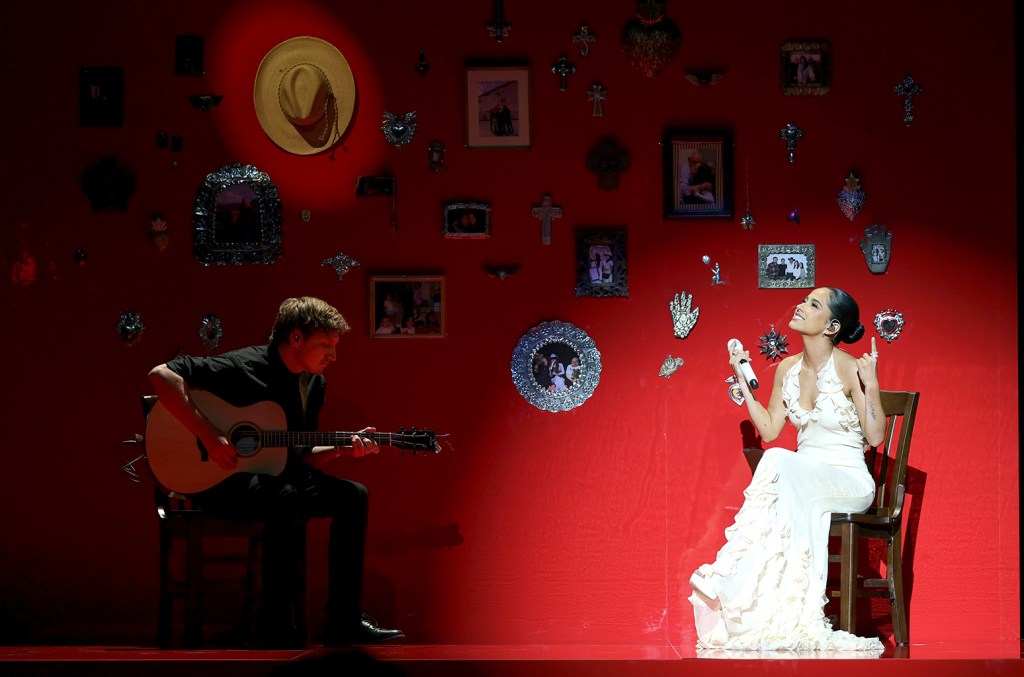
Becky G premiered her deeply personal and beautifully crafted documentary, Rebbeca, at the Tribeca Festival on Thursday (June 12) at United Palace in Washington Heights, New York. Directed by Gabriella Cavanagh and Jennifer Tiexiera, the film peels back the glitz of stardom to reveal an intimate portrait of Becky as Rebbeca, the Mexican-American woman behind the music phenomenon. Shot during a pivotal moment in her life — as she prepared for her first headlining tour, the Mi Casa, Tu Casa Tour, and worked on her música mexicana debut Esquinas (2023) — the film “symbolizes resilience, the kind that shows up quietly in our families, our culture, our growth,” Becky G told Billboard Español. Through moving and at times tear-jerking storytelling, the documentary celebrates her cultural roots as a Latina from Southern California and her evolving artistry.
After the screening, the evening segued into a Q&A with Becky and directors Cavanagh and Tiexiera, and moderator Tefi Pessoa. They discussed the creative process behind the doc, and the importance of shedding light on pressing issues like immigration and family separation. “My grandfather’s immigration story is a big part of that, and sharing this now, at a time when so many in our community are being targeted, feels even more urgent,” Becky G added. “This isn’t about having it all figured out. It’s about holding space for who we’ve been, who we are, and who we’re still becoming.” The night closed with a heartfelt acoustic performance alongside guitarist Ethan Riding, where she performed her breakout 2013 rap hit, “Becky from the Block,” a nostalgic callback to where it all began. She then segued into “Querido Abuelo,” a touching bolero dedicated to her late grandfather.
Trending on Billboard
Johann Vera & Christian Chávez’s “Closet”
Less than a year after releasing “Closet,” an ultra personal ballad with which Vera came out as queer, the Ecuadorian pop artist has teamed up with Mexican star Christian Chávez for a new version of the poignant track — just in time for Pride Month. “It took me two years, but it pushed me to be honest and open with myself,” Vera previously told Billboard. “‘Closet’ is about acceptance. I want to be as honest as I can be.”
“In these moments where minorities are being so attacked, Christian Chávez and I join with #Closet to remind them that love should always be above all else,” Vera captioned a post on Instagram.
Arcángel’s Special Moment With His Son
Arcángel is celebrating Father’s Day in a special way. The Latin trap and reggaetón star released “Gohan y Goku,” marking the official musical debut of his son, Austin. “I had already dreamed of this—this is a déjà vu,” Arcángel sings in a part of the lyrics. “It’s a symbolic gesture that honors the bond with his son and celebrates a legacy that lives on through music,” according to a press release. “Arcángel is introducing Austin to the world from the most authentic place possible—as a father, mentor and guide.”
Artists Denounce ICE Raids
A number of Latin artists have shared words of solidarity with the immigrant community in the U.S. amid ICE raids and mass deportation efforts under the Trump administration. “It no longer feels like the country of hope they told us so much about,” DannyLux wrote in a heartfelt post. Check out the complete list of artist reactions — from Fuerza Regida to Ivan Cornejo and Chiquis — here.
Billboard Latin Editors Win Award
The 2025 Ritmo Latino Entertainment Awards were announced on social media on June 10 with Bad Bunny announced as the biggest winner of the night with seven wins, including artist of the year.
After being sidelined for two decades, the awards made a comeback this year. Originally slated to take place live at the Coca-Cola Music Hall in San Juan, the ceremony transitioned to a digital formate “due to unavoidable schedule conflicts,” according to a press release. See the complete list of winners here.
Billboard‘s Jessica Roiz and Griselda Flores and Billboard Español‘s Isabela Raygoza won the favorite music reporter category.
Additional reporting by Isabela Raygoza.
This week, Billboard’s New Music Latin roundup and playlist — curated by Billboard Latin and Billboard Español editors — features fresh new music, including Grupo Frontera’s surprise EP Y Lo Que Viene and Buscabulla’s LP Se Amaba Así, to name a few. Explore See latest videos, charts and news See latest videos, charts and news […]

New Music Latin is a compilation of the best new Latin songs and albums recommended by Billboard Latin and Billboard Español editors. Check out this week’s picks below.
Explore
Explore
See latest videos, charts and news
See latest videos, charts and news
Grupo Frontera, Y Lo Que Viene (Grupo Frontera)
Following Mala Mía, the joint EP with Fuerza Regida that dropped last December, Grupo Frontera surprises fans with a new five-track EP called Y Lo Que Viene (and what’s coming). The set kicks off with the Carín León-assisted “Mutuo,” a country-tinged norteño song where they chant about unreciprocated love. In the following tracks, “La Buena Eras Tú” with Netón Vega and “¿Qué Haces Por Acá?” with Mister Chivo, the Texas-based group delivers two refreshing cumbia tunes. “No Se Parece a Ti,” the only solo track on the set, is a weeping Tejano highlight where frontman Payo Solís compares his “perfect” new girlfriend with his “unforgettable” ex. Meanwhile, in a second collaborative effort, Frontera teamed up with Manuel Turizo for “La Del Proceso” — a soft cumbia single that effortlessly transitions into a thumping electro-merengue groove.
With the release of Y Lo Que Viene, Frontera pledges a portion of all proceeds to support the Latin community during the ICE raids. “In light of the ongoing events across the country and the injustices faced by our fellow immigrants, we feel a deep responsibility to use our platform and music to make a difference […] We will be donating a percentage of all proceeds to organizations on the frontlines, fighting for and supporting our communities. We also encourage our listeners to take action — whether that means donating, protesting, educating others, or simply showing up for those in need. Every voice matters,” the group expressed on their Instagram stories on the eve of release date. — JESSICA ROIZ
Trending on Billboard
Hamilton, “Y Por Ahí Me Dicen y Que” (Cigol Music Group)
Cartagena native Hamilton shares his inspiring life story in his new song “Por Ahí Me Dicen y Que” (“They Tell Me So What”). Produced by Jao Beats, with a soft melody that accompanies his heartfelt interpretation, the artist reflects on his humble origins and expresses gratitude for living what was once just a dream. The song becomes an anthem to perseverance, faith in God, and staying authentic, leaving a powerful message that not giving up has its rewards. In a statement about the release, Hamilton says the song is linked to Juneteenth: “I’m Black and I’m Colombian, and I grew up with few resources, but now I have a different life, and I want other Black artists to know that they can achieve their dreams too.” — LUISA CALLE
Buscabulla, Se Amaba Así (Domino Recording)
On Se Amaba Así, Buscabulla turns inward, examining love, connection, and perception through a kaleidoscope of Latin and tropical influences filtered with ethereal synth-pop precision. The Puerto Rican duo’s second album — its first in five years — sees co-founders Raquel Berrios and Luis Alfredo del Valle dive deeper into their intimate reflections on modern relationships, infusing stories of romantic struggles with pulsating basslines and dreamy melodies.
The collection’s opening track, “El Camino,” sets the stage with warped disco guitars and laid-back percussion, its mellow sound belying the song’s emotional intricacies. Meanwhile, pre-released single “Te Fuiste” marries a calm yet persistent beat with cascading synths that wash over listeners, inviting them to linger in its serene melancholy. And the focus track, “Miraverahí,” delivers syncopated, thumping bass lines beneath Berrios’ breathy, celestial vocals, exploring the disorienting shifts in love and connection — all while keeping the rhythm alive.
Throughout the 10 tracks, Buscabulla demonstrates its knack for transporting listeners to lush soundscapes that feel intimate yet expansive. While much of Se Amaba Así orbits concepts of vision — understanding the past, assessing romance, imagining the future — the duo keeps listeners tethered with grooves and textures that ground its self-reflective musings. — ISABELA RAYGOZA
Judeline, “Chica de Cristal” (Interscope Records)
After making her U.S. debut at Coachella earlier this year, the Spanish-born singer-songwriter is making waves with “chica de cristal,” a gorgeous song that perfectly captures Judeline’s melodic dream-pop essence. Produced by LILCHICK, Sacha Rudy, Tuiste and Gese Da O, Judeline embraces nostalgia as she explores the emotions left behind after a breakup. Her disarming, ethereal vocals soar as a subtle-yet-intentional drum beat sets the tone for this moody track. Judeline released her debut album Bodhiria last year via Interscope, and most recently had released “Tú Et Moi” (featuring Brazilian funk carioca artist Mc Morena), where she sings in Spanish, French, and Portuguese. — GRISELDA FLORES
La Nueva Ola de Cumbia & La Coreañera, “Cumbiando” (Veo Sonora/Universal Music México)
Los Angeles-based collective La Nueva Ola de Cumbia features Tejano accordionist La Cumbiañera on “Cumbiando,” a revamped and upbeat version of the 1980s classic “Bailando,” by Spanish group Alaska y Los Pegamoides. Clearly inspired by icons like Chico Che, Los Ángeles Azules and even Celso Piña, this highly danceable track combines vallenato, pop, hip-hop, and reggaetón, while always respecting cumbia. This innovative Latin-flavored offering is the result of the fusion of cultures among the members of La Nueva Ola de la Cumbia: the voice of Colombian singer Chelyn Dion; the guitar and bass of Mexicans Luzio “El Sucio” Nava and Primitivo Ríos; the timbales of Nicaraguan Tacho Vázquez; the percussion of Peruvian Wereke Valdivia; and the drums of Hipólito Madero. In case this musical madness was missing an extra touch, the group wears Mexican wrestling masks as part of its wardrobe in the fun music video. — TERE AGUILERA
Check out more Latin recommendations this week below:

The L.A. raids coupled by the Trump administration’s immigration policies have sent shockwaves through the Latin music world and beyond, bringing cultural and political tensions to the forefront. From abrupt visa issues disrupting major touring schedules from Mexican stars like Julión Álvarez and Grupo Firme, to Donald Trump’s deployment of 2,000 California National Guard to […]

Colombian singer songwriter Fonseca is taking his Latin Grammy-winning Tropicalia Tour on a limited U.S. arena run that kicked off June 10 in Atlanta and will play in seven cities before heading off for nearly 20 dates in Latin America and Spain. The trek will mark the first time Fonseca has played songs from 2024’s […]

It’s 2 a.m. on a May morning in Aguascalientes, Mexico, long past most people’s bedtimes. But inside the Palenque of Feria de San Marcos — a venue in this central Mexican city — Carín León is entering the third hour of a performance where he has sung nonstop while pacing the small 360-degree stage like a caged lion.
Palenques, found in most Mexican cities and towns, were originally designed and used for cockfighting, and most have been transformed into concert venues that put artists in shockingly close proximity to their fans, with no ring of security around the tiny stage. The palenque circuit is de rigueur for Mexican artists, even a superstar like León — a burly man who tonight looks even bigger thanks to his ever-present high-crown cowboy hat.
Nearly 6,000 fans surround him in arena-style seating, the steep, vertical layout allowing everyone a close view of the man below, flanked by his backing ensemble: a norteño band with electric guitars, a sinaloense brass section, backup singers and keyboards — nearly 30 musicians in all, who wander about, grab drinks, chat and return to the stage throughout the show. León leads the organized chaos, traversing repertoire that, during the course of the evening, goes from corridos and norteño ballads to country and rock’n’roll.
“I think it’s the most Mexican thing possible in music, a palenque. I always say you have to see your artist play in a palenque to understand it,” León tells me a few hours before the show. He has been playing them for years throughout the country, like most regional Mexican artists do. They’re places of revelry and drink, a rite of passage, and the place to test new sounds.
“As artists, we appreciate that experience,” he adds. “We love it because you have people so close to you. You can be with them, have drinks with them — it’s a very interesting artist-fan communion.”
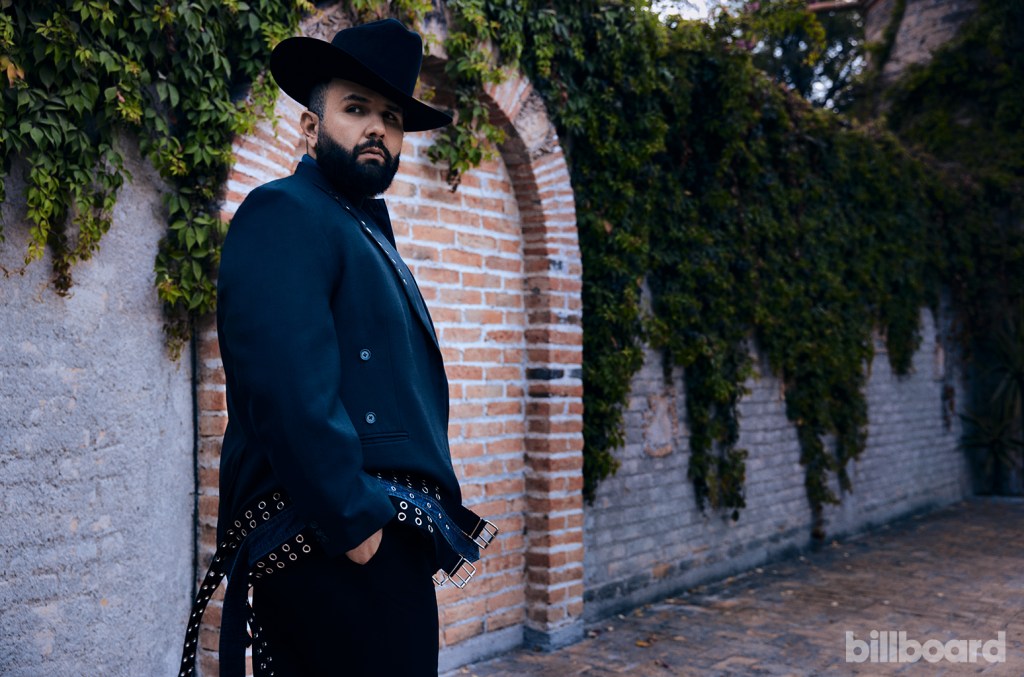
We’re chatting between sips of tequila at a country house on the outskirts of Aguascalientes, and despite the stifling afternoon heat, León keeps his hat on, looking stately in his boots and black jacket with metal buckles. Soft-spoken but emphatic, the 35-year-old música mexicana star alternates between Spanish and English, which he speaks with the American-sounding but accented cadence of someone who learned it by ear from transcribing songs by hand, but never in a classroom.
“I always had trouble with my accent when I sang,” he says. “But I didn’t want to lose the accent because it makes you unique. [An accent] is more valid now. I always want to ensure the music is good, refine it, make it better. But we’re coming from the 2000s, when music [production] was perfect. Now value is given to what’s natural, and that includes having an accent.”
Christopher Patey
While at his core León is a regional Mexican artist who performs contemporary banda and norteño, he loves collaborating with artists spanning many genres and incorporating regional sounds from around the world into his music: Spanish flamenco, Colombian vallenato and salsa, Puerto Rican reggaetón. And as he blends these sounds in unexpected ways, León has found an avid and growing audience.
In 2024, he crisscrossed the world on his Boca Chueca tour, playing 81 palenque, arena and stadium dates in the United States and Latin America. Of 1.3 million total tickets sold, according to his management, 374,000 were reported to Billboard Boxscore for a gross of $51.2 million, making it one of the year’s most successful Latin tours. This year, he’s scheduled to play 40 more shows, including Chilean and Colombian stadiums, Spanish arenas and German theaters — a leap few regional Mexican acts, whose touring is usually restricted to the United States and Mexico, have accomplished at such a scale.
But León has transcended mere geographic borders. Last year, after releasing singles with country star Kane Brown and soul musician Leon Bridges, León became the first artist to perform mainly in Spanish at the Stagecoach country music festival, just a couple of months after making his Grand Ole Opry debut. On June 6, he became the first regional Mexican artist to play CMA Fest, as a guest of Cody Johnson, who invited him to perform the bilingual “She Hurts Like Tequila” with him as part of his set at Nashville’s Nissan Stadium.
“What struck me most was how effortless it felt,” Bridges says of working with León on the bilingual duet “It Was Always You (Siempre Fuiste Tú).” “We come from different musical backgrounds, but the emotion, the storytelling — that was shared. Collaborating with him wasn’t about chasing a fusion — it was about two artists trusting each other to make something honest. Going down to Mexico and being immersed in his world was a powerful reminder of how universal that connection through music really is.”
From a purely commercial standpoint, León has no need to take musical risks like this beyond the Latin realm. In the past five years alone, he has notched three entries on Billboard’s Top Latin Albums chart, including Colmillo de Leche (2023) and Boca Chueca, Vol. 1 (2024), which both reached the top 10. He has placed three No. 1s on the Latin Airplay chart, seven No. 1s on Regional Mexican Airplay and 19 entries on Hot Latin Songs, including three top 10s. He’s a widely sought-after collaborator for pop stars (Camilo, Maluma, Kany García, Carlos Vives), Spanish stars (Manuel Carrasco, El Cigala), Mexican legends (Pepe Aguilar, Alejandro Fernández) and fellow current chart-toppers (Grupo Firme, Gabito Ballesteros) alike.
But regardless of what sounds he’s working with, or whether his collaborator is an established name or an untested act (a particular favorite of his), León knows what he likes. That confidence is at the core of his and manager Jorge Juarez’s strategic plan to make him a truly global artist — and for the past year, they’ve set their sights on country music, hoping to bridge the divide between two genres that, despite their different languages, are in fact remarkably similar.
“It’s something that fills me with pride and something that’s been very difficult to achieve as a Mexican and as a Latin: to reach the center of the marrow of this country movement,” León says. “To get to know this [country music] industry and start moving the threads to act as this missing link between regional Mexican and country music.”
Carín León photographed April 29, 2025 at Gran Ex-Hacienda La Unión in Aguascalientes, Mexico.
Christopher Patey
León first tested the country waters back in 2019 with a Mexican/country version of Extreme’s “More Than Words,” recorded in English and Spanish. Though it now has 14 million streams on Spotify, “it’s kind of lost because there was so much other stuff happening at the time,” he says. It was a risky move, especially coming when León was not yet the established star he is today. But to him, it was one worth taking.
“It was the perfect excuse to show something different,” he says. “And it was amazing. It was so liberating. Because I was trapped in this box that was regional mexicano at that time, and [this song] was very fun for me.”
Country and regional Mexican are, truly, natural siblings. Both genres are anchored in storytelling, with acoustic instrumentation and guitars central to their sound. Boots, hats and fringe jackets are staple outfits for artists and fans alike. And though they stem from different cultures, both are, as León puts it, “roots genres” with their foundations in regional sounds.
Unsurprisingly, other Latin artists have forayed into country before — but none have brought León’s existing level of Latin music stardom, nor have they generated the buzz and impact that he has since releasing his first country team-up, “The One (Pero No Como Yo),” with Brown in March 2024. Since then, he has spent weeks in Nashville, working with local producers and songwriters for a country-leaning album featuring other major names that’s slated for a 2026 release.
For country music, that’s good news. According to the Country Music Association’s 2024 Diverse Audience study, 58% of Latino music listeners consume country music at least monthly, compared with 50% when the last study was conducted in 2021. Finding the right opportunity to tap that market had long been in the Grand Ole Opry’s sights. “And then,” says Jordan Pettit, Opry Entertainment Group vp of artist and industry relations, “the opportunity with Carín came up.”
At León’s Opry debut in 2024, “we had a lot of audience there, more than normal,” Pettit recalls. “The show itself absolutely blew my expectations.” The plan had been for León to play three songs, but the crowd clamored for more, and the musician obliged with a fourth. “I can think of only one or two occasions in my seven years here where I’ve seen an artist get an encore,” Pettit says. “It was really, really awesome to see the worlds collide.”
León’s worlds have been colliding since he was born Óscar Armando Díaz de León in Hermosillo, Mexico, a business hub and the capital of the northwestern state of Sonora, located 200 miles from the U.S. border at Nogales, Ariz. That proximity, coupled with his family’s voracious appetite for music, exposed him to a constant and eclectic soundtrack that ranged from Cuban troubadour Silvio Rodríguez and corrido singer Chalino Sánchez to country stars Johnny Cash and George Strait to rock mainstays like Journey, Paul McCartney and Queen.
“What’s happening now in my career is the result of the music I ingested since I was a kid,” he says. “Music gave me the incentive to learn about many things — the origin of other countries, political movements linked to music, cultural movements. I’m very freaky about music. Everything I have comes from the music I listened to.”
When León finally started dabbling in guitar, he gravitated to the music closest to his roots, regional Mexican, and eventually adopted his stage name. By 2010, he was the singer for Grupo Arranke, which through its blend of traditional sinaloense banda brass and sierreño guitars eventually landed a deal with the Mexican indie Balboa. After a slow but steady rise, Grupo Arranke garnered its sole Billboard chart entry, peaking at No. 34 on Hot Latin Songs in 2019 with “A Través del Vaso,” penned by veteran songwriter Horacio Palencia.
Then the coronavirus pandemic hit, and León switched gears: He went solo, signed to indie Tamarindo Recordz and began releasing music at a prolific pace, launching what he now calls his “exotic” cross-genre fusions.
He scored his first top 10 on a Billboard chart with “Me la Aventé,” which peaked at No. 6 on Regional Mexican Airplay in 2019. But his true breakouts were two live albums recorded and filmed in small studios during lockdown, Encerrados Pero Enfiestados, Vol. 1 and Vol. 2 (Locked Up, but Partying). The bare-bones sets, featuring León singing and playing guitar with a stripped-down accompaniment of tuba and guitar, struck a powerful chord. At a time when teenage performers with gold chains and exotic cars were propelling corridos tumbados and música mexicana with hip-hop attitude up the charts, this 30-year-old relative unknown with a poignant tenor that oozed emotion was performing regional Mexican music with a Rhodes organ, a country twang and, with his cover of ’90s pop hit “Tú,” a female point of view. No one else sounded like him.
Christopher Patey
Those acoustic sessions “were the first things I realized could make the audience uncomfortable [and] question what they were hearing,” León recalls. “Wanting everyone to like you works, but it doesn’t let you transcend. I think things happen when you change something — for good or bad — and you get that divided opinion. All my idols — Elvis, Bob Dylan, Johnny Cash — were people who swam against the current. And not in a forced way, but in a sincere way, exposing vulnerabilities. We knew it was good stuff. And things began to happen.”
During the pandemic lockdown, León had the time and creative space to experiment and explore a new openness within regional Mexican music, a genre where artists used to seldom collaborate with one another. In 2021, he notched his first No. 1 with “El Tóxico,” a collaboration with Grupo Firme that ruled Regional Mexican Airplay for two weeks.
Then, Spanish urban/flamenco star C. Tangana DM’d him on Instagram and invited him to collaborate on “Cambia!,” a song from Tangana’s acclaimed album El Madrileño that also featured young sierreño star Adriel Favela and can best be described as a corrido flamenco. The track “blew my mind,” León says — and exposed him to a completely different audience. “It taught me divisions are literally only a label. When I heard that album, I understood music has no limits. C. Tangana is to blame for what’s happening with my music now.”
Collaboration requests from artists seeking León’s unique sound (and sonic curiosity) started to flow in at the precise time that he was itching to explore and globalize his music. In 2022, after recording the pop/regional Mexican ballad “Como lo Hice Yo” with Mexican pop group Matisse, he met the band’s manager, Jorge Juárez, co-owner of well-known Mexican management and concert promotion company Westwood Entertainment. The two clicked, and when León’s label and management contract with Tamarindo expired in early 2023, he approached Juárez.
“There comes a time when managers and the artist have to be a power couple,” León observes. “I found the right fit with Mr. Jorge Juárez. He’s a music fiend; he has a very out-of-the-box vision. That’s where we clicked. And he had huge ambition, which is very important to us. He’s the man of the impossible. We want to change the rules of the game.”
In León, Juárez says he saw “a very versatile artist who could ride out trends, who could become an icon. He wasn’t looking to be No. 1, but to be the biggest across time. He had so many attributes, I felt I had the right ammunition to demonstrate my experience of so many years and take him to a global level.”
Juárez, who shuttles between his Miami home base and Mexico, is a respected industry veteran who has long managed a marquee roster of mostly Mexican pop acts including Camila, Reik, Sin Bandera and Carlos Rivera. He’s also a concert promoter with expertise in the United States and Latin America. He sees León as having the potential to become “the next Vicente Fernández,” he adds, referring to the late global ranchero star.
Because León had parted ways with Tamarindo, which kept his recording catalog, he urgently had to build a new one. He and Juárez partnered in founding a label, Socios Music, and began releasing material prolifically, financing the productions out of their own pockets. Since partnering with Juárez, León has released three studio albums: Colmillo de Leche and Boca Chueca, Vol. 1, which both peaked at No. 8 on Top Latin Albums, and Palabra de To’s, which reached No. 20. Beyond the catalog, they had three other key goals: finding a tour promoter with global reach, building the Carín León brand and expanding into country.
AEG, which León and Juárez partnered with in 2023, could help with all of it. Last year, the promoter booked León’s back-to-back performances at Coachella and Stagecoach — making him one of very few artists to play both of the Southern California Goldenvoice festivals in the same year — as well as his slot opening for The Rolling Stones in May in Glendale, Ariz. AEG president of global touring Rich Schaefer says they sold over 500,000 tickets for León headline shows in the United States since they started working together, including a 2024 sellout at Los Angeles’ BMO Stadium.
“There are few artists who put out as much music as Carín does on a regular basis,” Schaefer adds. “He’s able to sing and speak fluently in two languages, which has already opened a lot of doors both in the States and abroad. Our team works very closely with Jorge and his team, and he has a deep understanding of how to approach international territories. With a little luck, Carín is poised to take over the world.”
Carín León photographed April 29, 2025 at Gran Ex-Hacienda La Unión in Aguascalientes, Mexico.
Christopher Patey
That international viewpoint also informed León’s approach to recording. When Juárez set out to unlock country music for his client, he first contacted Universal Music Publishing Group head Jody Gerson — “our godmother,” as Juárez likes to say. “She opened so many doors to us.”
Gerson first met León in 2023, after Yadira Moreno, UMPG’s managing director in Mexico, signed him. “It was clear from my first meeting with him that he possessed an expansive vision for his songwriting and artistry that would take him beyond Mexican music,” Gerson says. “Before signing with us, he wanted to make sure that we were aligned with his ambitions and that he would get meaningful global support from our company, specifically in Nashville. Carín actually grew up listening to country music, so his desire to collaborate with country songwriters is an organic one.”
Beyond opening the door to working with Nashville producers and songwriters, Gerson also connected Juárez and León with Universal Music Group chief Lucian Grainge, who in June 2024 helped formulate a unique partnership between Virgin Music Group, Island Records and Socios Music. Through it, Virgin and Island distribute and market León’s music under Socios, with Virgin distributing and marketing to the U.S. Latin and global markets and Island working the U.S. mainstream market.
The agreement encompasses parts of León’s back catalog as well as new material, including 2024’s Boca Chueca, Vol. 1, which featured his bilingual collaborations with Brown (“The One [Pero No Como Yo],” which peaked at No. 46 on Hot Country Songs) and Bridges.
He plans to deliver Boca Chueca, Vol. 2 before the end of the year and just released a deluxe version of Palabra de To’s that includes new pairings with Maluma (their “Según Quién” topped the Latin Airplay chart for four weeks in 2023 and 2024) and first-time duets with ranchera star Alejandro Fernández and flamenco icon El Cigala.
While flamenco is another passion point for León, the country album — his “first magnum opus,” he says — is his most ambitious goal. Already, he has worked in Nashville with major producers and songwriters including Amy Allen, Dan Wilson and Natalie Hemby. On the eclectic project, he says, “Some stuff sounds like James Brown, some stuff sounds like Queen, some stuff sounds like regional Mexican with these corrido tumbado melodies, but in a country way. It’s very Carín. It’s what’s happening in my head and in my heart.” He won’t divulge all of its guests just yet, but he says it includes friends like “my man Jelly Roll” and other big stars he admires.
It’s new territory for a Latin act, and León is acutely aware of the fact. But he’s approaching it from a very different point of view. “I’m not a country artist,” he says flatly. “I’m a sonorense. I have regional Mexican in my bones. But I love country music, and I’m trying to do my approach with my Mexican music and find a middle point. It’s not easy. You have a lot of barriers because of the accent, because of the language, the racial stuff.”
For some successful regional Mexican artists who tour constantly and make top dollar, the trade-off is not worth it; financially speaking, they don’t need to open new territories or genres and the audiences that come with them. But for León, “the money trip passed a lot of years ago,” he says with a shrug, taking a last sip of tequila and adjusting the brim of that ever-present accessory he shares with his country friends. “I need to change the game,” he adds. “I’m hungry to make history, to be the one and only. I’m so ambitious with what I want to do with the music. It’s always the music. She’s the boss.”
It’s 2 a.m. on a May morning in Aguascalientes, Mexico, long past most people’s bedtimes. But inside the Palenque of Feria de San Marcos — a venue in this central Mexican city — Carín León is entering the third hour of a performance where he has sung nonstop while pacing the small 360-degree stage like […]