State Champ Radio
 Music
Page: 101
Trending on Billboard Over the years, there’s been a fair bit of “paranormal” activity on the charts, with numerous creepy crawly tracks climbing their way up the Billboard Hot 100 at different points in time. Frequently, such songs are summoned to the charts when spooky season is at its peak, particularly perennial frightening favorites such […]
Trending on Billboard
Kenshi Yonezu’s “IRIS OUT” extends its run at No.1 on the Billboard Japan Hot 100 for a sixth straight week, topping the chart dated Oct. 29.
The Chainsaw Man – The Movie: Reze Arc theme leads four metrics this week: — downloads, streaming, video views, and karaoke. Downloads dipped 26% from the week before, but the song returns to No. 1 on the metric for the first time in three weeks. Radio airplay continued to build for a second week, rising to 127% of last week’s points.
Yonezu’s previous longest consecutive streak at No. 1 was the five-week run of “Lemon” in January 2019 (seven total weeks at the summit). With “IRIS OUT,” he now sets a new personal record for consecutive weeks at the top.
Explore
See latest videos, charts and news
JO1’s “Handz In My Pocket” moves to No. 2, soaring from No. 41 following its CD release. The single sold 692,223 copies in its first week, launching at No.1 for sales. Since debuting, JO1 have now placed all ten of their singles at No. 1 for sales. The CD release also lifted other metrics: downloads climbed from 19-3, streaming 40-33, radio 58-4, and video 65-47. Radio saw the sharpest increase, jumping to 655% of last week’s points.
At No. 3 is “JANE DOE” by Kenshi Yonezu and Hikaru Utada, rising a spot from last week. Karaoke increased to 108% of the previous week. HANA’s “My Body” climbs two notches to No. 4 as the breakout girl group places seven songs on the chart this week, including “Blue Jeans” at No. 6 and “ROSE” at No. 14.
Yonezu’s “1991” settles at No. 5, down two positions. The track comes in at No. 3 for streaming, No. 6 for downloads, No. 8 for video, and No. 14 for radio.
Elsewhere in the top 10, CLASS SEVEN’s first single “miss you” bows at No. 9, selling 18,522 CDs to place No. 4 for sales, while hitting No. 2 for radio and No. 89 for downloads. CUTIE STREET’s “We Can’t Stop Suddenly!” returns to the tally for the first time in about three months, charting at No. 10. The CD sold 50,567 copies to hit No. 2 for sales.
The Billboard Japan Hot 100 combines physical and digital sales, audio streams, radio airplay, video views and karaoke data.
See the full Billboard Japan Hot 100 chart, tallying the week from Oct. 20 to 26, here. For more on Japanese music and charts, visit Billboard Japan’s English X account.
Trending on Billboard
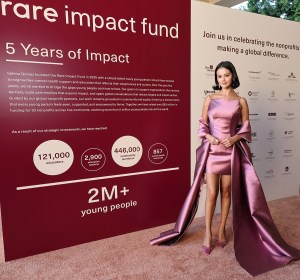
Selena Gomez knows she’s in a rare position to give back, and she’s taking it. On Wednesday (Oct. 29), the singer-actress hosted her third annual Rare Impact Fund Benefit in Los Angeles, an event that raised more than $600,000 for mental health charities.
The night’s programming was hosted by Jimmy Kimmel and featured performances from Laufey and The Marías, each of whom Gomez snapped photos with on the red carpet. Her new husband, Benny Blanco, was also in attendance, as were recognizable names such as Lil Dicky, Jake Shane, Jay Shetty and more.
“This night is a celebration of how far we’ve come and a powerful reminder of how much more we can do together,” Gomez said of the event in a statement shared with Billboard in September. “I’m incredibly grateful to Jimmy and The Marías for joining me in shining a light on youth mental health. Their support means the world – not just to me, but to millions of young people this work touches around the globe.”
The $600,000 raised on site via commitments from the night’s guests make up just one big step in the Rare Impact Fund’s mission to generate $100 million for global mental health resources and education programs. The event comes five years after Gomez first founded the fund in conjunction with her billion-dollar Rare Beauty business.
Last year’s benefit — which featured live music from Karol G and Teddy Swims — raised upward of $2 million for the Rare Impact Fund.
“Mental health is personal for me,” Gomez says in a mission statement on her organization’s website. “I went a long time without the support I needed because I didn’t understand what I was feeling. After experiencing what seemed like endless highs and lows that would take me out for weeks at a time, I finally found the help to see what I was going through.”
“That’s why I started the Rare Impact Fund,” adds the mogul, who’s long been open about her struggles with depression and bipolar disorder. “It’s a commitment to expand access to mental health services and education for young people everywhere. Because no one — regardless of age, race, gender, sexual orientation, or background — should struggle alone.”
See photos from Gomez’s third annual Rare Impact Fund Benefit below.
Selena Gomez attends the Third Annual Rare Impact Fund Benefit hosted by Selena Gomez at Nya Studios on October 29, 2025 in Los Angeles, California.
Amy Sussman/Getty Images for Rare Impact Fund
(L-R) Selena Gomez and Jimmy Kimmel attend the Third Annual Rare Impact Fund Benefit hosted by Selena Gomez at Nya Studios on October 29, 2025 in Los Angeles, California.
Amy Sussman/Getty Images for Rare Impact Fund

Trending on Billboard
Since it first roared onto the Billboard charts with 2009’s Guns Don’t Kill People… Lazers Do LP, Major Lazer has established itself as one of the most innovative collectives in mainstream music through its fusion of EDM, dancehall, hip-hop, reggaetón, trap and soca. Now, the group’s three current members — Diplo, Walshy Fire and Ape Drums — have officially added a fourth name to the lineup: America Foster.
A 28-year-old British-Jamaican artist, model and content creator, America Foster hails from the outskirts of London in South Buckinghamshire. As one of seven children in a household dominated by boys, she quickly learned how to lean into her knack for entertaining to ensure her voice was heard. She remembers developing her freestyling as a party trick as young as 10, and around age 15, she started playing around with accents and voice acting, sending friends into laughing fits with prank calls and her imitations of the London Underground voiceover. As she entered the final years of her adolescence and her creative friends started seriously pursuing their dreams, Foster brushed off countless requests to hop in the booth and freestyle over a track.
“I was completely opposed to it,” she recalls. “And then one of my friends [convinced] me to come to their studio session, the producers spun around in their chairs like, ‘Your turn!’ I was like, ‘Not happening!’ That ended up being the first time I ever put my vocals on a studio recording.”
Foster is the first to admit that those early songs weren’t the strongest — “They were very commercial, Chris Brown dance-pop; I call it McDonald’s music” — but she eventually landed on a sound that distilled the authenticity, cultural fluency and bubbly quirk of her off-the-cuff social media content, which garnered her hundreds of thousands of followers pre-Major Lazer and resulted in a Red Rat-informed approach to dancehall toasting and singjaying anchored by her striking charisma.
After a few viral clips caught Diplo’s attention, Foster quickly took advantage of the potential music industry connection. She thanked the Grammy-winning DJ for following her, and the two started exchanging music, culminating in an in-person meeting at his Roundhouse show last September. There, the pair planned a studio session in Jamaica, where Foster met the rest of Major Lazer, and by Paris’ Fête de la Musique in June, she made her live debut with the group. In July, Foster officially announced her addition to Major Lazer via Instagram.
Arriving as the group’s youngest and first woman member, Foster made her official Major Lazer debut with a freestyle remix of August’s “Gangsta,” a shatta-informed track that also features Kybba and Busy Signal. A few weeks later (Oct. 24), Foster joined forces with buzzy Toronto artist Sadboi and Emmy-winning choreographer Parris Goebel for “Bruk Down,” a standout ‘90s dancehall-inspired track that doubles as Goebel’s musical debut. Goebel also co-directed the track’s flashy music video alongside Philippa Price.
“She understands what she’s good at, and she understands that she’s got a market for it. It’s genius to me,” Foster tells Billboard about working with Goebel. “I’ve heard some of her songs that are due to come out, and they are amazing — especially for the dance community.”
In a candid conversation with Billboard, America Foster details her origins, integrating herself into the Major Lazer family, fashioning “Bruk Down” out of a freestyle and what else she’s cooking up with her new groupmates.
What are some of your earliest musical memories?
[They’re] definitely attached to dance. Rhythm and beat [were] my first introduction [to music]; I never really heard lyrics for what they were when I was younger. I’d be able to recite a whole song, but I wouldn’t be able to tell you the content.
Where do you consider home?
Growing up, I lived just on the outskirts of London. But my heart was always in Northwest London; I was always there. That’s where my mum and her sisters were raised, and my gran still lives there. During weekends, half-terms and school holidays, I’d be in London. And then I’d be living in South Buckinghamshire, which is where I was raised.
How did you land on the “America Foster” sound?
Eight years ago, when I first got into the studio, I didn’t understand my sound, so I started trying to develop it. I really captured my sound in the last four years. I made a couple of demos that were getting close, but they weren’t the final sound, which were the demos that I actually sent to Diplo.
You connected with him over Instagram, right?
He came across my page from a viral moment; I’ve had quite a few of those on Instagram from my content creation. I was trying to figure out how to transition into being a respected artist, so I started dropping bits of content surrounded by my music. Whether I’m talking about the weather or my menstruation, I put it in a rhyme pattern and people love it — especially because you don’t expect me to have such a strong Jamaican accent, because I’m light-skinned and from England, and my name’s America. It’s like, “What the f—k is going on?” [Laughs.]
He followed me off a viral freestyle, and I was really excited, because I was seriously making music at the time. I knew that he was behind Major Lazer, and I also know he was behind [M.I.A.’s] “Paper Planes.” I grew up to that song, just banging it out constantly. So, obviously, I shot my shot. I thanked him for the follow and sent about four demos. We started exchanging music on WhatsApp, and he’d send me beats he heard my voice on.
Last September, he came to London, and I met him at the Roundhouse while he was performing. The next day, we went to a football game and planned for a studio session in Jamaica, which is where I met the rest of Major Lazer.
What was that first meeting like?
It was amazing, we just clicked. Me and Walshy were bantering left, right and center; it felt like I had known these guys for ages. It didn’t feel like the first initial meeting at all. I went to Diplo’s home in Jamaica, and it’s quite a showroom home, but it still has this beautiful, homely vibe. I had 32 hours in Jamaica, and we made six songs, one of which was “Bruk Down.”
“Bruk Down” started as a freestyle, right?
Diplo just had the beat running, and we all knew it was f—king hard. He kept it running to see if we came up with anything; he even freestyled a little bit, which was quite funny. And then I just heard, “Bruk out, bruk out, waan fi.” I knew I liked that, but I wanted to repeat it twice, and then change it a bit the third time. Walshy was in the room, and he was like, “Yea, man, dat fyah!” Diplo also liked it, so I continued freestyling and writing at the same time.
It’s crazy how the final version sounds like a completely different song from how it first started. My initial freestyle was shared with Parris Goebel and Sadboi, and when I heard it with their parts, it sounded so good. I was only briefly familiar with Sadboi, and I hadn’t connected the dots about who Parris was. I didn’t know she was making music. I was like, “Oh my God, my music video’s gonna be sick!” [Laughs.]
Did you have any initial reservations about pursuing your music career through a collective as opposed to just going solo from the jump?
About two years before Major Lazer was on the table, I thought about being in a girl group. And I was like…. no. I just couldn’t see that for me. Part of me felt like I had to really weigh it up and see what the exit would look like.
When Major Lazer came into the picture, I was like, “Oh my God, this is the best group that could have ever asked me to join them.” Firstly, it’s all boys. Secondly, they’re not vocalists; they’re producers and DJs, so I’d be the only vocalist, which gives me the opportunity to still be a solo artist.
Being the only woman and the youngest, what made you trust these guys?
My familiarity [with them] through their music. Through being a consumer, I felt like I knew them already. That’s why it felt so family-oriented in the first meeting. I’m big on signs, energy and spirituality, and I just followed my gut.
What does your contract look like?
It’s a featured artist agreement. I’m contracted as the fourth member.
So, you’re technically an unsigned artist?
Yes.
Is America a stage name or your given name?
Birth name. I was orphaned by the age of four, and my mum gave me my name. I look at it as if that was the best and final gift that my mum could have given me. I can’t change it, even though I hated the name when I was younger. I’m the only one out of my siblings with the name of a country or state or continent. I don’t have a middle name.
My mum knew something that no one else knew. She knew what she gave birth to. I can’t put a different name on my stardom. I don’t feel like that would be paying homage to my mum. She would have been a performer if she was still about; she had the essence that I do, but I’ve just been able to live and show it.
What else from your childhood do you see reflected in the music you make today?
My inspirations. When I’m freestyling, I hear Beenie Man, Elephant Man, Vybz Kartel, a little bit of Lady Saw, all of that. I hear their attitude in my freestyles. The sound I’m running with at the moment is Red Rat’s; I’m paying homage to him. I’m tuning in to the things that made me love music in the first place, taking elements of all of that at combining it with who I am to produce something that the world will just say “yes” to.
How do you anticipate your content creation might evolve as your artist career grows?
I’m not creating content; I’m capturing moments. There’s a difference for me. It’ll be exactly the same. I’ll just be capturing bigger moments and things that people will want to see: being on the road with the boys, backstage banter and little humorous exchanges.
Do you feel embraced by Major Lazer’s fanbase?
I’m definitely taking it in. With my social media content, I was becoming a little bit more known in London. A year before [joining] Major Lazer, I went to Barbados, and someone recognized me. That was like one of the first moments that I realized how far my reach is.
Major Lazer’s fan base is great. They’ve taken me in like I’ve been a member since day one. It feels like they have literally said, “Oh, Diplo, you like her, yeah? Walshy? Cool, we like you too.”
Top three Major Lazer songs of all time?
“Pon de Floor,” “Hold the Line” and “Watch Out for This (Bumaye).”

Trending on Billboard
On Oct. 31, while much of the country revels in Halloween activities, bluegrass-Americana powerhouse group Greensky Bluegrass will officially celebrate its 25th anniversary.
Explore
See latest videos, charts and news
The group first launched during an impromptu house party performance on Halloween night in 2000 in Kalamazoo, Michigan, a performance that has evolved into a musical journey that has brought the five-piece group to headlining festival main stages and selling out venues throughout the country, including recently spearheading their 20th show at iconic venue Red Rocks. Since issuing their debut album Less Than Supper in 2004, Greensky Bluegrass has notched two Billboard Bluegrass Albums chart-toppers, with 2014’s If Sorrows Swim, and 2019’s All For Money.
Greensky Bluegrass will commemorate its silver anniversary by returning to its hometown roots with two shows at Wings Event Center in Kalamazoo on Oct. 31 and Nov. 1, but also with the release of new album XXV, arriving Friday, (Oct. 31) on Big Blue Zoo Records/Thirty Tigers.
“It’s the first time that I’ve ever actually slowed down enough to look back and it’s worth celebrating, because so many bands don’t even get a chance to do that,” Greensky Bluegrass dobroist Anders Beck tells Billboard.
On XXV, Greensky Bluegrass reimagines many of its most well-loved songs, captures a couple of live-show staples for the first time, and welcomes a strong roster of collaborators, including Sam Bush, Lindsay Lou, Nathaniel Rateliff, Aoife O’Donovan, Holly Bowling and Greensky Bluegrass’s fellow Michigan native, Billy Strings.
“It wasn’t about, like, ‘We want really big, important guests on this record.’ It was calling friends,” Beck says. “It’s almost like a family photo album. And it was fun to reimagine the songs. When you finish a record, you’re trying to make the penultimate version of that song, and then to get to redo it 10, 15, 20 years later is pretty cool.”
On XXV, Rateliff joins on “Past My Prime,” while Bowling joins on “Last Winter in the Copper Country” and “Windshield.” Previously-recorded songs such as “Old Barns” and “Windshield” get fresh patinas, but the album also sees live-show favorites such as “Who Is Frederico?” and “33443” make their initial appearances on a recorded Greensky project.
The band’s name has long embodied the group’s nimble balancing act of being rooted in and familiar with bluegrass traditions while also using it as a launching pad for exploring other, often contrasting, musical styles. In the process, Beck and his bandmates Michael Arlen Bont (banjo), Dave Bruzza (guitar), Mike Devol (upright bass) and Paul Hoffman (mandolin) became trailblazers for the acceleration of the freewheeling, jamgrass movement over the years, a style that now fuels live shows for artists such as Strings.
“A lot of these arrangements and guest spots were born out of the live shows—In fact, most all of ’em,” Beck says. “The things with Holly Bowling, she’s essentially the sixth number of our band. And Lindsay Lou, she wrote a key part for the song ‘In Control’ live, just singing with us one day.”
Strings joins on a revamped version of “Reverend,” which originally was included on Greensky Bluegrass’s 2008 album Five Interstates. The group first met fellow Michigan native Strings when he was a precocious teen, and Strings was opening shows for Greensky Bluegrass before his ascent to headlining arenas.
“He’s played ‘Reverend’ in his shows, and it’s funny, with him, he could sing most of our songs,” Beck says. “I think at the first time we met, we went to a campground and jammed all night around a campfire. That was the beginning of the musical friendship, if I recall correctly. I remember he seriously was like, ‘How do I jam these tunes?’ And I remember my answer being like, ‘First, you stop stopping,’ which is totally true, and it’s also right in line with my sense of humor. Bluegrass songs are concise, and he was into real traditional stuff. Then he was on tour opening for us for a long time and he’s an incredible musician.”
The Bowling collaboration of “Last Winter in Copper Country” took place during the COVID-19 pandemic, during the recording sessions for the group’s 2022 Stress Dreams album. “We went into the studio and they basically gave us the keys and said ‘See ya.’ So, we had her come play on this song and the six of us were in the room together and it just felt great to just jam again.”
New Grass Revival founding member and progressive-bluegrass luminary Sam Bush joins them on a rendition of New Grass Revival’s 1987 song “Can’t Stop Now.”
“Sam’s a hero who’s become a friend,” Beck says. “I was in the studio with Sam and basically producing the song for the band a bit, and that was one of those ‘How did I get here?’ moments. Sam later brought me the little 45 record, the radio edit, of the New Grass version of ‘Can’t Stop Now.’”
Over the years, the group has forged a sound that isn’t easily categorized, blending and bending sounds along a spectrum of bluegrass, folk, Americana, jazz and rock. The band’s concerts have become a hallmark of improvisational energy that has attracted a devoted and eclectic fanbase.
“I think something that’s always been important, is it’s a collective of individual humans, and that that’s why we’ve got so many eclectic sounds,” Beck says. “It’s bluegrass, but also rock n’ roll, it’s all those things. Our fans encourage risk-taking, musically. And that’s what I love about it so much—failure is totally an option in a jam, as long as you’re teetering on the edge.”
He adds, “That’s what keeps this music alive for 25 years, it’s always evolving live. The band is so locked in on an improvisational level that I’ve had lots of times where I play a wrong note or what I perceive to be a wrong note, and I’m sort of searching for something and might play a weird half-step [note], and the whole band within that instant turns on a dime and follows that note. It’s a beautiful thing. But it almost took me sort of playing the wrong note to realize how dialed in we are as a unit.”
Though the new album deals in retrospection, the group continues moving forward. Greensky Bluegrass just extended its current tour into 2026, and Beck notes the group intends to go into the studio early next year, saying, “We’ve got tons of material for the next record.”
Though Greensky Bluegrass has built its reputation on live shows, Beck says it is the songwriting that will ultimately be the band’s most enduring creative asset.
“The success and longevity of a band comes from the songwriting. That’s why I joined this band 17, 18 years ago — the songs were f—king killer. In the digital age, it’s cool to think about the idea that anybody can find any music, anytime, and there will be some kid that goes back and discovers this band. Knowing that we’ve been successful in doing it our way is exciting.”

D Smoke and Jay Taj take a trip down memory lane while splitting a few signature dishes at Two Hommés in Inglewood, Calif. In the latest episode of Billboard‘s Takes Us Out, Smoke and Taj order grilled broccolini, plantain and crab, and lamb tacos, among other dishes. While the food was being prepared, the pair […]
Trending on Billboard
The growing prominence of faith-based/Christian hip-hop and R&B, aka Rhythm + Praise, is resonating far beyond the traditional radio airwaves. It’s making notable shifts into film, TV, sports and even the gaming world. Rhythm + Praise (R+P) artists possess the ability to marry powerful messaging with innovative sounds and, in the process, are finding their music being featured in an ever-expanding range of media — often in ways directly impacting the cultural landscape.
Sitting between gospel and contemporary Christian music (CCM), Rhythm + Praise bridges gospel with contemporary styles, offering a more modern, relatable sound for younger audiences. R+P offers an alternative to mainstream secular messages: non-traditional in format, melody, lyrics and production. Not limited to religious beliefs, these artists foster themes of hope, redemption, mental health awareness and positive living.
Related
According to Luminate, in the first 30 weeks of 2025, on-demand audio streams of songs in the core Christian/gospel genre — which were also categorized in the sub-genre of R&B/hip-hop —totaled 1.37 billion, up from 878 million during the same 30-week period in 2024. These figures are inclusive of user-generated content (UGC) streams.
Four-time Grammy winner Lecrae and Dove Award-winning artist NF have been paving the way in faith-based hip-hop for years. Both artists have individually accumulated billions of streams and video content views. Lecrae has 2.03 billion and NF has 13.28 billion on-demand official audio and video streams for all of their songs, over the course of their careers, in the U.S. through Sept. 25, according to Luminate. (Note: These figures do not include UGC streams.) Given the powerful reach of their music, both NF and Lecrae have successfully secured licensing and sync opportunities in the sports gaming arena, marketing their music via the NBA, ESPN and Madden NFL video game series.
Another example is emerging independent hip-hop artist Miles Minnick. He recently released his first album, Via Dolorosa, through his GLO label joint venture with EMPIRE. Minnick is also reaching beyond the church-going audience via his first sports gaming sync placement, “Lowkey Wildin,” with NBA 2K25. His growing base of more than 500,000 fans — aka GLO Nation — prompted the launches of his GLO Festival in the San Francisco Bay Area and his own clothing line, Christlike. Minnick also made history in March when he became the first Christian hip-hop artist to headline a stage at Rolling Loud Los Angeles.
Related
Noting that Gen-Z and millennials are demanding more uplifting content, Minnick says a major cultural shift, which he tags the “New Mainstream,” is happening. “New Mainstream isn’t just a phrase — it’s my lifestyle,” he explains. “It means putting faith at the center of culture and proving you can be bold about your beliefs while making a real impact. Whether it’s getting the stamp [of approval] collaborating with rap icon E-40, launching a label, performing at Rolling Loud or selling out tours, I’m showing the world that you don’t have to change who you are to change the world.”
Mainstream artists are also magnifying messages of faith in their music. From Drake (“God’s Plan”) and DJ Khaled (“God Did”) to Mustard (“Pray for Me”) and GloRilla, who won her first BET Award for best gospel/inspirational song (“Rain Down on Me” featuring Kirk Franklin, Maverick City Music, Kierra Sheard and Chandler Moore), these artists are helping to broaden the crossover space for faith-based music.
The same thing is happening on the label front. Co-founded with Ben Washer in 2004, Lecrae’s Reach Records is now seeing other music companies join the movement, including EMPIRE and Universal Music Group. Earlier this year, the latter relaunched legacy label Tamla with a faith-based hip-hop/R+P artist roster that includes Childlike Cici and Dante Pride. One of Tamla’s artists, Dove Award nominee Lee Vasi, performed at this year’s BET X 106 & Park Experience in Los Angeles. And gamma., home to Mariah Carey and Usher, established a joint venture with Grammy-winning producer Rodney Jerkins’ R+P imprint Alienz Alive with signees Alex Jean, Jon Keith, Aha Gazelle and nobigdyl.
Related
While streaming numbers are strong, streaming radio still remains an important promotional tool in expanding audience reach. And that’s thanks to shows like the Trendsetter Sense-hosted Chosen Journey on SiriusXM’s Hip-Hop Nation channel and Da Fixx on SiriusXM’s Christian hip-hop/R+P channel, Holy Culture Radio. Holy Culture owner James Rosseau Sr. partnered with SiriusXM in 2022 to cater to a burgeoning audience of more than 5 million listeners, per Nielsen Compass.
Film and TV are also homing in on the faith-based market. Producers Tyler Perry and DeVon Franklin, heavy hitters in both of those arenas, joined forces with Netflix for Ruth + Boaz. The just-released film features the original song “Faithful,” penned specifically for the project by Grammy-winning artist/producer Babyface. It also appears on the film’s five-song companion EP.
As a music supervisor starting out in faith-based television programming, I produced season 2 of the award-winning soundtrack album for the hit series Greenleaf. I’ve seen firsthand how the power of positioning faith-based hip-hop/R+P artists on a major network show (scripted or unscripted) can help break their music and expand their brand.
Related
In response to that and other above-referenced factors, I established the traveling roundtable series Faith + Sync in L.A. this year. I wanted to provide a unique platform to discuss how faith is influencing culture, creative direction, content placement and the future of music in film, TV and digital media. And also to offer the opportunity to connect with influential voices in those mediums who are shaping the conversation about how faith-based/R+P artists are influencing music, sync licensing and culture.
Through changing demographics, streaming power and strong independent success stories, faith-based hip-hop/Rhythm + Praise is debunking assumptions by mainstream media about its audience size, relevance and impact. As this movement gains stronger momentum, I’m committed to joining all those building the bridge to keep pushing this music forward like EMPIRE president Tina Davis. “Inspirational hip-hop/R&B isn’t new,” says Davis. “But there’s a new wave of anointed young talent across the globe raising their hands in their God’s name. And it’s needed!”
Angela M. Jollivette, founder of Moonbaby Media Inc. and Faith + Sync, is an award-winning music supervisor/producer whose credits include the major network series Greenleaf, Sunday’s Best, Black Ink Crew: New York/Chicago/L.A. and Norman Lear’s final TV production, Clean Slate.
Trending on Billboard D’Angelo had already proven a transformative R&B figure as a 21-year-old with his 1995 debut LP Brown Sugar, scoring hits and winning awards and growing the movement that would ultimately be known as neo-soul. And when his sophomore album Voodoo arrived in 2000, it topped the Billboard 200 — helped by the […]
Trending on Billboard
Esaú Ortiz had already penned important songs for Luis R Conriquez (“De Fresa y Coco”) and Grupo Firme (“Tronando Ligas” with Junior H) when he had a thought: “If I’ve written hits for other artists, how could I not write one for myself?” Then, it happened. The 27-year-old artist from Monterrey, Nuevo León released his biggest hit to date, titled “Triple Lavada” — which also includes a remix featuring Conriquez, Alemán, Óscar Maydon and Victor Mendivil.
The remix — released in May, two months after the original one — earned Ortiz his first top 10 on any Billboard chart when the song peaked at No. 9 on the Hot Latin Songs chart. It also peaked at No. 12 on the Billboard Global Excl. U.S. chart and at No. 17 on the Billboard Global 200 chart. The plan was to only release the remix version, not two separate ones. But, he had to pivot quickly when, earlier this year, a part of the song was leaked on TikTok and gained momentum.
“It took time to get everyone on board, so I had to release it on my own, and besides, it had been leaked, so I had to release it right away,” Ortiz says over Zoom. “The leaked version was already at the top of the [TikTok] charts, so I had to request for it to get taken down and release my own version. I couldn’t wait for the remix.”
Still, the spunky retrobélico stands as Ortiz’s biggest milestone yet since launching his career over 10 years ago, mainly as a songwriter, and the song has now cemented his status as a Latin artist on the rise in a crowded field of new música mexicana acts.
Ortiz may have had his major breakthrough as a songwriter, but his dream was always to be a performing artist. He began performing in Kindergarten singing Pedro Fernández songs and later, in his teens, transitioned into rap. He was motivated by his mom, who also sings and performs at parties doing tributes to stars like Gloria Trevi.
“Then I started singing reggaetón, banda, grupero, corridos tumbados, I think I performed in every genre,” Ortiz says. He joined a few local bands and also started writing his own songs because, “the music I was listening to didn’t say what I experienced exactly, so I had to write it myself.” He began uploading videos of him performing his songs on Facebook and eventually promoters and even local bands began reaching out to him.
“I wanted to be an artist, but it’s really difficult, it takes time,” Oritz says. “I thought, I’m going to sneak in this way and make a name for myself as a composer, then I’ll make money for everyone and then, when I decide to be an artist, I’ll already have superstar friends I’ve written for that I can collaborate with. When you start as a songwriter, you’re already on the other side and there are people who like what you do and how you write. You’ve already proven yourself.”
This year, “Triple Lavada” marked the launch of his career as an artist, and earned him a distribution and marketing deal with Sony Music Latin. His first big deal in the industry after experiencing a few heartbreaks early on in his career when other companies “stole” from him, he explains. “I was just doing deals how I thought I should but no one was guiding me, I was on my own.” Today, he’s releasing music under his own self-titled label.
“‘Triple Lavada’ was that change from composer to artist, that watershed moment, where there is a before and after,” Ortiz says. It also served as an introduction to the subgenre he pioneered, retrobélico — which came to him when he was listening disco music at a party. It was also the perfect set up for his latest album Discontrol, released Oct. 10. The album cover, inspired by Michael Jackson’s Thriller, is enough indication that Ortiz is offering something different, a more nuanced approach to regional Mexican music.
As a self-declared fan of The Weeknd, Sabrina Carpenter and Post Malone, his music is a fusion of disco, rap, cumbia, pop and ballads powered by Mexican music instruments. “I wanted people to realize that I can do many genres,” he says. “I don’t want to limit myself to just one genre, that’s why I made the album super varied. I consider myself regional, but as a variation, as a branch of regional music.”
Below, learn more about this month’s Billboard Latin Artist on the Rise:
Name: Esaú Ortiz Anzuara
Age: 27
Recommended Song: “Triple Lavada” or “Discontrol”
Biggest Accomplishment:
“Launching my career as an artist and pioneering retrobélico.”
What’s Next:
“I’m working on my next album, which will drop next year. Discontrol didn’t really have collaborations because I wanted to showcase my essence what I represent as a retrobélico artist. But I have collaborations coming up with Lit Killah, Xavi and Alemán, and I want to save them for the next album.”
Trending on Billboard Ariana Grande is celebrating the release of her Positions (Vevo Official Live Performances) in honor of the fifth anniversary of the singer’s sixth studio album, 2020’s Positions. Tracks on the six-song EP use audio from Grande’s 2021 Vevo Official Live performance taping of the songs “POV,” “Positions,” “Safety Net” (feat. Ty Dolla […]