State Champ Radio
 Latin
Page: 13

Trending on Billboard
As Afrobeats gains momentum outside of West Africa, where it originated, Latin artists are fully embracing the rhythm and fusing it with their own signature sounds. Such is the case for Goyo, Humby, Kapo, Ozuna and Venesti, who were part of the Afrobeats panel at Billboard Latin Music Week 2025 on Tuesday (Oct. 21).
Moderated by Billboard‘s Jessica Roiz, the conversation focused on respecting the culture, roots and pioneers that have fueled this genre in Africa, and how Afrobeats has influenced their latest projects, including Goyo’s debut album Pantera.
“This movement is so big and it has brought so many opportunities for Latin artists who sing Afrobeats but are not from Nigeria,” the Colombian star said. “It is important to respect the roots and culture; but restlessness has led to the Afrobeats movement that is being mixed with hip-hop, R&B, and Nigerian music. We have to give importance to Africa through this genre that unites us.”
Meanwhile, hitmaker Ozuna spoke candidly about how experimenting with Afrobeats opened doors for him and got him out of a comfort zone that reggaetón was becoming. “I didn’t know much about the rhythm, but I was interested in learning, I was into reggaetón, and this rhythm opened doors for me.”
He added that the key to continue growing the movement is unity and collaboration. “We did it with reggaetón and it worked for us. Afrobeats is a movement that needs unity. It needs artists like me to collaborate with new artists. I was given that opportunity when I began my career, and now it’s our turn to do it with the new artists, and with the newest artists. This is a chain; we’re all on the same boat.”
Have you played Billboard’s Latin Music Week Crossword?Play now!
Both Colombian artists Kapo and Venesti also dabbled in Afrobeats early on in their careers. After recording in other styles, it was Afrobeats that gave both these rising artists their biggest hits, including Kapo’s “Ohnana” and Venesti’s “Umaye.”
“This song marked a turning point,” Venesti explained. “I was going through a moment in the creative process where others would tell me, ‘This is what you have to do.’ But when I signed with AP Global, my label, they told me, ‘Be yourself.’ I recorded ‘Umaye’ with a $50 microphone. It was my first number one hit on Billboard. ‘Umaye’ is a poem turned into a song.”
“We are born with that feeling; it’s something I can’t explain,” Kapo added. “We created ‘Ohnana,’ and it connected with many people. It wasn’t my beginning, but it has contributed a lot. We have role models in the world who do it so well.”
Spanning more than 30 years, Latin Music Week is the largest gathering of Latin artists and industry executives in the world. This year’s event once again hosts panels, marquee conversations, roundtables, networking and activations, in addition to its celebrated Billboard En Vivo showcases.
Latin Music Week also coincides with the 2025 Billboard Latin Music Awards, set to air Thursday, Oct. 23, on Telemundo and Peacock, where Bad Bunny will be honored as Top Latin Artist of the 21st Century.

Trending on Billboard
The convergence of film and music as powerful vehicles for cultural storytelling took center stage on Tuesday (Oct. 21) at Billboard Latin Music Week 2025.
Presented by Sony Pictures, Sony Music Latin, and Rancho Humilde, the “Shaping the Future of Film and Music” panel at the Fillmore Miami Beach brought together industry leaders Afo Verde (chairman and CEO, Sony Music Latin Iberia), Jimmy Humilde (CEO and founder, Rancho Humilde), and Sanford Panitch (president, Sony Pictures Motion Picture Group). Moderated by Billboard’s Leila Cobo, the panel unpacked strategies and collaborations between music and cinema that highlight cultural movements and elevate underrepresented communities.
Explore
See latest videos, charts and news
For Humilde, the explosive growth of Rancho Humilde during the pandemic fueled the idea of creating a platform for storytelling through film. “When COVID happened, my business partner Jay Dee [of Herencia de Patrones] and I sat there coming up with what’s next,” he said. “The world stopped — that’s when Rancho Humilde was born. [We went] from millions to hundreds of millions, where everyone was hearing what we were doing, but no one really understood our culture.” This realization set the stage for Rancho Humilde’s entry into filmmaking.
Have you played Billboard’s Latin Music Week Crossword?Play now!
Humilde envisioned this as a celebration of Mexican-American culture, not confined to any traditional genre or region. “Everyone wants to put us in a box, in a space that we can’t grow out of. But we’re saying, no, this is the time. This has been done in pop, hip-hop, rap, in films like Boyz n the Hood and Friday with Ice Cube. Now we need to have it in Latin music.”
“Hollywood has had an incredible history of transferring the electricity of an artist to an actor,” Panitch remarked. “Latino audiences make up 30 to 40% of the box office on every movie, which reflects the incredible opportunity to tell fresh, authentic stories that resonate.” Humilde added, “The big percentage of moviegoers are Latinos. Thank God that the majority are Mexican Americans, 65% in the U.S. — people we need to serve. Not just Mexicans, but all Latinos, period.”
Afo Verde highlighted how music and cinema represent a natural evolution of artists’ creative expressions. “In the ’50s, [artists] needed to sing in recording studios; in the ’60s, they had to play instruments; in the ’70s, they learned how to tour; in the ’80s, the [music] video came out; and later, it was social media. It’s common to ask how things evolve, and now, it’s filmmaking. Not every artist will become an incredible actor, [but exploring film] is a great outlet for creativity and reaching audiences in new ways.”
Latin Music Week coincides with the 2025 Billboard Latin Music Awards, set to air Thursday, Oct. 23, on Telemundo and Peacock.
Trending on Billboard
On Tuesday (October 21), Argentina and Colombia united for Billboard Latin Music Week in a conversation where two superstars of Latin American folk music shared their experiences: Soledad and Silvestre Dangond.
During the panel “Desde La Raíz” (“from the root” in English) moderated by Ezequiel Ruiz of Billboard Argentina, the award-winning Argentine singer-songwriter and the Colombian vallenato star discussed the importance of preserving original sounds.
“It’s important that there are purists. [At first] they told me I was killing vallenato. However, that kept me going and brought me to where I am,” said Dandong proudly. He has brought his own style to the genre across the 18 albums that make up his discography, always including at least two native songs. “That’s how I grew up; I grew up watching the great exponents of vallenato. I lived it and I breathe it.”
For her part, “La Sole,” as many call her, shared how she began to carve out a space for herself in the industry. “I come from a small town, where musical culture is very strong,” said the artist born in Arequito, in the Argentine province of Santa Fe. “When the big names were no longer around, I thought I could have a place, my own place, but continue that legacy,” she recalled, thanking her father for buying the 5,000 records ordered by the first record label that signed her (Sony Music) to continue her contract. “He borrowed money to solve it at the time. My old man always believed in me, and to this day, I write songs dedicated to him.”
Have you played Billboard’s Latin Music Week Crossword?Play now!
Both figures agreed on the reason they represent their countries through their voices: to love what they do, honor it, and enjoy it. However, they have very personal views on the future of folk music.
In Soledad’s case, she admitted that she’s more open to the music being made by young people in Argentina today. “Sometimes there are things I don’t like as much,” she confessed, “although I must admit that some people look to folklore for elements to fuse with their sounds.”
With his characteristic laid-back personality, Dandong stated that he isn’t critical of the music currently being made in Colombia. “I also did what I wanted; age defines what one sings. Let’s let people mature and let’s do less criticism and more accompaniment,” the singer emphatically declared. In recent months, he has released collaborations with Emilia, Banda MS, and Carín León, demonstrating his openness and interest in conquering and experimenting in new markets.
Spanning more than 30 years, Latin Music Week is the single-most important and largest gathering of Latin artists and industry executives in the world. This year’s star-studded lineup includes Aitana, Alofoke, Anuel AA, Bebeshito, Carlos Vives, Carín León, Danny Ocean, DJ Khaled, Daddy Yankee (DY), Emilia Mernes, Ivy Queen, Gloria Estefan, Grupo 5, Kapo, Laura Pausini, Luck Ra, Netón Vega, Olga Tañón, Óscar Maydon, Ozuna, Pablo Alborán, Rawayana, Suzette Quintanilla, Tokischa, Xavi and Yailin La Más Viral, to name a few.
Latin Music Week also coincides with the 2025 Billboard Latin Music Awards, set to air Thursday, Oct. 23, on Telemundo and Peacock, where Bad Bunny will be honored as Top Latin Artist of the 21st Century.

Brooklyn’s Caribbean Social Club, one of the last surviving Puerto Rican social clubs in the city, will host its second annual Toñita Fest on Sunday (June 22). The festival marks the club’s 51st anniversary and the legacy of María Antonia Cay — better known as Toñita — whose contributions over five decades have elevated her to a revered figure in Williamsburg’s Latin community.
Explore
See latest videos, charts and news
See latest videos, charts and news
The event will feature a lineup of artists representing a variety of styles, including bomba and plena, Afro-Caribbean group Daso and Grupo Cemi, Latin Grammy winner La Lulu, and salsa orchestra The Anonima Orchestra. Additionally, there will be a domino tournament paying tribute to the club’s roots. The festival, organized with the help of the nonprofit La Gesta Inc., builds on the success of last year’s inaugural event, which drew over 4,000 attendees from across the city.
Yet behind the exuberance of the festival lies a quiet reflection on what it means to preserve dwindling cultural spaces like Toñita’s amid the gentrification of Williamsburg. “It’s very important to bring people together from all walks of life,” she tells Billboard Español at the venue. “Whenever [the locals] come in, it’s like they’re at my home. They feel good and happy.”
Trending on Billboard
In 1973, Toñita founded the Caribbean Social Club as a gathering spot for the Puerto Rican baseball team she managed. “The club started because the baseball league didn’t have a place to get together. Mommy created the space where that could be possible for us,” Toñita’s daughter, Sylvia Rosado, says.
Dominoes, beer and music shaped its laid-back atmosphere. Over time, the club grew into something much bigger — not just a place for intergenerational gatherings but a resource for addressing community needs like hunger and displacement.
“The amount of food that we’re cooking now daily — because we cook daily for the people who are less fortunate — is astounding,” Rosado added as she spoke about her mother’s ongoing impact. Fifty-one years later, those same elements endure, though Williamsburg’s demographic changes have significantly diminished cultural spaces like Toñita’s.
Toñita & Bad Bunny
Gabriel Hernández Solano
Although Toñita’s mission has always been centered around community, fame has recently found her. In 2022, superstar Bad Bunny visited the club on Residente’s recommendation. In 2025, Bunny name-dropped her in his song “NuevaYol” from his album Debí Tirar Más Fotos. She was also invited to celebrate the Puerto Rico-themed album on The Tonight Show Starring Jimmy Fallon alongside then co-host Bunny. Toñita’s reaction to the superstar’s recognition was, as always, understated: “It was immensely joyful, and I’m happy. I hope it can happen again,” she says.
Over the years, artists like Rauw Alejandro, J Balvin, Nicky Jam, and Guaynaa have also visited this iconic Williamsburg space, drawn by its authenticity and cultural significance. However, for Toñita, celebrity visits pale in comparison to the satisfaction of seeing her club continue to thrive decade after decade, expanding its legacy through events like Toñita Fest.
Giovanni González, one of the festival’s organizers, added: “This is one of the last social clubs left in Williamsburg. It’s a real effort to make this place thrive in such a small space. But just like Puerto Rico, size doesn’t matter — it’s the heart and energy of the people that make it what it is.”
Emerging Mexican singer-songwriter emjay, who will be performing in the U.S. for the first time at Toñita Fest, shared her excitement about being part of the event: “It’s a true honor. To be considered so that New York’s Latin community can get to know my music, and especially at such an incredible event like Toñita’s, is amazing.”
As Williamsburg continues to transform, Toñita’s Caribbean Social Club stays rooted in its purpose — but for how long? Toñita herself insists she doesn’t dwell on legacy, stating, “Memories are memories; I don’t place too much emphasis on them,” though her longevity speaks for itself. For this year’s attendees, the festival represents far more than just music or dominoes; it’s a reminder of the importance of preserving the spaces that keep Latin identity alive in New York.
Rauw Alejandro & Toñita
Gabriel Hernández Solano
Guayna & Toñita
Gabriel Hernández Solano
Summer has officially arrived, and to celebrate the three-month long season, this year running from June 20 to Sept. 22, Billboard has curated the ultimate Latin playlist. Explore See latest videos, charts and news See latest videos, charts and news The nearly two-hour list has 35 songs that have been released in 2025 so far […]
This week, Billboard’s New Music Latin roundup and playlist — curated by Billboard Latin and Billboard Español editors — features fresh new music, including Karol G’s Tropicoqueta, Xavi’s “El Malo” and Yami Safdie and Emilia’s “+ Te Vale.” In their strikingly vulnerable ballad, Safdie and Emilia narrate the POV of a heartbroken woman who is watching her ex move on, and she […]
New Music Latin is a compilation of the best new Latin songs and albums recommended by Billboard and Billboard Español editors. Check out this week’s picks below.
Explore
See latest videos, charts and news
See latest videos, charts and news
TINI & Beéle, “Universidad” (5020 Records)
Argentine star TINI and Colombian hitmaker Beéle join forces on this refreshing merengue-pop track, perfect for kicking off the summer. With catchy lyrics and rhythm, “Universidad” talks about learning about love and heartbreak through the experiences that only life can offer. “Because there is no university where they teach you how to love properly/ There is no book that says how much it hurts,” says part of the chorus. In her first foray into the Dominican musical genre, TINI shines and once again demonstrates her versatility, while Beéle brings his Caribbean urban flavor. Don’t miss the music video, directed by Martín Rietti and written by TINI herself. The clip is full of vibrant scenes and funny moments that will make you smile and dance. — SIGAL RATNER-ARIAS
Edén Muñoz, “Raite Pa’ Con Diosito” (Sony Music México)
Trending on Billboard
Edén Muñoz’s “Raite Pa’ Con Diosito” is a song that transports us to the golden age of Mexican cinema with a contemporary twist. Powered by a ranchera vibe, the single is accompanied by a Sinaloa band and the distinctive touch of his accordion. The lyrics — a story that often happened in the past, when fathers refused to let their daughters marry rebellious men on horseback — use witty phrases accompanied by a contagious rhythm that invites us to dance. The singer, composer, arranger and producer of regional Mexican music makes it clear that he will continue to defend his roots and traditional music, adding only a few fresh touches. – TERE AGUILERA
Yami Safdie & Emilia, “+ Te Vale” (Warner Music Latina)
Yami Safdie and Emilia waste no time in this two-minute poignant ballad where they offer advice to the man who broke their hearts and has already started a new relationship with another woman. “Your relationship better last and you better treat her like a queen,” Safdie sings evocatively at the top of the song, which quickly gets your attention. “You better love her like you never loved me,” she adds. Emilia later joins in with an equally emotional vocal delivery to get their point across. In the song, Safdie and Emilia are both vulnerable and raw, capturing the pain that comes with healing from a heartbreak. — GRISELDA FLORES
Brray, Inframundo (Universal Music Latino)
Puerto Rican rising star Brray showcases his signature deep, raspy vocal style in his latest EP, titled Inframundo. This collection of tracks strikingly captures the vibrant sounds of the Caribbean, putting Brray’s innovative fusion of reggaeton, reggae and hip-hop influences at the forefront. The focus track features reggeatón OG Tito el Bambino in “Dale TO,” setting the tone for the EP with a refreshing return to the classic old-school reggaeton vibe.
Kicking off the EP is “100POL35,” a powerful collaboration with Baby Rasta, which carries a robust sociopolitical message that reflects the current landscape of Puerto Rico. In “Una Gata,” featuring Nio García and Juanka, Brray delves into the complexities of relationships, turned into a parody talking about the desire of freedom. “Kittypon” perfectly blends reggae flavors with reggaetón, combining keyboard notes and a thumping perreo sound to create an atmosphere full of island vibes. — INGRID FAJARDO
Dale Pututi X El Chulo, “Buzón” (Plus Media)
In a new collaborative effort, Dale Pututi and El Chulo drop “Buzón,” co-produced by RoMn Beatz and Pututi. Sonically, the track is a hard-hitting reparto—a rhythmic genre that fuses reggaetón with traditional Cuban music and is notably marked by the claves. Lyrically, and steering away from the explicit and street dialect that represents reparto music, “Buzón” (mailbox) tells the story of a man who doesn’t understand why his relationship came to an end, and most importantly why he’s blocked on all platforms: “I learned that all that glitters is not gold/ You betrayed me even though I gave you everything.” Pututi passionately delivers the song with his crispy and dulcet vocals, while El Chulo brings his rugged and intense verses. Both Cuban acts have previously collaborated on “A Mi Manera” and “Que Rico Sería.” — JESSICA ROIZ
KATSEYE, “Gabriela” (HYBE/Geffen)
Girl group KATSEYE’s “Gabriela” is a bilingual Latin-flavored track that also pays homage to Dolly Parton’s iconic “Jolene.” Comprised of members of various nationalities (Philippines, South Korea, Switzerland, and the United States), the group sings about a woman who begs her rival to leave her love. “He came with me and with me he goes/ His eyes are mine, that won’t change/ He wants me and the others don’t matter,” sings Daniela, of Cuban and Venezuelan-American descent, in Spanish. The fun music video, starring Jessica Alba and set in the style of a Latin soap opera, shows the members fiercely competing and attacking each other to become the next “Gabriela.” “We leaned into the world of telenovelas because they’re iconic and over-the-top in the best possible way – from the acting to hair and wardrobe,” the group says in a press statement. “It’s all love, all homage, and definitely all drama!” — LUISA CALLE
Check out more Latin recommendations this week below:
Latin music stands at a pivotal crossroads, as mounting immigration policies threaten its continued explosive rise in the U.S. While regional Mexican artists break records and capture global audiences, visa delays, revoked work permits, and aggressive immigrant raids cast a shadow over the genre — disrupting touring schedules, dividing fan bases, and stifling industry momentum.
From Fuerza Regida’s historic 111XPANTIA debut at No. 2 on the Billboard 200 — the highest-charting regional Mexican and Spanish-language album ever by a duo or group — to Grupo Firme and Grupo Frontera joining YouTube’s Billion Views Club this week, the demand for regional Mexican music has never been stronger.
But what happens when the people and communities who fuel this cultural movement are under fire?Should artists and the broader industry step up and take a stand? Billboard staffers tackle these pressing questions and more below.
Trending on Billboard
1. Should Latin artists in particular speak out on immigration issues? How does this responsibility intersect with their roles as entertainers?
Leila Cobo: No artist has an obligation to use their platform for anything, or to speak out about anything beyond what they want to. Through the years, some artists have been very vocal on immigration issues while some have stayed quiet. It’s a polarizing issue — plus, artists who are not U.S. citizens or residents are reluctant to give opinions about immigration policies inside a country that is not their own.
However, given that most touring Latin artists today owe a debt of gratitude to a growing immigrant fan base, it feels, at the very least, disingenuous to ignore the issue and not call for basic rights. With that, I mean asking for basic decency in enforcing immigration rules – and by basic decency, I mean asking to put a stop to raids on working people and giving people due process.
Griselda Flores: These aren’t simply “immigration issues.” What we’re seeing happen across the country are aggressive raids that are, in some cases, uprooting community members who — like my parents — have been here for many years and came here to pursue the “American Dream.” Families are being ripped apart under the Trump administration in front of our eyes, hard-working people being taken away while at work or at routine immigration check-ins in an effort to meet an ambitious quota of 3,000 arrests a day.
We need to say it like it is. No artist is obligated to comment on anything, period. But I do think that our Latin community has always been there for these artists, supporting their careers, paying thousands of dollars for their shows, buying really expensive merch — so, in return, expressing some sort of message in solidarity would go a long way. At this point, if you’re a Latin artist with a platform and you’re not saying anything publicly, you’re sticking out like a sore thumb. Some Latin artists who weren’t born in the U.S. have preferred to not opine on politics or immigration policies — but when this is affecting your core fanbase, when you’re not selling tickets because some of your fans are too scared to go out, isn’t it worth speaking up then?
Sigal Ratner-Arias: I agree with Gris. These are not just mere immigrant issues. The level of pain and trauma caused by these aggressive raids is unfathomable, and is affecting thousands and thousands of people. Of course, every person and artist is free to decide whether or not to speak out, but given the magnitude of the problem and how it directly affects their community and their fan bases, their words can certainly offer some encouragement and support to those who have always been there for them.
Isabela Raygoza: No individual — famous or not — is obligated to speak out on social and political issues — however, the influence and reach of Latin artists make their voices uniquely impactful in shaping public opinion. For entertainers, the decision to address immigration issues carries deeper significance, as their art and public personas often serve as bridges that connect their audiences to cultural and social realities.
The conversation becomes even more nuanced when distinguishing between U.S.-born Latin artists and those born in Latin American countries who require visas to perform or reside in the U.S. For immigrant artists, speaking out against immigration policies can be fraught with personal and professional risks, as their critiques could potentially jeopardize their own legal standing or career opportunities. But when artists choose to engage, they could help humanize the immigration debate, amplify marginalized voices and inspire action.
Jessica Roiz: They are not obligated to — but ideally, when it’s directly impacting their community and fan base, I would think yes they would. We’ve seen artists such as Maná, who are not even from the United States, go on social media to defend immigrants and encourage protesters to be non-violent and protest peacefully amid the ICE raids. This, for me, is a viable and compassionate way of supporting your people — those, like Griselda best said, who are the ones consuming your music and buying your concert ticket. This goes beyond immigration issues, and it truly speaks volumes when an artist uses their platform to raise awareness, advocate, or educate their followers on current social issues.
2. A handful of Latin artists like Becky G, Fuerza Regida, DannyLux, Ivan Cornejo, and Eslabon Armado are using their platforms to stand up against anti-Latino rhetoric. Do their efforts help shape public discourse around immigration and inspire broader advocacy?
Leila Cobo: Sadly, I don’t think they do. As much as we like to think that what artists say swings a voting base or changes laws, history has shown that that’s simply not the case. And that’s particularly true when the message gets emotional and strident. However, I do think that artist voices at least raise awareness among those who perhaps weren’t following the issue.
Griselda Flores: To answer the question directly, yes, it does shape public discourse and inspire broader advocacy. These are public figures who have millions of followers, one single post can start a conversation where you least expect it. That doesn’t mean it will lead to policy change, but it creates awareness, especially among young zealous fans who spend many hours on social media. I think that generation is particularly paying attention to who is saying what.
Sigal Ratner-Arias: It definitely creates awareness among their millions of followers, who today are not only Latinos. We see some of these artists really opening up about their parents or grandparents’ experiences as immigrants in this country — sharing what they left behind, how much they sacrificed and worked so that they can have the lives they do today. Many are also sharing resources and information on how to help or get help. It is, at the very least, touching and inspiring. It helps give dignity and humanity to the affected community.
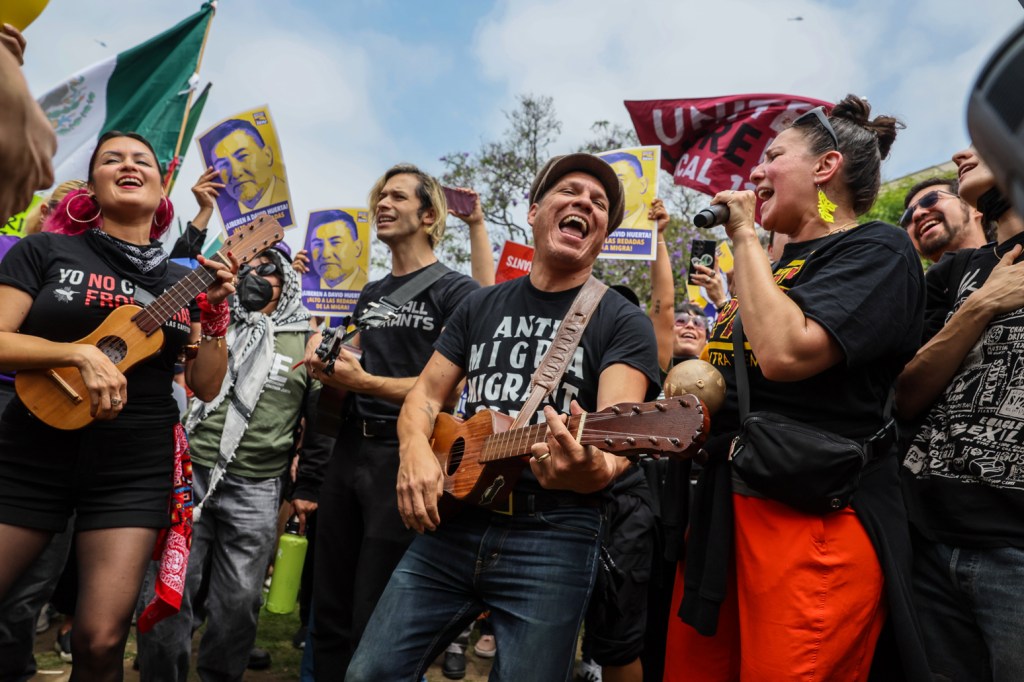
Isabela Raygoza: It absolutely does. By leveraging their influential platforms to address anti-Latino sentiment and oppressive immigration policies, these artists help amplify the human side of the immigration debate, which can get lost in political rhetoric. Becky G reminding her fans that those being targeted are “human beings with rights,” can compel her millions of followers to empathize and act. Artists like Eslabón Armado, Junior H, and Cuco have taken tangible steps by dedicating concert proceeds to immigrant advocacy organizations such as CHIRLA. Similarly, band members of Las Cafeteras demonstrated resistance by taking to the streets of L.A. to perform and protest against ICE during the protests, to empower communities impacted by these policies. By blending art, activism, and philanthropy, these artists not only elevate awareness but also motivate communities to unite in finding solutions.
Jessica Roiz: 100 percent — como dice el dicho: “juntos somos más” (together we are more). Not only are they showing solidarity with the Latin community, but they are amplifying the voices of undocumented immigrants and other marginalized communities. They might lose followers, they might break brand deals for voicing their opinionn — but they are definitely raising awareness on an important issue, and that to me, is an act of bravery.
3. Meanwhile, revoked visas and canceled shows have disrupted the ability of Mexican stars like Julión Álvarez and Grupo Firme to tour in the U.S. How might these restrictions not only limit live performances but also impact the U.S. recording industry’s relationship with regional Mexican music and its growing popularity?
Leila Cobo: The effects of these restrictions are already being felt. Tours have been cancelled, performances have been cancelled, and I worry that it’s a matter of time before attendance drops because fans are afraid to go to shows and be caught in raids. It’s very alarming. I hope, however, that this doesn’t affect the recording music market, particularly in an age of streaming that allows the music to be consumed everywhere.
Griselda Flores: I wrote a whole story on this so I’m not sure what else to add. Simply put, this could potentially derail the movement of genre that had entered spaces it had never entered before and reach new audiences. Just two years ago, we were having conversations about música mexicana’s significant growth in streaming and touring. Now, the conversation has shifted so significantly that it’s heartbreaking. I think, if anything, regional Mexican will remain strong in streaming because the audience is there, no doubt about it.
Sigal Ratner-Arias: In the last few years, we were really excited to see and report on regional Mexican music achieving new highs, including on the Billboard charts and the touring scene. We’ve also covered extensively its refreshing evolution and new subgenres through a young generation of Mexican and Mexican-American acts. Overnight, we are dealing with a situation that is putting its growth at risk, temporarily. On one hand, we have visa delays or cancellations; on the other, the aggressive immigration raids could lead fans to decide to stay home for fear of being detained or deported. But música mexicana is a legacy genre that has been around for over a century and a half — it will not cease to exist because of this.
Isabela Raygoza: I believe these restrictions can definitely impact the U.S. recording industry’s relationship with regional Mexican music — a genre whose popularity has seen unprecedented growth in recent years. In the last two years, artists like Guadalajara-born Peso Pluma have shattered records on the Billboard charts. Billion-stream Tijuana band Grupo Firme has also been a powerhouse on the charts and, like Peso, has graced the cover of Billboard Magazine. Such milestones demonstrate the genre’s meteoric rise, shining a spotlight on Mexican music and positioning it as a cultural and commercial powerhouse within the U.S. music industry. Restricting these artists from touring diminishes both their ability to expand their audience and the industry’s opportunity to capitalize on the growing demand for regional Mexican music — a dynamic that continues to reshape the U.S. music landscape.
Jessica Roiz: I think what’s truly worrisome here are the live shows being impacted. This not only puts a halt on the artists promotion plan and extra income, but like Sigal said, the ongoing ICE raids are also causing fear among the community, resulting in fans not wanting to buy tickets and attend concerts. On the other hand, I feel that while the revoked visas situation gets handled (hopefully sooner than later), artists can continue using social media to promote their music and new projects, all helping keep the música mexicana genre afloat.
4. Beyond Mexican artists, overall, obtaining visas has — anecdotally — become a more protracted process. How could this affect the Latin music business overall?
Leila Cobo: It affects artists’ abilities to come perform and promote their business. We’re seeing it more and more. But, unless there’s a legal issue delaying a visa, they are being issued, so this is a relatively easy solution. Begin the process sooner. I’m an immigrant and I went through many, many visa processes before becoming a resident and now a citizen. And mind you, the process to come here was perhaps easier than that of going to many other countries. There’s a process and it takes time, and however inconvenient that may be, that’s the way it is. Plan ahead.
Griselda Flores: It’s already affecting it. It’s not business as usual. Shows will get cancelled or postponed while artists figure out their visa situations, and then it becomes a domino effect impacting not only the artist, but the promoter, venue, vendors, staff, etc.
Sigal Ratner-Arias: This is already happening and is very worrisome. In the last couple months, we’ve seen not only shows but full festivals canceled, affecting both the music industry and surrounding businesses like hotels and restaurants. Live music represents a significant source of revenue in the music industry, particularly for artists. And we expect to see more cancelations over the year.
Isabela Raygoza: It could slow everything down — from international tours to collabs between U.S. and Latin artists. If visa delays become the norm, it makes it harder for artists to connect with their fans abroad and build their global reach. For the Latin music industry, which thrives on cultural exchange and live performances, this kind of red tape could stifle growth and momentum at a time when the genre is booming worldwide.
Jessica Roiz: As I mentioned before, I think the live industry could be the most impacted one: Artists will not be coming to the U.S. to do shows, and if they do, fans might not buy tickets out of fear of going out. This will then create a domino effect, affecting artists, venues, hotels, and beyond. Same could apply for those fans who like to travel to see their favorite artists in another country — they might want to stay put during these uncertain times.
Additionally, it’s very common for artists from Colombian, Venezuela, Argentina, and other countries to come to the states on a work visa and spend some time in Miami, Los Angeles, etc, working on new music, negotiating new business deals, networking, doing shows. I can only see this as a setback in their careers and within the industry.
5. Should the broader U.S. Latin music industry play a role in standing up against immigrant raids? How can fans, labels, promoters, festivals, etc. work together to actively align with these social causes?
Leila Cobo: I am very surprised, and frankly disappointed, that the industry hasn’t come together over this in a significant way yet, Beyond the brutality of ICE actions and the demonization of the entire Latin community, the effects in our burgeoning touring industry could be huge. This affects the entire chain of business: Artists, concerts, vendors, concessions, merch, sponsorhips. We should follow the example of the farming and hospitality industry — which lobbied, showed the effects of the raids in numbers and economical impact and garnered a reprieve from raids in farms, hotels and restaurants. Demonstrations that result in vandalism or any show of violence (as happened in Los Angeles) is hugely detrimental to our cause. Of course, it’s an emotional issue. But it was to be approached from a rational standpoint. This is a question of decency, humanity, family and yes, economics.
Griselda Flores: Yes. Again, this is impacting the very community that is buying tickets to your events. Your business will be impacted, if it hasn’t been already, if people are too scared to go to shows — or if all of a sudden you have to cancel an entire festival or a show over artist visa uncertainties. I think if industry execs reached out to political leaders and spoke up about how this is impacting their business, that may move the needle. That’s the most efficient and logical way to create change, and that’s what CMN’s Henry Cárdenas told me he is doing.
Sigal Ratner-Arias: The broader U.S. Latin music industry is directly affected and should get together, like Leila pointed out, as other industries have already done. I’d like to see the industry act and show a united front, reach out to their congressmen to ask for support and stand by its artists and loyal fanbases.
Isabela Raygoza: Absolutely, the Latin music industry has a unique platform to make a real impact. Fans, labels, promoters, and festivals can come together in powerful ways — from raising funds for organizations — like CHIRLA.org, ilrc.org, Nilc.org, UnitedWeDream.org — that support immigrants, to using social media to amplify stories and voices from affected communities. Festivals could dedicate space or moments to highlight these causes, and labels/promoters can support artists who are vocal about these issues. Even small actions, like merch sales benefiting advocacy groups, can go a long way. The industry thrives on the culture and stories of immigrants, so it only makes sense to stand with them when they’re under threat. It’s about turning the power of music into meaningful change.
Jessica Roiz: I think it’s important. We’re already seeing some artists do their part on social media to raise awareness, and we’re already seeing Latin music fans hitting the streets to protest. Grupo Frontera even pledged to donate proceeds from its new album sales to help these efforts. Anything helps the cause, and if more artists, record labels, concert promoters, and industry leaders unite, the impact will be bigger and stronger, and can potentially strike a chord and incite actual change regarding the current immigration policies.
The spark for Karol G’s genre-spanning tribute to Latin culture, Tropicoqueta, released Friday (June 20), came from an epiphany far from home — in a packed arena in Europe, surrounded by the warmth of fans who reflected her roots.
Standing on a stage during the European leg of her record-breaking world tour, Mañana Será Bonito, watching thousands of Latin fans who had traveled far and wide to see her, the Colombian superstar realized that her next album wouldn’t be about chasing broader fame or crossing over into English-language music — as she had briefly considered — but about celebrating the soul of everything that makes them feel at home.
“It was really beautiful because people brought their signs, and in a way, it was super important to them that someone was bringing a little piece of home all the way over there,” she tells Billboard Español at New York’s Republic Studios. The artist is radiating warmth as she shows off a deep tan and a fresh, summery look that’s totally in sync with the tropical vibes of her new project.
Trending on Billboard
For Karol G, those fans gave her clarity, inspiring the album’s main mission: to bring that “little piece of home” to every corner of the world through the music that defines who she is and where she comes from.
Karol G
Brianna Capozzi
This revelation came at a pivotal moment in the hitmaker’s career. Her previous album, 2023’s Mañana Será Bonito, made history as the first all-Spanish-language album by a woman to debut at No. 1 on the Billboard 200. Its record-breaking streak, paired with a massive stadium tour, marked an undeniable high point in her journey. Yet amid her search for the next step, she chose not to aim outward but inward — to honor the music and culture she has always carried within her.
The 20-track opus is inspired by the sounds and stories of Latin music icons who shaped her passion for artistry. “This album is an homage to all those Latin music genres I grew up listening to,” she says, listing music heroines like Rocío Dúrcal, La India, Amanda Miguel, Myriam Hernández, Elenita Vargas, Thalia and Selena Quintanilla among her childhood inspirations.
Tropicoqueta, produced by Edgar Barrera, takes listeners across a musical map of Latin America, weaving together Colombian vallenato, Argentinian cumbia villera, Cuban mambo, Dominican dembow and regional Mexican music, with live instrumentation at its core. “I’m super Colombian, I love Colombia, but more than feeling Colombian, I feel super Latina, like I’m from everywhere. When I go to Chile, I don’t know why, but I feel like I’m from there. And if I go to Peru, people make me feel like I’m from there, too.”
She adds, “The album is a journey to every place; a little nod of gratitude for when I travel around the world.”
Below Karol G breaks down five essential tracks from her fifth studio album, Tropicoqueta.
https://open.spotify.com/prerelease/2KPHxEpMysaqoXa8ULyACJ
“Ivonny Bonita”
When I was in the making of Mañana Será Bonito, I was going through a difficult situation in my life. I was very disappointed in myself for many reasons. I felt like I just wasn’t capable. I was sinking into this huge sadness, allowing myself to spiral down, and I couldn’t pull myself out of it. Then I remembered being with my friends in the Bahamas, and a Wizkid song was playing, where it says something about an “Ivonny, my baby.” That name sounded amazing to me, powerful and mystical. If I was told that my boyfriend was with a Daniela, fine. But if they told me he was with an Ivonny, I’d jump in head first to find out who Ivonny was!
That day I told my friends: “Call me Ivonny.” If Carolina can’t, Ivonny will. I even called myself Ivonny in Zoom calls. And unintentionally, I adopted an alter ego. That gave me a little bit of freedom. Then I realized that [the song “Essence” with Tems] didn’t say Ivonny. It said, “You don’t need no other body” [laughs]. I think it was meant to be. Time passed and Ivonny ceased to exist, but I had to thank her for everything she had been at that time for me. This song is the message I’ve always wanted women to get from everything I do.
“Latina Foreva”
Part of the message of the song was to talk about a little bit of everything Latinas are: that we are the soul of the party, our curves, that a party with Latinas is not the same as a party without. Well, I consider myself a Latina who is a little outrageous, but I think it’s part of our energy: we are happy, joyful, and we always have a fun attitude. That song celebrates that. The video is incredible. We shot it in a snowy mountain. It was minus 11 degrees [Celcius], as if we were at a beach. Latinas bring the heat, the warmth, everywhere we go. There are Latinas that go to the beach in heels, and I thought that was amazing. Latinas like to be on point in style. We like to be always super cute, super organized. If we have a party, we think about the outfit. We love that.
“Coleccionando Heridas” With Marco Antonio Solís
I love the old-fashioned way. I love the little details; I write handwritten letters and take any opportunity to leave a small gesture. I’m a romantic. I feel like people nowadays love differently — I think everything is a bit more fleeting. I feel like people have less emotional responsibility. I don’t know. When we were working on this song, I said, “I think I was born to collect wounds.” I’m always ready to love, and I feel like my heart will always be willing to love no matter what happens. I’ll turn the page, and I’ll try to find love again. Some experts say that love belonged to another era, and that’s why I said, “We need to bring an artist from that time to bring [that essence].” What a feeling. I’ve had favorites over time, and right now it’s this song. I listen to it, and I love it. It’s very special.
“Ese Hombre es Malo”
I was in Medellín with Edgar Barrera, working on other things. He went out to answer a phone call and when he came in, he was laughing as if he had been told the joke of his life. Edgar’s personality is super serious, and I’m pretty outrageous. I was really curious because I had never seen him laughing so hard. I said, “What happened?” And he says, “I got a call from a friend of mine who is a cabrón. I said, “So what?” He was still laughing and said, “The wife just left him”. So I asked, “But what’s the joke?” He said that he’d been told that the wife had left him because he had woman in every port. His wife had been OK with it to a certain extent — she’d say, “You can have your girlfriends, as long as you don’t bring them home and I never find out about it,” like that was her boundary. But then one of the women started leaving little things in his clothes and belongings for his wife to find. She started piecing it all together, and one day she said, “This is crossing the line. This is as far as we go.”
“That’s the lyrical theme of this song,” I said. The song has 57 musicians, a mix between mariachi and a symphony. We recorded it in Guadalajara. It’s one of the strongest songs on this album — because of how it was created, how it’s written and the musicians on it. Rocío Dúrcal, even though she was Spanish, embraced Mexican culture so well, and Mexico welcomed her with open arms. I’m such a huge fan of Juan Gabriel’s En el Palacio de Bellas Artes. I love all of his music. But the piece he created specifically for Bellas Artes has always inspired me. One of the things on my list for this album was to create a song with an arrangement at that level and with that level of grandeur.
“Tropicoqueta”
At parties, the DJ always calls out, “OK, it’s time for ‘la hora loca’ [crazy hour],” and everybody has to get up. That’s like the call to action. They hand out party hats, sunglasses, little props, and everyone comes together in the middle to start dancing to songs with choreography. We dance to “La Mayonesa,” “La Macarena,” “El Tiburón”… We all dance like we’re pretending to be sharks.
So I said, “If I’m going to have a super Latin album that pays homage to everything we are as Latinos — it needs to go deep into our Colombian culture too.” And I thought, “I need to create a song that people will play during ‘la hora loca.’” The idea is to have the song include instructions that people can follow — so they can do the choreography, step by step, just like that.
Shakira announced on Thursday (June 19) two new dates for the second leg of her Las Mujeres Ya No Lloran World Tour in Mexico.
The first will take place on Sept. 18 at Mexico City’s Estadio GNP Seguros. The second will mark her first-ever performance in the state of Veracruz, where she will perform at the Estadio Luis Pirata Fuente on Sept. 24. With the new dates, Shakira further breaks her own record of shows in Mexico on a single tour — now reaching a total of 28 on this trek.
“With the announcement of this new date, the Colombian singer solidifies herself as the artist with the most concerts at the iconic Estadio GNP Seguros,” promoter OCESA said in a press release.
Explore
Explore
See latest videos, charts and news
See latest videos, charts and news
“My beautiful Mexico! 12 shows at Estadio GNP! Thank you, thank you, and thank you again for continuing to break records with me. See you soon. I love you!!” Shakira wrote in an Instagram post, where she appears posing with a plaque of recognition from OCESA for her new milestone.
Trending on Billboard
The second leg of her 2025 trek in Mexico kicks off on Aug. 11 at the Estadio Caliente in Tijuana, Baja California, and continues on Aug. 14 at the Estadio Héroes de Nacozari in Hermosillo, Sonora; Aug. 17 at the Estadio UACH in Chihuahua, and Aug. 20 at the Estadio Corona in Torreón, Coahuila.
After making history with seven consecutive sold-out shows at the Estadio GNP Seguros, the Las Mujeres Ya No Lloran World Tour will return to Mexico City to complete another series of five shows on Aug. 26, 27, 29, and 30, and Sept. 18, for a total of 12 performances. This will make Shakira the first artist to achieve such a number of concerts at the venue (formerly known as Foro Sol).
The superstar, who has been adding dates to the tour as tickets continue to sell out, will also match Grupo Firme’s record of eight shows at Estadio GNP Seguros. The band is scheduled to perform their eighth show there on June 28.
The success of Shakira’s monumental tour has led the “Hips Don’t Lie” singer to top Billboard‘s monthly Top Tours ranking for the first time, generating $32.9 million with 282,000 tickets sold in February, according to figures reported to Billboard Boxscore. The following month, she again led the chart and broke records by earning $70.6 million from 11 reported shows — more than any artist has ever generated in a single March since the ranking’s launch in 2019.
Shakira’s tour has left an indelible mark on Latin America, drawing more than one million fans, according to OCESA. Also this year, the Barranquilla-born star was ranked No. 1 among Billboard’s Best 50 Female Latin Pop Artists of All Time.