State Champ Radio
 Business News
Page: 17

Michael Bublé will headline the City of Hope’s 2025 Spirit of Life gala on Wednesday Oct. 15. The event will be held at the Pacific Design Center in West Hollywood, Calif. As previously announced, the event will honor Tom Corson, co-chairman and COO of Warner Records, as the Music, Film and Entertainment Industry [MFEI] group’s 2025 Spirit of Life honoree.
“Like so many people, my family has been personally affected by cancer, and I know how important it is to have hope — and real answers,” Bublé said in a statement. “City of Hope is doing the work that changes lives, and I am thrilled to be part of this night honoring Tom and supporting the incredibly important groundbreaking work of this wonderful cause.”
Bublé’s oldest son was diagnosed with hepatoblastoma, a rare form of liver cancer that primarily affects young children, in 2016. The singer canceled a planned tour to spend time with his son during chemotherapy and radiotherapy. Bublé’s son has fully recovered.
Trending on Billboard
“This is about making a difference that lasts,” Corson added. “Cancer has touched all of our lives. What City of Hope is doing — fast-tracking research, delivering leading-edge care, and supporting survivors beyond the hospital — is nothing short of extraordinary. I’m proud to stand with this community to help move it forward.”
The music industry’s relationship with City of Hope spans five decades, beginning with Mo Ostin in 1973 and echoed today by the continued support of Warner Records and the broader artistic community.
“Aside from the Grammys, there are very few nights when the entire music industry gathers in one place — and this is one of them,” said Alissa Pollack, executive vice president of global music marketing at iHeartMedia and president of City of Hope’s MFEI board. “But unlike an awards show, this night is about something bigger than all of us: saving lives. I’m incredibly grateful to Tom Corson and Michael Bublé for using their platforms to support City of Hope’s mission. Their leadership makes this moment possible — and meaningful.”
“There’s nothing more powerful than this industry using its influence to help save lives,” said Evan Lamberg, president of Universal Music Publishing Group North America and chair of City of Hope’s MFEI board. “What makes the Spirit of Life Celebration so special is that it reminds us why we do this — not just to make music, but to make an impact. Supporting City of Hope means we’re helping push forward the research, care and compassion that cancer patients urgently need.”
Bublé, signed to Warner’s Reprise label, has amassed four No. 1 albums on the Billboard 200: Call Me Irresponsible (2007), Crazy Love (2009), Christmas (2011) and To Be Loved (2013). He has won five Grammys for best traditional pop vocal album, the second-highest tally of wins in the history of that category, topped only by the late Tony Bennett, with 14.
For more information about the Spirit of Life campaign or to get involved, contact mfeievents@coh.org.
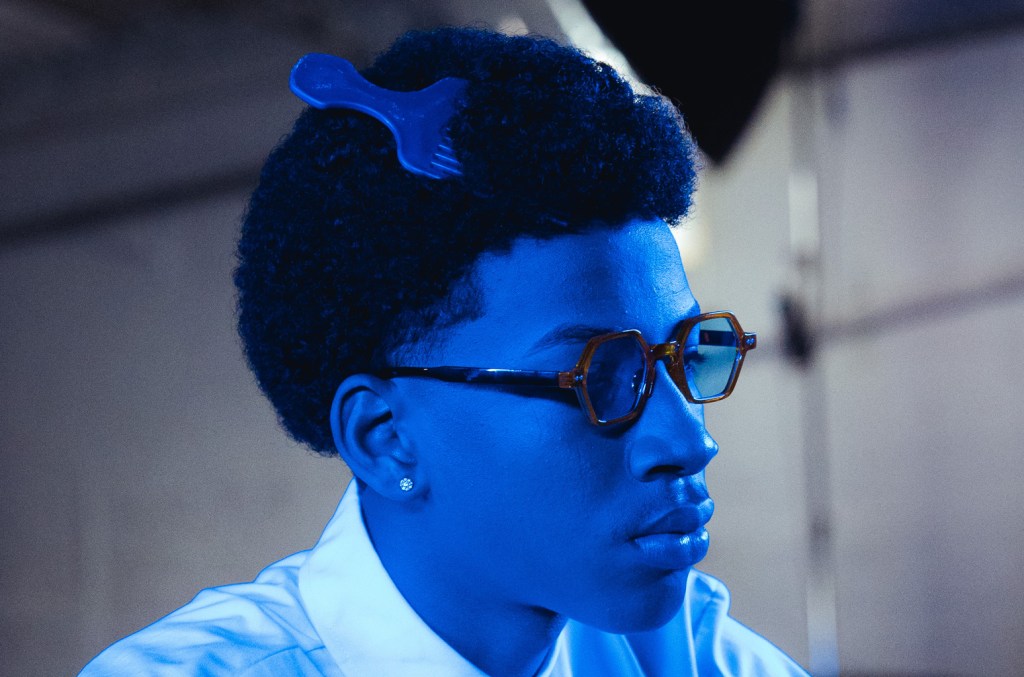
Warner Music Latina signed three emerging urban artists who are creating a viral buzz on social media and the Billboard charts: DFZM (Colombia), Jombriel (Ecuador), and Milo Bvgatti (Venezuela). DFZM made his Billboard chart debut last November DFZM with “+57” in collaboration with Karol G, J Balvin, Feid, Ryan Castro, Maluma, and Ovy on the Drums. Jombriel hit No. 1 on the Billboard Argentina Hot 100 chart this March with his “Parte & Choke (Remix)” with Ryan Castro. Meanwhile, Bvgatti has already received stamps of approval from Feid, Jay Wheeler and Dalex. “At Warner Music Latina, we believe in the power of fresh voices from the Andean region to make waves globally,” said Roberto Andrade, MD of Warner Music Latina, in a statement. “We proudly welcome DFZM, Jombriel, and Milo Bvgatti — a new chapter begins, filled with music and momentum.” – Jessica Roiz
Southern California band Of Mice & Men signed with Century Media Records. The group released the single “Another Miracle” on May 8, marking its first new music since 2023. Of Mice & Men is currently on tour in the U.S., with festival dates including the Summer Daze Festival in Elko, Nev.; Warped Tour in Long Beach, Calif.; and Louder Than Life in Louisville, Ky.
Trending on Billboard
Jutes signed a global record deal with Position Music, which will release his new single, “Left on Dilworth,” on Wednesday (May 21). The singer-songwriter’s singles so far this year include “Red Velvet” with Ari Abdul, “House of Cards” and “SMUT”; previous album releases include Ladybug and Sleepyhead. He’s managed by Mike Maloian at 25/7.
Indonesian dream-pop duo Galdive signed with Mom + Pop Music, which released its new album, Blue, on May 9. The act’s song “Teach Me How to Love” has picked up steam on TikTok, where it has generated more than 16 million views, 1.8 million likes, and over 2,200 UGC posts, according to the label.
Armada Music struck a joint venture deal with Dutch electronic artist Joris Voorn spanning A&R, distribution, promotion and marketing. The label will work with Voorn on his upcoming album Serotonin, which is set for release in July. It will additionally leverage its publishing arm “to add creative value” to his work via “writing camps and collaboration,” according to a press release. Armada previously released Voorn’s remix of “Transmission” by Eelke Ekleijn.
Scouting for Girls signed a label services deal with Absolute. Next year, the British trio is releasing a new album, which Absolute will support with digital marketing, distribution, project management and a long-term strategic direct-to-consumer campaign.
Sub Pop signed Brooklyn-based trio Nation of Language and will release the band’s new music globally this year and beyond. The first release under the deal is the new single, “Inept Apollo.” The band will tour North America and Europe this fall.
Virgin Music Latin signed a global agreement with rising Cuban act Wampi for the release of his forthcoming debut studio album, El Rey de la Habana. His first single under the label is “Veni,” an uptempo track that represents the Cuban Reparto music scene. El Rey de la Habana will feature collaborations with Cimafunk, Ibeyi, Los Van Van, Maffio, Michael Brun, and more. – Jessica Roiz
Mom+Pop Music signed Minneapolis artist Mother Soki, whose single “Rivet Gun” has been growing on TikTok. She is managed by Avalanche in Los Angeles.
Nettwerk signed indie-pop band Joseph, composed of sisters Natalie and Meegan Closner. The first release under the deal is the single “Bye and Bye,” a track from the duo’s forthcoming album (its first without sister Allie). The band is kicking off a round of tour dates on June 13 in Spokane, Wash.
Singer-songwriter N8NOFACE signed with Stones Throw, which released his new song, “Waiting to Wait for You,” last week. N8NOFACE is touring with Eyedress on the Stoner Tour this summer.
Scout Willis signed with WME for global representation. The singer-songwriter is currently recording her second studio album on the heels of singles “Over and Over” and “Take Me” last year. The album is slated for release this fall.
Atlanta-based five-piece band Penelope Road signed to Warner Records. The first release under the deal is the single “Out Tonight.” According to a press release, the song has already racked up “millions of views” leading up to its official release. The band, which is set to embark on a summer headlining tour on June 12 in Charleston, S.C., is managed by Lindsay Brandt.
Giant Music, a division of The Azoff Company, signed rock band Riff Wood. The band is independently producing its debut album, Tough Luck, which is set for release this summer. It’s been preceded by singles including “Blur” and “Stay a Little Longer,” the latter serving as its first release on Giant. Riff Wood is embarking on a summer tour starting July 29. The band, which won Utah’s Battle of the Bands last year, is managed by Rob Cavallo‘s Done Deal and Echo Street.
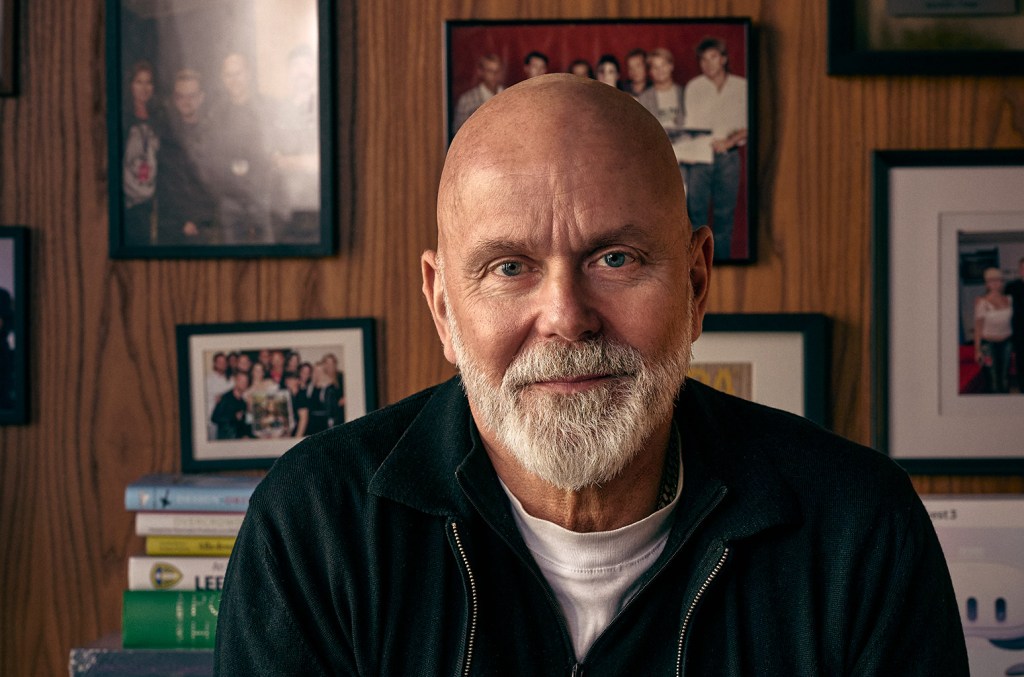
In 2022, Pophouse Entertainment premiered ABBA Voyage in London, a virtual concert in which avatars of the Swedish powerpop foursome as they appeared in 1979 — one of them Pophouse co-founder Björn Ulvaeus — performed their biggest hits in ABBA Arena, a custom-built venue at Queen Elizabeth Olympic Park that seats 3,000.
More than 40 years after ABBA’s initial success and the subsequent popularity of the Mamma Mia! musicals and movies, fans have purchased more than 3.3 million tickets to over 1,000 ABBA Voyage shows, according to Pophouse, which cost approximately $185 million to mount. Now, armed with $1.3 billion from its first round of private equity fundraising and the backing of Swedish investment giant EQT, Pophouse CEO Per Sundin is eager to replicate the franchise’s success.
Sitting in front of photos of Michael Jackson, Destiny’s Child, Lana del Rey, Billie Eilish, Barry Gibb and other artists Sundin worked with during the decades he spent as Sony and later Universal Music Group’s top executive in the Nordics, he sees ABBA Voyage as a template to attract the devoted fan bases of certain other acts. KISS, which completed its End of the Road tour in 2023 and whose catalog Pophouse acquired the following year, will be the next act to get the avatar treatment. Another possible candidate is Cyndi Lauper, whose farewell tour ends in August and whose catalog Pophouse owns. The company’s portfolio also includes the catalogs of two of Sweden’s most famous electronic music artists, Swedish House Mafia and the late DJ Avicii, for whom the company recently said it will release new music.
Trending on Billboard
Speaking at the New York offices of law firm Morrison Foerster, Sundin says Pophouse didn’t cut any corners in creating ABBA Voyage — even footing a “shocking” Dolce & Gabanna clothing bill, Sundin says, for the avatars’ costumes. (“They should have sponsored us, it was so expensive,” he jokes.)
Sundin says that after KISS vocalist-guitarist Paul Stanley saw ABBA Voyage, he asked to meet the band members backstage. Pophouse, he adds, is dedicated to producing the same realism for the blood-spitting, fire-breathing “Black Diamond” boys.
Geopolitical uncertainty and tariffs have not directly affected music assets. Did that motivate investors who participated in this latest funding round?
I don’t want to comment on what’s going on in the world today because I can’t guess where anything is going. But music is totally uncorrelated to inflation or interest rates, and that is a key message for people who invest from the financial world. When we said to investors, “This is a yield business because you have royalties coming in every quarter,” the financial support for music is fantastic. Even though you have tough times, maybe you don’t go out to restaurants or do big trips, but you will never cancel your Spotify, YouTube or Apple account.
You may not cancel your Spotify account, but you do buy fewer Broadway tickets. How are you changing your forecasts for the ABBA virtual show or other live- entertainment projects?
You have to value in assumptions and calculations for every venture, but we’re not going to do nothing for four years. The world we’re living in, it’s always SNAFU [an acronym for “situation’s normal: all fucked up”]. There is also opportunity. There is so much need for entertainment. ABBA Voyage is the next generation of music concerts. It’s on seven days a week, and it’s almost always sold out. I’ve been 16 times, and I’m emotionally connected every time. That’s how contagious this show is. Of the 50 biggest artists in the world still alive, I would say that 40 have been there to see it.
Given the show’s popularity with big stars, how’s your pipeline for acquisitions?
Really good. The press release about how much money we raised helped. We hope to announce at least one catalog we’re buying by summer. But we don’t just want to buy it and put it on the shelf. We create a road map for five to 10 years, and then we execute that road map. From the beginning, we told our investors that we want to buy eight to 10 catalogs. We have four. That leaves six to buy. The record companies have thousands of catalogs.
In the United States, ABBA Arena would be comparable to Sphere in Las Vegas. Will the KISS virtual show take place there?
No. The Sphere is a fantastic building, a fantastic venue, but for the type of avatar concert we are planning with KISS — which is something else — we are looking at more intimate sites. I’ve been to the Sphere four times [to see U2 live, a video replay of a U2 show, Anyma and the Eagles]. The first time I saw U2 at Sphere, the visuals were amazing, but I didn’t feel emotionally connected. Bono is a preacher. He has something to say to the world, and I didn’t find he was in the right element. I saw U2 virtual [a recording of a prior Sphere performance], and Bono was more of a preacher there. With U2 [both times], I asked people, “Did you go for U2 or did you go for the Sphere?” Two-thirds said they went there for the Sphere.
How will you give KISS fans something new for the virtual show?
Every catalog we buy will not be an avatar show. ABBA was only active for eight to nine years. KISS toured for 40. Kiss is more male-biased. ABBA is more female-biased. But they both have fans of all ages. That’s why their brands are so valuable. If you’re a KISS fan, you’re a fan for life.
Pophouse also owns Avicii’s catalog, another artist with hyper-engaged fans who are very sensitive to coverage and monetization of that catalog, given his suicide at the age of 28 in 2018. Would Pophouse buy another catalog that comes with a significant risk of offending fans?
There is so much data available to look at before we buy catalogs today. We also do brand and narrative due diligence. KISS has superfans. Taylor Swift has superfans. The same goes with Avicii. On Spotify, 2% of listeners of a catalog stand for 80% of a catalog’s streams in an average month or year. In some cases, we have found 5% [of listeners] stand for 50% of streams. If I can increase an act’s superfans from 5% to 6%, the total streams will go up 10%, meaning the value of the catalog will go up 10%.
So back to your question about sensitivity: We take this very seriously. With KISS, there are fans that have been fans for 50 years. We did deep research and collected 10 people into a superfan panel and invited them to Vegas [in mid-March]. In workshops, we asked them what they would expect, what they liked and didn’t like because we respect them. That doesn’t mean we will do everything they say. We will adapt their feedback for the next 50 years.
We’re going to do a superfan panel with Avicii, too. His parents are very close to me personally since I signed Avicii in 2010. I am probably the person who is saying, “Do as little as possible.” There are a lot of things Avicii never released, and we are doing Avicii Forever, a collection of his best songs — and one new song.
What’s a challenge you encountered in your career, and how did you overcome it?
The first decade of the century was a true roller coaster for me, but also for everyone in the music industry. It started with the best year ever selling CDs, then came Napster, LimeWire and, eventually, Pirate Bay. Sweden was the most pirated country in the world, and I had to restructure Sony Music Nordic. Then came the merger between Sony Music and BMG, and I moved to Universal Music Nordic. I had to let more than 300 people go, and the music market in Sweden decreased 50%. We tried everything to overcome the shrinking market: ringtones, iTunes and many more. Nothing compensated. When I joined Universal in April 2008, UM Sweden had the lowest digital revenue based on micro [gross domestic product]. Spotify was launched that October, and I decided to go all-in and sign as many new and established artists as possible: Avicii, Alesso, Tove Lo and many more. In 2013, Universal Music Sweden had the highest digital revenue on micro GDP in the [entirety] of Universal Music.
What are you most proud of from your career?
Every artist you sign to a label you feel in some way connected to them. I don’t think they always feel connected to you, but to sign an artist or band is such an important decision [for everyone involved]. Even though I’ve left Sony and Universal, I continue to follow the careers of the artists I signed. It’s emotional. It’s about creating an entertainment brand or artist who can live on their creativity. It’s fantastic.
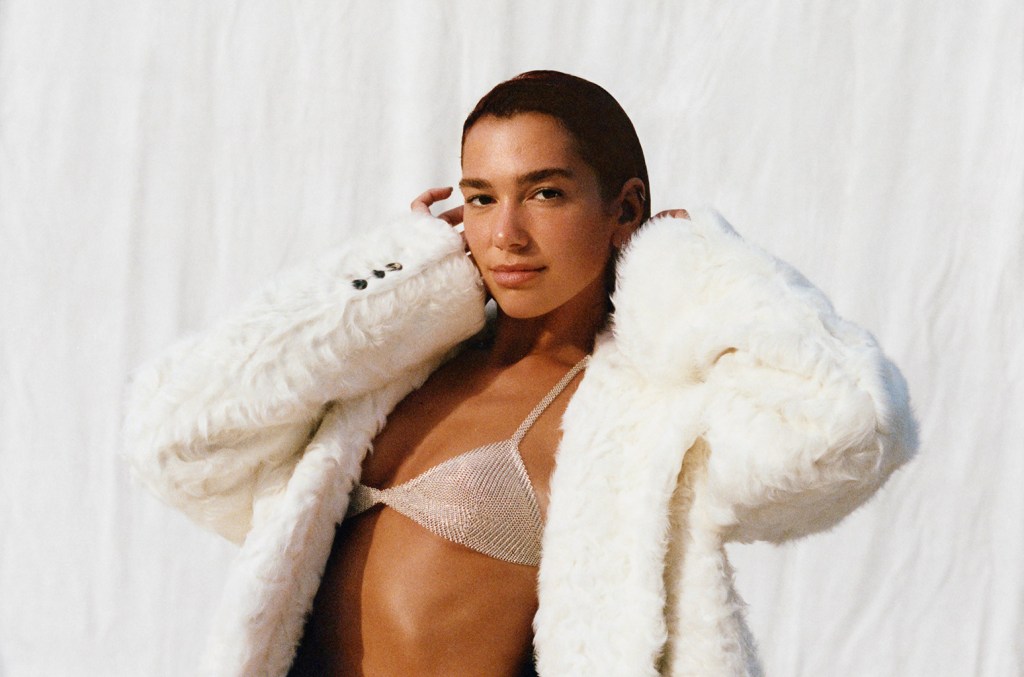
LONDON — Dua Lipa has been named as the U.K.’s most-played artist across radio, TV and public places in 2024, surpassing Ed Sheeran, Taylor Swift and more. This is the second time she has achieved the feat, having first done so in 2020.
On Tuesday (May 20) collection society PPL (Phonographic Performance Limited) shared its annual report into the U.K.’s most played music over the past year, with its data reporting the music played on radio, TV and in public places across the UK, including shops, bars, restaurants, gyms, offices and more.
Lipa, who released her third album Radical Optimism in 2024, also features in the most-played songs list, with “Houdini” named as the sixth-most played song in the U.K. last year. Speaking to Billboard U.K. as part of the Global No. 1s issue, Lipa said that 2024 was “the best year of my life,” and that she’s “so proud” of the LP and “where it’s brought me.” The album hit No. 1 in the U.K., and No. 3 on the Billboard 200.
Trending on Billboard
In June 2024, Lipa kicked off her Radical Optimism era with a huge headline slot at Glastonbury Festival in England, which was also broadcast live on the BBC and streamed online globally. Her ongoing tour will head to London’s Wembley Stadium in June, before continuing into North America this fall.
Data released by PPL says that Lipa’s music is played on average 400 times a day, with her 2018 hit “One Kiss” averaging 55 plays per day across UK radio and TV. Ed Sheeran was 2023’s most-played artist, and has claimed the prize seven of the past 10 years.
Seven of the top 10 artists in the PPL’s list were British, with Taylor Swift, Ed Sheeran, David Guetta, Coldplay, Calvin Harris, Ariana Grande, Elton John, Becky Hill, and Harry Styles all placing behind Lipa in the top spot, respectively.
Elsewhere, Noah Kahan’s “Stick Season” was named as the U.K.’s most-played song in 2024, with a number of international superstars dominating the top 10. Teddy Swims’ “Lose Control,” Benson Boone’s “Beautiful Things,” Dasha’s “Austin (Boots Stop Workin’)” and Myles Smith’s “Stargazing” round out the top five.
Alongside Dasha’s triumph, country songs perform well overall perform, with Shaboozey’s “A Bar Song (Tipsy)” (No. 7), Beyoncé’s “Texas Hold ‘Em” (No. 11) and Post Malone’s team-up with Morgan Wallen “I Had Some Help” (No. 12) all appearing in the data.
Peter Leathem OBE, PPL CEO, said: “Congratulations once again to Dua Lipa for leading PPL’s Most Played Artist Chart, and to Noah Kahan for securing the most played track of the year. British artists continue to perform well, making up 70% of the Top 10 – proving they have staying power across the nation’s broadcasters, businesses and public spaces. It is also fantastic to see fresh UK talent such as Myles Smith make a big splash in the top five most played tracks, showing there is plenty of promise in UK music going forward.”
PPL Most Played Tracks 2024
Noah Kahan, “Stick Season”
Teddy Swims, “Lose Control”
Benson Boone, “Beautiful Things”
Dasha, “Austin (Boots Stop Workin’)”
Myles Smith, “Stargazing”
Dua Lipa, “Houdini”
Shaboozey, “A Bar Song (Tipsy)”
Sabrina Carpenter, “Espresso”
Hozier, “Too Sweet”
Coldplay, “Feelslikeimfallinginlove”
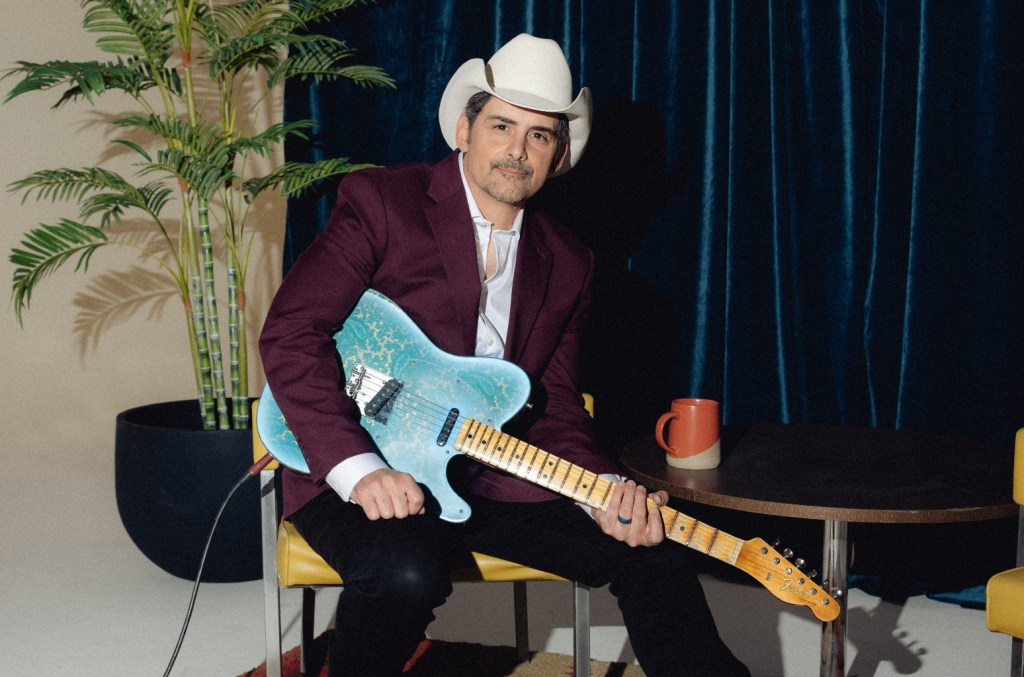
It’s a familiar pattern: paisley, to be specific about the visual; cutting and masculine, to identify the sonics.
A late-1960s version of the Telecaster guitar with that amoeba-like design and signature sound was particularly fascinating to Brad Paisley once he discovered that Fender had produced a line that matched his last name.
Now he has partnered with the company to create a limited-edition Brad Paisley 1967 “Lost Paisley” Telecaster, a select line of guitars that captures the vintage appearance and muscular tone of the instrument that was introduced to the market in 1968.
“There’s some magic involved in getting these things to feel old again and new again,” Paisley says in a small room on the second floor of Fender’s East Nashville building. “We had to really figure out what was it that made these things so cool. They are a unique moment — like, why in the hell Fender ever thought it was a good idea to make Paisley Telecasters? And then here I come, born with the strangest last name.”
The Tele was already legendary before Paisley’s national arrival, associated with the likes of Keith Richards, Vince Gill, Muddy Waters and Nashville studio veteran Brent Mason, who contributed key licks to recordings by Alan Jackson, Brooks & Dunn, George Strait and Lee Ann Womack. Country Music Hall of Fame member James Burton gave the Paisley Tele a high profile when he started playing a red model during Elvis Presley‘s concerts.
Trending on Billboard
“They became cool,” Paisley says. “Otherwise, I am Brad Plaid. I’d have had to change my name by the time I had a deal. [There’s] nothing cool about Paisley, but it was, luckily, cool thanks to James.”
The sound is cool, but there’s something nerdy about making guitars. And Paisley celebrated the retro instrument line by performing a short set at Fender for an invitation-only crowd of insiders and fellow nerds, including Steve Wariner, who joined Paisley’s band for a rollicking, extended version of “Workin’ Man Blues.”
Paisley’s guitar project owes its reemergence to one of the nerds attending that day. Canadian broadcaster Alan Cross spotted a Craigslist ad for an ammo case of blue Cling-Foil, the adhesive wrap Fender used on the Paisley Tele back in the day. Cross talked the seller from $50 down to $25 — and, to keep peace at home, told his wife he’d only paid $20 for the material.
Once that foil got into Fender’s hands, the company had the opportunity to re-create the line, and Paisley worked hand in hand with Ask Zac YouTube host Zac Childs, Glaser Instruments owner Joe Glaser and the Fender team to learn the nuances of the Paisley Telecaster production process: assembling the neck, body and pickups; applying the paper wrinkle-free; and covering it with a sleek finish.
“The finish is a key element,” Paisley says. “It’s not just the look of it. It does change everything about how it responds. So it’s really great that they were willing to sort of go down the rabbit hole with me. We’ve worked on this for a year now, trying to get it exactly right.”
In recognition of the Lost Paisley’s 1967 model year, Fender will produce 67 guitars through its Custom Shop in Corona, Calif., pricing them at $7,000. Paisley will manufacture 19 pieces with the Fender Nashville team, videoing the assembly and playing each guitar, providing its future owner an assessment of that guitar’s particular strengths and weaknesses. He’ll burn the neck of each of them with a cigar to simulate the abuse they take onstage, and the cigar label will be pasted inside the guitar cavity.
“I’m going to have time-lapse cameras set up,” Paisley explains. “As I paint each one, I will hold up the number, you’ll see me [build] it, you’ll get a little video, and then I’ll tell you what I think of it. I’ll play it once it’s assembled. They get a guitar with its birth [documented], and then a lot of case candy, the really fun stuff, too. There’s all these cool old campaigns and bumper stickers and things they did in the ’60s with Fender. They had these buttons that said, ‘Fender Lovin’ Care,’ and they had the ‘Peace, Love’ bumper sticker. Your case will be covered.”
Paisley is covering plenty of other bases as well. For starters, with the economy poised for a likely downturn, The Store — a referral-only grocery store for financially struggling Nashvillians that he co-founded with his wife, actress Kimberly Williams-Paisley — is expected to experience greater demand at a time when a portion of its donors are tightening their belts.
“It’s going to be probably a really important thing for people that didn’t expect to need it coming up, based on what things look like,” Paisley predicts. “There’s funding that went away, but at the same time, we are in a really generous town. I knew this when we decided to try this idea. There are really generous people here, and there are generous people outside of Nashville that know about it, that are committed to helping us in a lot of ways, so it’s not easy right now, but it definitely keeps me sane.”
Meanwhile, he’s optimistic about changes at Music Corporation of America, formerly Universal Music Group Nashville. UMGN chair/CEO Cindy Mabe, who was key in bringing Paisley to the label, left the company. New MCA chief creative officer Dave Cobb and senior vp of A&R Austin Jenkins successfully quelled any apprehensions about the turnover.
“New regimes at labels, which I’ve dealt with three or four times in the course of my career, can make it very clear right away whether or not they get you,” Paisley notes. “These guys have really done a great job of being like, ‘We get you, and we want to empower you to be who you want to be.’ And I’m thrilled so far.”
Paisley was prepared for the new leadership to present a game plan that might not resonate with him. Instead, the team came in with questions.
“They were like, ‘Will you play us some stuff? Will you talk to us and give us an idea of what you have, and what you are in your mind, and what you want to be?’ ” he says. “Then they came up with ideas, sitting there with me, that I went, ‘Oh, I love that.’ The next thing you know, we have days on the calendar now based on one idea in a meeting. So I’m really hopeful that this is a good thing.”
The Paisley pattern is set for its next chapter, whether it’s for the Fender guitar, the artist or both.
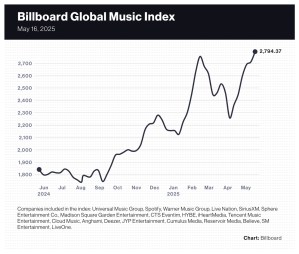
Music stocks — and stocks in general — had a terrific week as Sphere Entertainment Co., Tencent Music Entertainment and Cloud Music posted double-digit gains and the 20-company Billboard Global Music Index (BGMI) set a new high mark.
The BGMI rose 3.1% to an all-time high of 2,794.37, bringing its year-to-date gain to 31.5%. The index has overcome two downturns — one caused by an escalation of trade tensions, the other prompted by President Trump’s announcement of his tariff policy — to surpass the previous record of 2,755.53 set on Feb. 14.
Sphere Entertainment Co. gained 19.3% to $38.78. The company’s quarterly earnings, released on Monday (May 12), showed the Sphere venue was able to cut costs to offset a decline in event-related revenue. Investors cheered the result: flat operating income rather than a loss. As for tourism to Las Vegas, CEO James Dolan brushed aside concerns and said demand for Sphere concerts is strong enough to withstand a downturn should one arise.
Trending on Billboard
China’s Tencent Music Entertainment (TME) jumped 18.0% to $18.62 after the company reported on Tuesday (May 13) a 17% increase in music subscription revenue in the first quarter. Following earnings, CFRA upped its price target to $18 from $17 but downgraded its rating to “hold” from “buy.” TME, which operates Kugou Music, QQ Music and Kuwo Music, finished the quarter with 122.9 million subscribers, up 8.3% from the prior-year period.
Another Chinese music streamer, Netease Cloud Music, rose 12.6% to 203.40 HKD ($26.03) after the company’s financial results, released on Thursday (May 15), showed an 8.4% drop in revenue that the company attributed to a decline in its social entertainment business. The scant Q1 numbers didn’t provide details on the online music side of the business, but the two sides of the business are going in opposite directions. In 2024, social entertainment revenue fell 26% while online music revenue grew 23%.
Not only were TME and Cloud Music among the top performers of the week, they are among the biggest gainers in 2025. Year to date, TME shares are up 49.1% while Cloud Music has gained 81.3%. SM Entertainment’s 64.9% gain is the second-best amongst music stocks.
Live Nation improved 8.2% to $147.68 this week despite news that the company and AEG Presents are facing a criminal antitrust probe by the U.S. Department of Justice over pandemic-era refund policies. Live Nation shares are still well below the all-time high of $157.75 reached on Feb. 21, but they’ve gained 14.0% year to date and are up 52.9% over the last 52 weeks.
Spotify, the index’s most valuable component, rose 1.2% to $656.30. Guggenheim raised its price target to $725 from $675 on the heels of a judge’s favorable ruling in Epic Games v. Apple. Guggenheim sees the ruling, which allows Spotify to display pricing options within the iOS app, as helpful to audiobook monetization.
German concert promoter CTS Eventim gained 3.2% to 111.90 euros ($124.90). Barclays started covering the company with a 130 euro ($145.12) price target and an “overweight” rating.
Elsewhere in the index, Universal Music Group and Warner Music Group gained 0.9% and 1.2%, respectively, and HYBE improved 1.9%. SiriusXM jumped 5.4%.
Only four of the BGMI’s 20 stocks lost value this week. SM Entertainment was the week’s biggest loser with a 5.2% drop. Believe fell 1.3%, Deezer dipped 1.5% and iHeartMedia dropped 1.6.%.
Stocks were up globally but performed especially well in the U.S. The Nasdaq composite rose 7.2% and the S&P 500 improved 5.3%. In the U.K., the FTSE 100 was up 1.5%. South Korea’s KOSPI composite index gained 1.9%. China’s SSE Composite Index rose 0.8%.
Investors were encouraged by a reduction of U.S. tariffs on Chinese goods while the two countries continue to negotiate a trade deal. Goldman Sachs lifted its estimate for the S&P 500 on Tuesday as tensions over tariffs eased between the U.S. and China.
There is still uncertainty about the U.S. economy, however. Since last week, numerous reports have warned of a sharp slowdown at the Port of Los Angeles, the nation’s busiest port. This week, Walmart CFO John David Rainey said high tariffs could cause the company to raise prices by the end of the month. And on Friday (May 16), the University of Michigan’s closely watched index of consumer sentiment fell to its second-lowest level on record.
Billboard
Billboard
Billboard

In just a few years, Toronto-born rapper and actor Connor Price has built a global audience and over 2 billion streams entirely on his own terms.
“Staying independent means ownership, creative control and being able to do things my own way,” says Price. “I can put out music when I want. I can say what I want. I can work with who I want. I can market it how I want. I don’t have to wait for a label.”
That mindset has already helped him carve out a career many would envy. Using social media, online savvy, and some help from his family and friends, Price has found a way to reach a wide fan base all over the world. It’s a 21st-century DIY rise. Build the fanbase first, then go out on the road. Release 110 songs, then record your debut album.
Connor Price stars on Billboard Canada’s new Indie Issue digital cover — a look at artists making it work without a label. In the story, he talks about going from a career as an actor into music and content creation, and the viral Spin The Globe project that has resulted in millions of streams not just for him but for independent artists all over the world.
“Being on the independent side and working so closely with my wife [Breanna, his manager], I have to know how the business side works,” he says. “Some artists might be in a label situation with a big team where all they have to do is focus on the music, which is great, all the power to them. But I actually have a lot of pride and enjoyment in both the business side and the creative side.”
Trending on Billboard
It’s every starry-eyed artist’s dream to sign a record deal — or so the conventional wisdom goes.
The recorded music industry has been built on the label model from its earliest days, with record companies providing funding to artists in exchange for rights to the music.
As recording has become cheaper and more accessible, though, the whole paradigm is shifting. Now, many artists are choosing to remain independent — or, in the case of major Canadian breakouts like The Beaches and Nemahsis, seeing success as independent artists after leaving a label roster.
That dynamic has been changing for decades, with strong independent streaks in DIY-minded genres like punk and hip-hop, but the internet has upended the industry to such an extent that artists across all genres are weighing the benefits of independence.
When you don’t have a label fronting funds or tapping into established release strategies and promotional networks, you need to make sure you’ve got a strong community around.
Ontario indie artist Ruby Waters knows that firsthand. She’s become a major breakout Canadian indie rock act in the last five years, with two Juno nominations, international tours and millions of streams under her belt.
“The main force to my independence as an artist really comes down to the love and support I’ve had from my day one homies and fans throughout my whole musical journey starting from back when I was singing on the street,” she says in another Billboard Canada Indie Issue feature.
Read the whole feature, which looks at the tools artists have without label support, here.
Billboard Summit Brings Global Talent to Toronto This Summer
A major global initiative is coming to Canada.
The inaugural Billboard Summit will bring some of the world’s biggest artists to Toronto’s NXNE Festival for a series of dynamic, artist-led conversations in June.
The full-day event will go beyond industry panel conversations to centre musicians talking about what they’re most passionate about: their processes, collaborations and breakthroughs.
Charlotte Cardin is the first artist announced to join the summit. The Montreal-based singer and songwriter has had an international breakout over the last few years, charting on multiple Billboard charts and touring throughout Canada, Europe and the Middle East.
Her global rise led from Billboard Canada Women in Music, where she was named Woman of the Year in 2024, to the global Billboard Women in Music stage in Los Angeles this past March, where she represented Canada as Global Woman of the Year.
Cardin will speak on the topic of Breaking Through Barriers by sharing experiences and moments that have defined her career and offering inspiration to anyone striving to push boundaries.
Other soon-to-be-announced names will include artists from around the world — from trailblazing Canadians who’ve built influential brands that have resonated across borders to international artists who’ve set chart and live music records throughout the globe.
Stay tuned for the full programming announcement, featuring an exciting lineup of diverse voices and thought-provoking speakers.
More info here.
PUP Chart on Billboard Canadian Albums for the Fourth Straight Time with ‘Who Will Look After The Dogs?’
Punk is back on the charts this week.
Toronto band PUP have debuted their newest album Who Will Look After The Dogs? on the Billboard Canadian Albums chart this week, dated May 17. The album enters at No. 72 and marks the band’s fourth consecutive album on the chart since its sophomore effort, The Dream Is Over, first landed at No. 48 in 2016.
The album is fun and self-deprecating in ways we’ve come to expect from PUP, but also reflects the band’s major life changes: members got married or had kids, one expanded his home studio, and singer Stefan Babcock ended a decade-long relationship.
Although they have previously reached higher peaks on the chart, the band has some serious momentum. Following a stint playing arenas opening for Sum 41 on the band’s farewell tour, they’re now currently on tour in Europe and will also celebrate the record with a citywide summer tour in Toronto. The Mega-City Madness Tour is set to kick off in July, with dates at six venues in PUP’s hometown.
Elsewhere on the chart, legendary British rock band Pink Floyd earns this week’s top debut on the chart with Pink Floyd At Pompeii: MCMLXXII, which lands at No. 45. It is the first-ever soundtrack album for the band’s 1972 concert film Pink Floyd: Live at Pompeii, which was recently remastered in 4K and re-released in theatres. It is the only other debut on the May 17 chart.
Check out the whole Canadian Albums chart breakdown here. – Stefano Rebuli

Companies frequently urge investors not to read too much into any one quarter’s results. After all, even large, diversified businesses don’t always take a neat, linear path to consistent annual gains, and any single reporting period can contain oddities that skew the results favorably or unfavorably. But most public companies report results every quarter and, for better or worse, we onlookers read as much into the results as possible.
With that caveat in mind, here are some takeaways from the earnings releases through Thursday (May 15). Note that while most music companies, including the largest ones, have already issued earnings, there are a couple more to come: CTS Eventim will release some first-quarter figures on May 22 and Reservoir Media reports on May 28.
1. Some Margins Improved from Cost Savings
Music companies — like employers across the spectrum — have thinned their headcounts to retool, refocus and ultimately cut down on expenses. Q1 results showed some notable improvements in companies’ bottom lines.
Trending on Billboard
Spotify started seeing bottom-line growth in 2024 after cutting about a quarter of its headcount in 2023. The Stockholm-based music and podcast giant’s operating margin rose to 12.1% from 4.6% in the first quarter of 2024 — an improvement of 341 million euros ($380 million) — while gross margin (gross profit as a percentage of revenue) rose to 31.6% from 27.6%. Gross margin is a good proxy for what Spotify keeps after paying for content costs (it also includes some smaller expenses such as credit card transaction fees and hosting costs). After keeping prices flat for more than a decade, gross profit improved after Spotify began raising prices in 2023.
Operating profit, not gross profit, shows the impact of layoffs (salary expenses are deducted from gross profit to calculate operating profit). Spotify’s operating profit, as a percentage of revenue, improved to 12.1% from 4.6% in the first quarter of 2024. That’s a huge improvement in 12 months, but it’s more remarkable considering the company’s operating profit percentage was negative 5.1% in the first quarter of 2023. CEO Daniel Ek’s controversial decision to make Spotify “relentlessly resourceful” by eliminating thousands of jobs has paid dividends for the company.
Lower expenses also helped the Sphere venue in Las Vegas show improvement in operating margin. Sphere’s sales, general and administrative expenses fell 12% as the company identified costs to reduce, including corporate support functions, Sphere Entertainment Co. CFO Robert Langer said during the May 8 earnings call. That helped offset a 12.8% decline in revenue due to fewer events being hosted by the one-of-a-kind venue. The opposing growth rates cancelled each other out, and Sphere’s operating income was flat in the quarter. Investors apparently liked Sphere’s ability to reduce costs: The share price of its parent company, Sphere Entertainment Co., surged 6% the day of the earnings release.
Over at Universal Music Group (UMG), which embarked on a cost savings plan in early 2024, the company’s adjusted earnings before interest, taxes, depreciation and amortization (EBITDA) margin was flat at 22.8%. Though the company’s global head count rose slightly to 10,346 on Dec. 31, 2024, from 10,290 on Dec. 31, 2023, according to its annual reports, the amount spent on salaries and benefits fell 14% to 1.79 billion euros ($1.94 billion) in 2024.
As for the other two majors, Sony’s operating margin improved to 18.0% from 16.9%, while the operating income before depreciation and amortization (OIBDA) margin at Warner Music Group (WMG) fell to 20.4% from 20.9%, due primarily to a change in revenue mix (meaning there was a higher proportion of low-margin physical sales compared to the prior-year period), though it was partially offset by savings from restructuring. WMG’s operating margin jumped to 11.3% from 8.0% due in part to a decrease in restructuring charges incurred in the prior year.
2. Subscriptions Lead the Way
Two companies had impressive subscriber gains in the quarter.
Spotify’s Premium revenue was up 16% year-over-year, and average revenue per user (ARPU) was up 4%. Subscription revenue was 90% of Spotify’s total revenue, the highest mark since Q3 2020 when advertising dried up — and subscription revenue exploded — at the onset of the pandemic. In fact, subscriptions have been Spotify’s workhorse in recent years, with subscription revenue growing 39.0% over the past two years compared to 27.4% for advertising revenue. After two rounds of price increases in the U.S. and U.K., plus hikes in many other countries, ARPU grew 9.5% in that two-year span.
Meanwhile, at Tencent Music Entertainment (TME), subscription revenue was up 16.6% and ARPU was up 7.5%. TME did not provide an updated subscriber count for its Super VIP tier — it’s still listed at 10 million-plus — but the company did disclose that high-quality audio and other perks are driving Super VIP conversions. Given that Super VIP costs five times the normal subscription price, it makes sense that it was the primary driver of the 7.5% jump in ARPU.
This is a case of the spoils going to the two largest music subscription services by subscriber count. MIDiA Research’s music subscription market shares for Q4 2024 put Spotify at No. 1 with 32% and TME at No. 2 with 15%. Spotify finished Q1 with 268 million paying customers (plus another 423 million ad-free listeners), while TME had 122.9 million.
Some other subscription services have been performing well, too, although only one other publicly traded music streaming company has released detailed financial statements for Q1. A revealing comment came from UMG, which saw double-digit revenue growth from four of its top 10 streaming partners and high single-digit growth at a fifth, the company said during its April 29 earnings call. Billboard believes two of the top four partners were likely Spotify and TME. The other double-digit growth services are anyone’s guess, but it probably wasn’t Deezer — the company’s total revenue rose just 1% in Q1 as its subscriber count fell 5.4%.
3. Advertising revenue was unsurprisingly mediocre but not terrible.
With the subscription business booming, there’s less pressure on the advertising side of music streaming to deliver value for platforms and rights owners. Good thing, too, because advertising hasn’t delivered much growth lately. In the U.S., advertising-based streaming royalties’ share of total recorded music revenues fell to 10.4% in 2024 from 10.9% in 2023 and 11.4% in both 2021 and 2022.
The numbers looked better in Q1 for Spotify, whose ad revenue rose 8% year-over-year (5% at constant currency). But because Spotify’s subscription business is faring better, advertising’s share of Spotify’s total revenue fell to 10.0% from 10.7% in the prior-year period. In fact, 10.0% was the lowest share for Spotify’s advertising since the early pandemic — 8.0%, 6.9%, and 9.4% in Q1, Q2, and Q3 of 2020, respectively.
Advertising is the lifeblood of the radio business. That explains why radio companies’ stock prices have fallen sharply over the last two years. iHeartMedia revenue rose 1% on the strength of a 16% gain in digital revenue, although the multi-sector segment that houses its broadcast radio business was down 4%. U.S. tariff policy has injected uncertainty into media companies’ outlooks, but iHeartMedia CEO Bob Pittman said on Monday (May 12) that iHeartMedia was seeing “generally stable ad spend.”
The same story played out at other radio companies: Total revenue change wasn’t bad because digital gains helped compensate for losses in broadcast ad revenue. Cumulus Media’s revenue fell 6.4% as broadcast dropped nearly 11% and digital gained 6.1%. Townsquare Media’s revenue fell 1% as gains in digital advertising (up 7.6%) and subscriptions (up 4.2%) almost offset a 9.1% decline in broadcast advertising.

The broadly supported American Music Tourism Act passed in the U.S. Senate unanimously this week. Sponsored by Sens. Marsha Blackburn (R-TN) and John Hickenlooper (D-CO), the bipartisan bill, which was first introduced last year and revived in January, aims to further promote travel and tourism to music-related sites and events in the U.S.
According to Future Market Insights, the music tourism market is already valued at $6 billion dollars worldwide, and it is projected to grow to $11 billion by 2032. In a day when superfans are increasingly crossing state and country borders to catch marquee music events like Taylor Swift’s Eras Tour, concerts at The Sphere or Coachella, the American Music Tourism Act plans to fuel that trend even further.
Trending on Billboard
The bill plans to leverage the existing framework within the Department of Commerce to highlight and promote music tourism across the country. More specifically, this bill would require the assistant secretary to implement a plan to support and increase music tourism for both international and domestic music fans, and to send a report on the plan’s successes and vulnerabilities to Congress.
The AMTA defines music tourism as travel to a state or locality to experience music-related attractions—ranging from historic and contemporary museums, studios and venues of all sizes, to live performances such as concerts and festivals. If enacted, the legislation aims to boost the economic impact of these experiences.
“The Volunteer State is home to so many iconic musical landmarks for tourists to experience – from Graceland in Memphis to the Grand Ole Opry in Nashville to Dollywood in Pigeon Forge,” said Blackburn. “Music tourism has such a positive impact on Tennessee’s economy, and we need to ensure that fans from all over the world can continue to celebrate our state’s rich history of music for generations to come. The Senate’s passage of the American Music Tourism Act gets us closer to that by promoting and supporting the fast-growing music tourism industry.”
Added Hickenlooper: “Colorado’s vibrant music scene attracts artists and fans from around the world. Our bipartisan bill will help our local music venues thrive and expand.”
The bill is backed by a wide range of organizations, including the Recording Academy, Recording Industry Association of America, Nashville Songwriters Association International, ASCAP, National Music Publishers Association, Society of Composers and Lyricists, Live Nation Entertainment, National Independent Venue Association, BMI, American Alliance of Museums, Airbnb and several institutions such as the Rock and Roll Hall of Fame and the Memphis Music Hall of Fame.
Co-sponsors include Sens. Bill Hagerty (R-TN), Gary Peters (D-MI), Andy Kim (D-NJ), and Ted Budd (R-NC).

Welcome to another Executive Turntable, Billboard’s weekly compendium of promotions, hirings, exits and firings — and all things in between — across the music business. Later, carve out some time today to peruse our annual list of the industry’s top whippersnappers (aka 40 Under 40).
Matt O’Neil is now chief marketing officer of the combined Legends + ASM Global. A seasoned sports and entertainment marketing executive, O’Neil joined Legends in 2022 as chief content & experience officer and has since led successful strategies that expanded the company’s client base and revenue. In his new role, he’ll oversee all marketing, creative, content and event initiatives, focusing on enhancing customer experience and driving growth. O’Neil previously held key leadership roles with the Dallas Cowboys and New York Red Bulls, where he developed fan engagement and branding strategies. His appointment follows Legends’ 2024 acquisition of ASM Global from AEG and Onex, forming a powerhouse that now operates iconic venues including Crypto.com Arena, Soldier Field, and AO Arena. CEO Dan Levy praised O’Neil’s expertise in fan experience and storytelling, saying his background “makes him the right person to shape our unified identity and help our clients thrive in an increasingly competitive landscape.”
Trending on Billboard
Armada Music Group named industry veteran Maarten Steinkamp as interim president, a new gig designed to support the company’s next phase of growth. Previously serving as an interim board consultant, Steinkamp will now lead efforts to strengthen internal operations and prepare Armada for future expansion. He’ll report directly to CEO Maykel Piron and be based in the Netherlands. Steinkamp brings extensive global experience, having held top leadership roles at BMG and Sony BMG Europe, where he was president of BMG International and chairman/CEO of Sony BMG Europe. Founded in 2003 by Armin van Buuren, Maykel Piron and David Lewis, AMG encompasses Armada Music, BEAT Music Fund and Armada Music Publishing. Piron praised Steinkamp’s “leadership, strategic insight, and deep understanding of our industry,” adding, “with Maarten’s continued support, I’m confident we will unlock new opportunities together and take Armada Music Group to even greater heights.”
ALL IN THE FAMILY: Rolling Stone appointed Gus Wenner as executive chairman and Julian Holguin as CEO. Wenner, who has led the company since its 2017 sale to Penske Media, will now focus on strategic vision and new ventures. Under his leadership, RS expanded its digital presence, launched live events and film divisions, and earned prestigious awards, including National Magazine Awards and an Emmy. Holguin brings extensive experience from another Penske pub, Billboard, where he led major mergers and revenue growth across advertising, events and licensing. He also served as CEO of Doodles, a next-gen entertainment studio. As CEO, Holguin will oversee the brand’s business operations and report to Penske Media CEO Jay Penske. “Rolling Stone is poised for continued success leveraging Gus’ deep experience and vision for the brand and Julian’s keen business instincts and passion for innovation,” said Penske. “Rolling Stone will continue its rich legacy of world class journalism and culture shaping conversation while creating new avenues for growth” … Congrats to PMC vice chairman Gerry Byrne, who received the Ellis Island Medal of Honor, an award recognizing individuals for their leadership and service across diverse fields.
Matt Harmon is the new head of rights development at Exceleration Music, an investment fund supporting indie music artists and labels. In this role, he will oversee label operations, A&R development, marketing and catalog growth across Exceleration’s portfolio, which includes +1 Records, Kill Rock Stars, Yep Roc, and more. Harmon brings over 20 years of experience from Beggars Group US, where he rose from Head of Sales to President, helping expand labels like Matador, 4AD, and XL Recordings. Exceleration Partner John Burk praised Harmon as the “perfect leader to guide and support our rights development activities,” while Harmon, a lifelong New Yorker based in Brooklyn, said he’s “energized by the opportunity.”
Rock Paper Scissors hired Adam McHeffy as the agency’s first-ever chief creative officer. He will lead a new initiative to expand RPS’s marketing and creative services, including advertising, artist collaborations, video production, and web development. McHeffey brings a strong track record from his time as CMO at Artiphon, where he led product launches, helped sell over 250,000 instruments, and raised more than $3.6 million on Kickstarter. He has also directed major marketing campaigns for innovative instruments like the Demon Box and MyTRACKS, and contributed to platforms like Musio and Feeture. His creative work spans brands such as Slack and Rivian. A singer-songwriter and children’s book author, McHeffey is praised by RPS CEO Dmitri Vietze as a top-tier music tech marketer. “Adam’s skills make him the marketing Swiss army knife every music tech company should have on hand and make our team a formidable force,” Vietze said. “Combining his marketing expertise with our PR strategy and placement creates exponential results for our clients.”
Andrew Farwell has been named president of Outback Presents, the independent live promoter. Formerly vice president, Farwell worked closely with founder and co-CEO Mike Smardak, helping produce thousands of concerts and events across the U.S. and Canada. Based in Nashville, Farwell’s promotion coincides with his recognition in Billboard’s just-released 40 Under 40 list. Farwell also serves as vp of the International Entertainment Buyers Association (IEBA) and is a 2023 Leadership Music alumnus. He previously won IEBA’s Rookie of the Year Award and has been nominated for promoter of the year. “We all have built something we are ALL incredibly proud of, and had fun doing it together,” said Smardak. “Andrew’s ethics and class are what I am most proud of. It is a great day for Outback Presents.”
NASHVILLE NOTES: The Country Music Hall of Fame and Museum promoted Ed Schulte to senior director of facilities, operations and sustainability from director. He replaces Leigh Anne Wise, who is retiring after 41 years at the museum … Doug Montgomery, Townsquare Media‘s country format lead since 2017, will retire on July 31. He previously led country content and served as director of content in Grand Rapids. Prior to joining Townsquare, he spent over 20 years at iHeartMedia’s Country B93.7, where he was svp and format brand coordinator … and Empire Nashville svp of operations Heather Vassar parted with the company on May 2, six years after she joined the firm.
G Major Mgmt, known for a roster that includes ACM entertainer of the year winner Thomas Rhett, is bolstering its team. Led by founder/artist manager Virginia Bunetta, G Major Mgmt has added Emilie Gilbert as manager of insights & fan engagement strategy, and Madeline “Sledge” Lary as digital manager. Samantha Thornton has been promoted to senior director of marketing, while Harry Lyons has been promoted to senior director of business operations, leading G Major’s lineup of day-to-day managers, while leading touring and business expansion. Bunetta continues to guide the company, while also continuing management for Thomas Rhett. –Jessica Nicholson
Alternate Side has expanded its artist management team with key promotions and hires. Cory Hajde, a Clevelander who manages Hot Mulligan and Dayseeker, becomes the first partner outside the co-founders. He also leads BravoArtist and owns venues in Ohio. Mike Scrafford, based in Brooklyn, joins as a manager, bringing artists like Beach Bunny and Car Seat Headrest, and is known for his artist-first approach. L.A.-based Ally Ehasz, with the company since 2022, is promoted to manager, overseeing acts like Pastel Ghost. The company recently celebrated success with Sydney Rose’s viral hit “We Hug Now.” Co-founders Evange Livanos and Zack Zarrillo emphasized their commitment to intentional artist development. Founded in 2019, Alternate Side represents artists like Cavetown and Chloe Moriondo, continuing to grow with a DIY, artist-focused ethos.
Octavius “Doc Ock” Crouch launched Red Octave, an Atlanta-based R&D and label services company designed to streamline talent discovery and reduce risk for labels and investors. Leveraging proprietary software, automated outreach and deep data mapping, Red Octave delivers vetted, ownership-cleared artist opportunities. Operating like a real estate brokerage for music IP, it uses a commission-based model with no monthly overhead, in an appeal to catalog buyers and distributors. Beyond data, it offers full label services including marketing, tour support, and DSP distribution. Crouch aims to restore Atlanta’s music industry prominence by building infrastructure to match its creative talent. “We don’t just need reps—we need real estate from the majors,” he said. “It’s time to build the infrastructure to match the creativity. Red Octave is my blueprint to make that happen.”
Nice Life Recording Company promoted Becky Lopez to senior director of marketing and streaming strategy, recognizing her pivotal role in the label’s recent success. Becky joined Nice Life in 2021 and has led campaigns for artists like Lizzo, The Marías, and Tinashe — whose viral hit “Nasty” earned her first solo RIAA Gold certification. The Angeleno began her career at Power106 Los Angeles in 2014, rising from programming assistant to music director, where she supported artists like Cardi B and The Weeknd. She also contributed to programming at 93.5 KDAY and helped launch Cali 93.9. CEO Ricky Reed praised Lopez as a “driving force behind our growth for years. Her promotion… is a natural next step.”
PR firm Milestone Publicity rebranded as Milestone Collective, launching a new digital marketing division to accompany their existing publicity services. Leading the company’s new digital marketing efforts is Caylie Landerville, who previously was part of the team at Red Light Management/Silverback Music. Milestone was founded in 2019 by Mike Gowen and has worked with artists including Blues Traveler, Colt Ford, Bryan Martin, Jerry Douglas, Lonestar, Leftover Salmon, Michael Cleveland and more. –JN
Langham Hospitality Group appointed Andrew Grant as its first Group Director of Music, emphasizing the rising role of audio marketing in hospitality. With over 25 years of experience as a DJ, producer and event specialist, Grant will oversee the development of a global music strategy for Langham’s 40-plus hotels. His responsibilities include curating live performances, artist partnerships, and immersive soundscapes to elevate guest experiences and reinforce brand identity. Grant will also lead music programming and events, including special activations for Langham’s 160th anniversary, while continuing as director of music and radio at Eaton DC in the nation’s capital, where he’s based. Prior to joining Langham in 2019, Grant was a longtime talent buyer and producer for the Okeechobee Music and Arts Festival in Florida, and for years was a resident DJ at Ibiza’s DC10.
Industry veterans Alan Grunblatt and Dave Goldberg launched DNA MUSIC, a hip-hop entertainment company focused on signing talent, acquiring iconic catalogs, producing original TV content and distributing physical formats worldwide. Distributed by Hitmaker Distribution, DNA made a strong debut with Black Samson, the Bastard Swordsman by Mathematics and Wu-Tang Clan, which hit over 10 million streams in its first week. The label also found viral success with Eke’s “Ghetto” and is backing Memphis up/comer Flippa T.
ICYMI:
Jeremy Sirota
Merlin announced that Jeremy Sirota, the licensing organization’s CEO since 2020, is departing at year’s end … Candice Watkins is the new president of Capitol Records Nashville and executive vp of Capitol Christian Music Group … Verizon and Tyson Foods veteran Matt Ellis is the new chief financial officer of Universal Music Group. [Keep Reading]
Last Week’s Turntable: Country Hall Curator Retires After 51 Years