State Champ Radio
 Music
Page: 359

Most of the time, Jelly Roll has a happy wife, happy life. But when he does this one thing, Bunnie XO definitely isn’t having it.
While guesting on The Jennifer Hudson Show Friday (April 18) alongside American Idol judge Luke Bryan, the “Son of a Sinner” singer revealed that a certain bad habit of his drives his spouse crazy. “I feel bad for her,” Jelly began.
“I have this problem I do where I leave a trail of clothes from the front door to the shower,” he continued, laughing, as people in Hudson’s audience groaned. “Everybody’s like, ‘We hate you.’ I just heard women shake their fists at me. I know — I’ve been trying to break this habit, y’all! It annoys her to no end.”
The revelation is far from the first time Jelly and Bunnie have been open about the ins and outs of their relationship. The musician and podcaster are currently trying to expand their family through IVF treatments — a challenging process on which Bunnie in particular has been keeping fans updated — and in March, the Dumb Blonde podcast shared something about her husband that’s been driving her wild in a good way: his chest hair.
Trending on Billboard
For the “Drunk on You” crooner’s part, he says wife Caroline Boyer can’t stand when he snores — much less when he leaves dirty spoons lying directly on tables in their home. Bryan — who’s a judge alongside Carrie Underwood and Lionel Richie on this season of Idol, meanwhile Jelly is the show’s first-ever judge in residence — also joined the “Need a Favor” musician in confessing to Hudson their most embarrassing onstage moments.
“I pooped myself one time,” Jelly said frankly. “I did, I’m sorry. I was coughing, and it was all there … I’m so sorry, I just watched this crowd go from loving me to just completely out. I overshared again.”
For the record, Jelly isn’t the only star who’s done so. Joe Jonas has also shared that he once put a little more trust than he should have in what he thought was just gas passing through during a concert — and on Hudson’s talk show, Bryan joked, “My problem is I didn’t really get embarrassed by it when I did it,” sending Jelly into fits of laughter.
Watch Jelly and Bryan open up to Jennifer Hudson below:
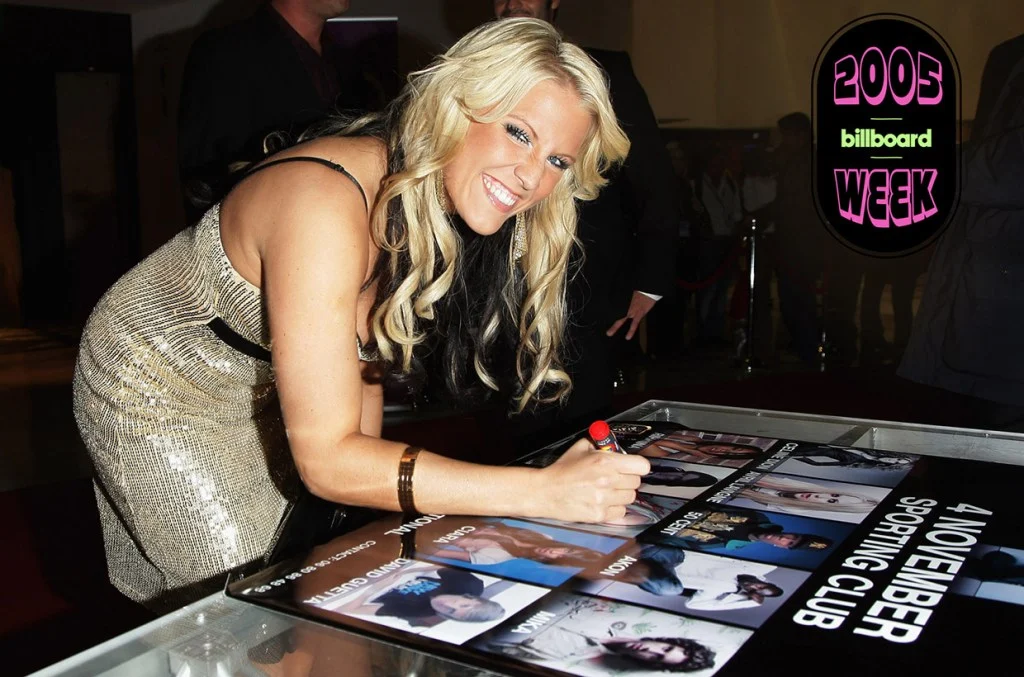
This week, Billboard is publishing a series of lists and articles celebrating the music of 20 years ago. Our 2005 Week continues here with a look at the unusual (and decades-spanning) path “Everytime We Touch” took to becoming a college basketball marching band jock jam.
What’s the connection between ‘80s Scottish folk singer-songwriter Maggie Reilly and Duke University athletics? Cascada’s 2005 Eurodance smash hit, “Everytime We Touch.”
20 years ago, German dance music group Cascada – then comprised of frontwoman Natalie Horler and producer-composers DJ Manian and DJ Yanou – found international success with “Everytime We Touch,” an advance single from their 2006 debut album of the same name.
Trending on Billboard
Before “Everytime,” Cascada scored European hits with “Bad Boy” and “Miracle,” the latter of which earned them a deal with American dance label Robbins Entertainment. After the U.S. release of “Miracle” failed to move the needle, the trio launched “Everytime We Touch” in August 2005. With American airwaves still dominated by sleek R&B/hip-hop fusions, pop-rock crowd-pleasers and Caribbean-flavored riddims, Robbins understood that breaking a Eurodance act in the U.S. would take some time. In fact, just two months before they released “Everytime,” Robbins earned a Billboard Hot 100 top 10 hit with Belgian dance group DHT’s cover of Roxette’s “Listen to Your Heart,” which they dropped back in 2003.
As “Everytime” slowly gained traction across dance music clubs and radio stations, the song debuted on the Hot 100 at No. 86 for the week dated Dec. 17, 2005. Curiously, America was the first country to embrace “Everytime” despite its Eurodance foundation being at complete odds with top 40’s dominant sounds at the time. To this day, Horler is still shocked at that initial reception.
“I know that ‘Everytime We Touch’ was quite out there for that time, especially in the States. Dance music just was not played on the radio much back then and generally wasn’t accepted as commercial music,” she tells Billboard. “Travelling to New York for the first time and getting into a cab — I think it was Z100 or KTU – and [hearing the song play] was quite an insane experience.”
By March 2006, the song reached its Hot 100 peak of No. 10, still Cascada’s best showing on Billboard’s marquee singles chart. According to Luminate, in the 20 years since its release, the song has sold over 2.9 million digital downloads and logged over 603 million official on-demand U.S. streams. Many of those streams likely came from Duke University’s Cameron Indoor Stadium during the NCAA men’s basketball season, where “Everytime We Touch” has emerged as a go-to anthem to galvanize the Cameron Crazies.
As “Touch” was making its way up the American charts, Duke marching band director Jeff Au was settling into his new job after previous band directing stints at Elizabeth City State University and Towson University. He got to Duke in June 2005, and for the last 20 years, his philosophy has remained “get suggestions from students, see what works for a band, write [an arrangement] and go from there.”
As with any good college tradition, the origins behind Duke’s adoption of the hi-NRG dance staple are a bit hazy — but the story goes that a group of students (or maybe just Greg Caiola, then a sophomore and the band’s secretary) suggested adding “Everytime” to the band’s repertoire during an officer meeting. Au tells Billboard that the first time he heard the song was when the students played it in that very meeting.
“I thought it could work; it wasn’t going to be something we did a big halftime production to, because it’s not that intricate,” he says of his initial reaction to the song. “But a catchy song, combined with the students’ love for it, is a sure way to sell me on something.”
Making good on his promise to incorporate students’ suggestions and nourishing the top 40 proclivities he teased with the prior year’s interpretation of Kelly Clarkson’s “Since U Been Gone,” Au quickly wrote an “Everytime” arrangement. Though “pretty spot on with the original,” Au’s version adds harmonies to the primary melody line and an ultimately unused woodwind section. He says it only took “three or four games” for the song to cement itself as a staple, and legend has it, that’s about how long it took for the accompanying student-crafted pseudo-choreography – dramatic slow claps during the verses and manic fist pumps during the chorus — to spread across the Cameron Crazies.
Several theories attempt to explain why “Everytime” stuck at Duke. Musically, the slow build of the song’s verses paired with its explosive choruses makes for the perfect soundtrack to the adrenaline-infused excitement that engulfs Cameron Indoor Stadium just before tip-off. What’s helped the song’s longevity at the school is that it isn’t tied to a specific moment, but rather a constant sensation that sometimes morphs from pre-game buzz to post-game victory. That feeling is borderline euphoric – the very phenomenon that inspired Maggie Reilly’s “Everytime We Touch,” the foremother of Cascada’s generational dance hit.
In 1992, Reilly ruled the European charts with her original “Touch,” the second single from Echoes, her debut solo album following several successful Mike Oldfield collaborations, including 1983’s “Moonlight Shadow.” Cascada’s version isn’t a straight cover, but it does lift Reilly’s entire chorus, which was inspired by the literal static shock she felt after hugging her boyfriend in an elevator at New York’s Mayflower Hotel — their first meeting in a long while.
“When somebody comes up with something new to add to [your song], it’s always quite exciting to hear,” reflects Reilly. “When I heard [Cascada’s version], it was very refreshing – and the video looked great as well. Within a very short period of time, I was told that it was doing amazingly in America for them, which was obviously exciting. It was like having a baby!”
With her legal team’s permission, Yanou and Manian, who both prefer to keep a low profile and are no longer a part of Cascada, interpolated Reilly’s chorus and wrote entirely new verses and production arrangements. Cascada’s rendition replaces Reilly’s yearning with decidedly more bombast, but the ecstatic feeling of connecting with a lover – whether on an elevator, dancefloor or basketball court – remains at the center.
“I get goosebumps every game, because I run our in-game experience for our men’s basketball program,” says Duke director of sports marketing Meagan Arce, “As the clock is ticking down and we get closer to me hitting the lights in Cameron, we play a [highlight reel] of past seasons, our fans and our students with ‘Everytime We Touch’ [in the background] and it’s one of my favorite moments of the game day experience. The song makes such a huge impact.”
Horler became aware of the song’s popularity at Duke “a few years ago” after getting tagged in videos on Twitter. Her manager explained to her Duke’s stature in the States, but she wouldn’t get a chance to connect with the school until 2020. For that year’s graduation, the university organized a virtual ensemble rendition of the song led by Horler and featuring members of the graduating class. “I had a lot of fun doing this during lockdown because, obviously, we weren’t very busy,” she reflects. “I thought they did such a great job. It was funny but also endearing. To use my song for that was pretty special.”
Now squarely a part of Duke tradition and lore – upperclassmen routinely pass the “Everytime” torch onto incoming freshmen – Cascada’s megahit has also become a foundational building block for any reputable nightclub playlist. In 2023, Billboard‘s staff honored it as one of the 500 Best Pop Songs of All Time (No. 211), and this week also named it the No. 8 Best Song of 2005. The song’s success – and that of follow-up Hot 100 hits, “What Hurts the Most” (No. 52) and “Evacuate the Dancefloor” (No. 25) — has allowed Cascada to embark on a fruitful career. The group’s first three LPs each reached the top 10 of Dance Albums, while Horler has successfully toured and played shows for the past two decades both with Cascada and as a soloist.
“I think music comes around again, and when you listen to ‘Everytime We Touch,’ you can actually [hear] those elements [like the synthesizer] coming out in modern music now,” says Horler. “It does not feel like 20 years — I’m still performing this song to this day!”

“My family lived in an American Idol household,” says Amanda Ibanez, who goes by Kiddo A.I.; specifically, Adam Lambert was the contestant who inspired her to pursue music. “I would get in front of the TV and sing and my brothers would make fun of me.” But her mother believed in her and encouraged her to get involved with a local church youth group, in which she would write songs and perform. The Miami native, now 28, began self-releasing her music as a teenager, but calls her career a “really slow climb.” A decade in, after meeting hit-maker JKash (Charlie Puth, Morgan Wallen), she started connecting with Los Angeles-based songwriters — and even crossed paths with Max Martin at one point.
Kiddo’s “zero to 100” moment came three years ago, when she worked with Selena Gomez on Rema’s “Calm Down” remix, which hit No. 3 on the Billboard Hot 100. “I used to watch her as a kid on Wizards of Waverly Place, so it was very full circle,” she says. That moment encouraged Kiddo to home in on songwriting for other artists instead of herself — “It’s less invasive,” she says with a laugh. Since then, she has worked on a number of pop hits, including several songs on Gomez and Benny Blanco’s collaborative album, I Said I Love You First, Le Sserafim’s “Crazy” and Tyla’s “Back to You.”
Trending on Billboard
Benny Blanco and Selena Gomez, “Sunset Blvd”
“It really came out of nowhere. I think Benny or [songwriter] Michael Pollack was playing the keys, and we all just started singing this hook melody,” Kiddo recalls of one of the standout songs on I Said I Love You First, which debuted at No. 1 on Top Album Sales. “I don’t remember who said ‘Sunset Blvd,’ but it just made so much sense because then Benny and Selena were like, ‘Wait, that’s where we had our first date.’ It was great to be able to help them say what they wanted to say. We wrote it in, I think, an hour. It basically wrote itself.”
Jennie, “Like Jennie”
“That was such a crazy day,” Kiddo says of working on one of the fiercer tracks from Blackpink member Jennie’s solo debut album, Ruby. “I went to Diplo’s house and he lives deep in Malibu, so it was an hour drive. I was working with [him and] Tayla Parx for the first time, so I was very nervous because I was such a fan of both of them. When we got there, we went through a couple of different tracks, but nothing made sense. Then Tayla and I were like, ‘We need something hard and just so in-your-face. This is Jennie’s song, right? So let’s make a song called “Like Jennie.” ’ Jennie freaked out. She loved it.”
Lisa, “Chill”
Kiddo worked on another Blackpink member’s solo debut album as well: Lisa’s Alter Ego. As she recalls, “I wrote [this one] with Ali Tamposi and John Byron. We actually came up with the hook before the session, and it just came so naturally.” She says that while Tamposi devised the title, they worked together on a couple of hook ideas before Kiddo had to go out of town. “Ali worked with Lisa to finish it, and it came out great. It’s one of my favorites on the album.”
This story appears in the April 19, 2025, issue of Billboard.

Submit questions about Billboard charts, as well as general music musings, to askbb@billboard.com.
Please include your first and last name, as well as your city, state and country, if outside the United States.
Or, reach out on Bluesky.
Let’s open the latest mailbag.
Hi Gary,
Here’s a sports angle that’s timely as Drake’s “Nokia” hits No. 2 on the latest Billboard Hot 100. In the song, he flirts, “Is that your bestie? Im’a ice both y’all like Gretzky.”
Fellow Canadian Wayne Gretzky, aka The Great One, held the National Hockey League record for the most regular-season goals scored — 894 — for 31 years. On April 6, Alex Ovechkin scored his 895th. With Gretzky, whose uniform No. 99 is retired league-wide, now at No. 2 in terms of that record, well, that’s a connection to Drake being at the Hot 100’s runner-up position.
Three other related stats, with “Nokia” at No. 2 and Kendrick Lamar and SZA’s “Luther” at No. 1:
Ovechkin’s nickname is Ovi. Drake co-founded the OVO Sounds imprint. (OVO stands for October’s Very Own; Drake was born in that month.)
Trending on Billboard
A drake is a male duck. Lamar’s full name is Kendrick Lamar Duckworth. Also can’t duck from this hockey history: The name of the NHL’s Anaheim Ducks originated from Disney’s 1992 movie about the sport, The Mighty Ducks. (You can double-check that on the web.)
Plus, despite their rivalry, both Lamar and Drake share incredible smiles. I’m guessing that neither lost any teeth due to playing hockey. I’m just trying to make hockey connections, this coming from someone who knows more about Shakespeare’s Puck, that mischievous muse from A Midsummer Night’s Dream, than a hockey puck.
Pablo NelsonOakland, Calif.
Hi Pablo,
You shot and scored with a look at how Drake and Gretzky are in some ways linemates. (Ovechkin, too. Notably, in the late 2000s/early ‘10s, the name that Nokia used for its software services? Ovi.)
Despite Gretzky now ranking second in NHL goals, he still leads for the most points – 2,857 – thanks to 1,963 assists along with his 894 goals. (Even without any goals, he’d have the most points; Jaromír Jágr ranks second with 1,921 points.) Somewhat similarly, Drake hasn’t notched the most Hot 100 No. 1s (with 13, he’s tied for the fourth-most), but he holds the marks for the most top 10s (80) and Hot 100 hits overall (358), through the April 19 chart, among other unprecedented feats.
Gretzky established the records for the most goals (92), assists (163) and points (215) in a single NHL season. He is also the only player with at least 200 points in a season, a milestone he achieved four times. On the Hot 100, Drake became the first soloist with at least 200 hits.
Meanwhile, Gretzky perhaps sensed his ties to Drake from the night that Drake was born. On Oct. 24, 1986, his Edmonton Oilers were 6 gods, as they beat the Boston Bruins, 6-2. Gretzky scored the winning goal, on the way to a hat trick.
Noted the Edmonton Journal the next day, “This was a night for shooting stars. And Gretzky’s the brightest.”
Also like Drake, Gretzky has even sung on a Hot 100 hit: He’s among the chorus (along with his wife, Janet) on the all-star charity single “Voices That Care,” which reached No. 11 in May 1991. It debuted on the chart dated that March 16, a day in which he showed off multiple talents: Then playing for the Los Angeles Kings, he tallied two assists, including on the game-winning goal over the Calgary Flames.
More record-holders on that record: Michael Jordan also contributed to “Voices That Care,” teaming Gretzky with the player with the highest NBA career scoring average (30.3 points).
Bringing things full circle (like a basketball or hockey puck, or a record or CD), Jordan in 2017 praised Drake. “Right now, I’m a Drake fan,” he told young attendees at his camp.
In March, Drake even boasted of outperforming Jordan — in sports! “I beat him at ping-pong a couple times, and he just wouldn’t leave the ping-pong table,” he shared of Jordan (with whom he has professionally partnered). “He kept just betting me, because he just couldn’t stomach the loss, you know? He’s definitely not a quitter. I respect him deeply for his gambling nature. So, yeah, I’d say Michael Jordan’s definitely one-of-one.”

At the dawn of the new millennium, Nortec Collective transformed the traditional sounds of northern Mexico into something entirely unheard of — a fusion of regional Mexican and electronic music that redefined a generation. Shorthand for “norteño” and “techno,” Nortec was culture rewired, fusing the bright accordions and brassy tubas of banda with driving techno and experimental beats. But what emerged wasn’t merely a genre — it was a sonic identity, a collision of past and future that encapsulated the spirit of Tijuana.
While Nortec Collective began as a collaborative effort of forward-thinking Baja California DJ/producers and visual artists, its global breakthrough was powered by the duo of Ramón Amezcua (Bostich) and Pepe Mogt (Fussible). With their boundary-pushing vision, Bostich + Fussible carried the sound, ethos, and imagery of Nortec beyond the Tijuana clubs and into Coachella (2001 and 2015), Cirque du Soleil, the 2011 Pan American Games, and events spanning Japan, Brazil, France, and Argentina. Along the way, they collaborated with icons like Morrissey, Beck, Tom Tom Club and Kraftwerk. Nortec Collective’s seminal album Tijuana Sessions, Vol. 3 (2005) earned them two Latin Grammy nominations.
Trending on Billboard
From the outset, Nortec’s work challenged conventions, subverting stereotypes of Mexican identity — like the outsider trope of the gun-slinging charro donning a weed plant shirt in a lawless Tijuana — while exploring new artistic terrain. Their influence hasn’t just resonated in music but across academia and art, sparking critical studies like Paso del Nortec: This is Tijuana! (2004), by Jose Manuel Valenzuela, and Nor-tec Rifa!: Electronic Dance Music from Tijuana to the World (2008) by Alejandro L. Madrid. Most recently, they’ve been the subject of a chapter in 2024’s Con sus charros cibernéticos: Un paseo por la música electrónica en México by Juan Antonio Vargas Barraza.
Nortec Collective
Courtesy of Nacional Records
Today, the ripple effects of Nortec’s inventive sound can be heard in the rise of electro corridos, a genre-blurring movement led by acts like Fuerza Regida (whose Jersey corridos album Pero No Te Enamores made waves), DannyLux (“House of Lux”), Codiciado (“Gabachas”), Grupo Marca Registrada, Luis R. Conriquez, and Los Esquiveles. Even this week, SoundCloud spotlighted the growing prominence of the movement among listeners, a testament to the enduring relevance of the fusion that Nortec originated.
Now, 25 years after the release of their first project as Bostich + Fussible, the pair continue to celebrate their legacy while adding new milestones. Last month, their single “Tijuana Sound Machine” from their Grammy-nominated 2008 album of the same name was certified double-platinum by AMPROFON in Mexico. With festival appearances this year at Vive Latino, Pa’l Norte, and Festival Arre, Nortec’s Bostich + Fussible continue to demonstrate the enduring resonance of their influence — not only for themselves but for the revolutionary fusion that changed how we hear and imagine Mexican music.
Below, the duo reflect on both their legacy and their place in contemporary music.
Fussible: Nortec started out as a collective back in ’99. Ramón and I had been making electronic music since the ’80s, experimenting with genres like industrial, breakbeats, EDM and house. Even though our paths were pretty different, in the mid-’90s we came up with an alias called Monitor, which leaned more toward experimental electronic stuff with a touch of breakbeat.
Neither Ramón nor I liked norteño or banda music because we grew up with different influences. It wasn’t because we had anything against that music — we’d hear it at family parties, and it’s very common in Tijuana. But when you grow up with electronic music coming across the border, whether through radio stations or record stores back then, our passion was electronic music — that’s what shaped our influences.
From there, I got my hands on some tapes of norteño music with snare drums and trumpets recorded by local bands. These groups made demos to land gigs in bars and nightclubs around Tijuana. They’d record covers of artists like Los Tigres, El Recodo, Intocable and even a norteño version of the Beatles in Spanish, all in their own style. While experimenting with mixing their recordings with ambient techno sounds, the track “Ventilador” was born, giving me the idea for an entirely new project.
Nortec Collective
Gregory Allen
At first, Ramón was a bit skeptical and thought it was a joke. I told him we could do something with it. More than anything, it was about searching for identity, an opportunity to create something different and shake things up, but only as a one-off project. Then Ramón released “Polaris,” followed by “Trip to Ensenada” [by Fussible] and “Tijuana Bass.” That set the foundation.
We had several musician friends in Tijuana who were making electronic music. We put out a call to see if they wanted to join in under the same concept and use the samples I had collected. However, many thought it was a joke or just weren’t interested. But a few with production experience jumped on board. We brought in Terrestre and Plantón from Ensenada, who had a strong background in advanced electronic music, jazz, and even rock. Then there were Hiperboreal and Panóptica, who were doing their own thing. Designers Jorge Verdín (Clorofila) and Fritz Torres also joined in, contributing to both the music and the visuals.
When we released our first tracks, a DJ from Tijuana named Tolo decided to use his budget, which was originally meant for house music on vinyl, and decided to fund the first Nortec vinyl. That’s how it all took off — with finished songs and a collective. It was the birth of the Nortec Collective.
Ramón and I had more material, so we dropped our first release, Bostich + Fussible Remixes, which came out on [the label] Opción Sónica in early 2000. That’s why the 25 years of Bostich + Fussible. The collective’s performances came to an end around 2006 or 2007, with one final show featuring everyone together. After that, each member went on to release their own albums individually. But Bostich and Fussible made a comeback with Tijuana Sound Machine in 2008. We kept creating more and found our formula for working and performing together.
We decided to create a story based on that car [featured on the album cover]. That’s when we came up with the trilogy about this mysterious car that you don’t know if it flies, smuggles undocumented immigrants or illegal goods, or maybe even traffics records. Its wheels are speakers, and inside there’s a norteño ghost. The design, created by Fritz, was also nominated for a Latin Grammy for best recording package.
Bostich: Each of our albums has reflected that [Tijuana] reality. In the beginning, the first Nortec cover, a digitized norteño, was very much tied to the concept of the music. It was a deconstruction through technology of a sound that was entirely regional and local. Even though norteño and banda music didn’t originate in Tijuana, it’s the music we grew up with in our city.
During the Tijuana Sound Machine era, Tijuana was an extremely violent city. It was necessary to keep your name out of phone directories to avoid being tracked or located. Many people left the city. There were a lot of kidnappings, and that reality was reflected in the themes of the albums, like “Retén” and “Akai 47.”
Bulevar 2000 (2010) is about a highway in our city that was built to support Tijuana’s growth but ended up becoming a place where many murders happened, with bodies wrapped in blankets being dumped there. Interestingly, when people Googled “Bulevar 2000” or on other search engines back then, all they found were stories about violent incidents. But when the Bulevar 2000 album was released, people started seeing the album or references to Nortec in the top search results. It was a complete shift and has changed so much since then.
Our latest album, De Sur a Norte (2022), reflects Today’s Tijuana, where the city no longer has its own distinct identity. Everything is so interconnected now. People listen to music from all over the world. You can go to Mérida, and folks there are listening to the same music we’re hearing in Tijuana — not just the sounds of guitars, trumpets, tubas and accordions, but also influences from other parts of the city. Pepe and I have tried to authentically capture our reality as Tijuana natives and what we’re experiencing today.
Tijuana, as a border city and a constantly changing place, has completely different sides to it. Every five to seven years, Tijuana isn’t the same city anymore. The Tijuana of ’99 and 2000, I can tell you, was industrial — it was a time of economic, social and political growth. There was also this new concept of globalization. Pepe and I were sharing our music in a very different way. Our first tracks on Napster were already among the most listened to, according to the creator of Napster himself when we met him. In fact, Nortec’s original slogan was “download is culture.” People would say, “Why are you giving music away? Why is it free? There won’t be any business; there won’t be anything.” But all of that was part of the vision of what was coming at the time — the era of downloads.
Nortec Collective
Courtesy of Nacional Records
The Rise of Electro Corridos
Bostich: We’re very aware that we’re not necessarily an influence on them [today’s acts in the genre]. It’s more a reflection of technology — an inevitable way of applying it to any type of music. Electronic music was bound to find its way into every musical style sooner or later. A few months ago, we played at Festival Arre in Mexico City, which focuses on regional Mexican music. Most of the crowd — 18, 20 years old — no longer wear cowboy hats or boots. We were a little nervous about how Nortec would be received, especially since Fuerza Regida performed right before us. The place was packed, with over 20,000 people.
And when they finished playing, the stage emptied out completely, and then we started. At first, there were maybe 50 to 100 people in front of us, tops. We thought, “Well, that’s it for us.” But then it filled up immediately, I think just like it did for the others. The most surprising thing was that the musicians from those bands stayed to watch us. They were off to the side, like, “Who are they? What are they doing? Why are they mixing this music?” We truly believe that the connection between the roots of Mexican music and electronic music was something inevitable — sooner or later, it was bound to happen.
“Tijuana Sound Machine” is included on The Story of Nacional Records, Vol. 1 limited edition double vinyl. The duo is slated to perform in Mexico City’s Pepsi Center on Aug. 30. They are currently working on new music.

I’m not trying to force my truth on anyone,” Little Simz says firmly. “But I do need to talk about it, for me.”
She’s referring to the shocking dissolution of one of her dearest friendships, which has played out publicly throughout the year. Four months after filing a lawsuit against longtime studio collaborator Dean “Inflo” Cover for allegedly failing to repay a 1.7 million pound loan (roughly $2.2 million), Simz is ready to lift the veil on her side of the implosion. Lotus, out June 6, is her reclamation manifesto — a sonic rendering about ownership of her story, music and confidence.
In the two-and-a-half years since No Thank You, Simz’ fifth studio album and follow-up to 2021’s career-changing Sometimes I Might Be Introvert — which won the 2022 Mercury Prize and scored Simz her first top five entry on the Official U.K. Albums chart — she comfortably settled in among U.K. hip-hop heavyweights, performing at the BAFTA Awards and the Glastonbury festival.
Since launching her career in 2015, Simz had worked closely with Grammy Award-nominated producer Inflo and his wife, acclaimed R&B singer Cleo Sol, frequently joining the couple for collaborations under their Sault moniker. Simz and Inflo met at St. Mary’s Youth Club as children, and the two went on to conquer the U.K. music industry in the years that followed, with Inflo producing three of her albums.
Trending on Billboard
But in December 2023, according to legal filings, Simz allegedly fronted over $1 million to launch Sault’s first and only live show, during which Inflo and Sol were joined by Simz and Grammy-nominated artist Michael Kiwanuka. But when the debt left her unable to pay her tax liability the next month, according to her filing, something broke inside the rapper.
“I got to a point where I lost my sense of purpose,” she says, carefully choosing her words. “I’m quite an introspective person, especially when it comes to my music. But this time around, it felt harder. Making this album felt like a real breakthrough. I was led by God, my inner child and the Simz that was coming up and had this fire in her belly.”
Lotus — which Simz introduced with the Miles Clinton James-helmed track “Flood” in February — peruses the full spectrum of her emotions throughout her journey to rebuild after one of her closest relationships ended. And on the rambunctious, bluesy album opener, which has yet to be released, she spits: “I’m lucky that I got out now, it’s a shame I really feel sorry for your wife … This person I’ve known my whole life, coming like a devil in disguise.” The song is downright irate — her intonation has rarely been this ferocious — and Simz understood that it was a gamble. “I was really frustrated and hurt, and I wanted to scream,” she says. “But it’s tricky starting off on that foot sometimes.”
To temper the album’s unrelenting moments, Simz explores other relationship dynamics. On one conversational track that feels like a leaked private phone call, she weighs the impact of work and celebrity on family; on a more uptempo cut, she lists the ways her understanding of love has evolved. With more guest stars than any of her previous projects, none of whom she’s ready to reveal, there are a lot of voices on the album, but Simz undoubtedly remains at the center.
Lotus, which she says sources its title from “one of the only flowers that thrive in muddy waters,” prioritizes Simz’ catharsis, but that’s not the only reason it’s such a hard-fought achievement. She tried to complete four other albums since the 2022 release of No Thank You, all to no avail.
“They were great, but it’s more the situation of who I made them with,” she says somewhat wistfully. “In letting go of that relationship, I had to let go of that music… It’s like having a kid with someone; you might split with the person, but you don’t just stop loving the kid.”
Even if those albums are never released, Simz has plenty on the horizon. She will curate London’s Meltdown Festival, taking place June 12-22, which will include her first orchestra-backed live performance. The 11-day undertaking will further cement Simz’ U.K. superstardom, while her U.S. crossover is still taking hold. (Last year, she made her Billboard Hot 100 debut thanks to her feature on Coldplay’s “We Pray,” which hit No. 87.)
Could Lotus be the album to land that jump? Now that Simz has finally regained the confidence to narrate her own story, it very well could be. “I feel like it’s growing slowly but surely,” she says, “and I feel really honored to be a voice from the U.K. that people are taking to.”
This story appears in the April 19, 2025, issue of Billboard.

Stevie Nicks is working on her first new solo album in 14 years. The legendary Fleetwood Mac singer and solo star shared the news during her induction into the Pollstar Hall of Fame on Wednesday (April 16). “I’m actually making a record right now,” Nicks said in her induction speech.
Explore
Explore
See latest videos, charts and news
See latest videos, charts and news
“I call it the ghost record. It just really kinda happened in the last couple of weeks because of, you know, the fires,” she said in seeming reference to the devastating Los Angeles wildfires earlier this year, during which she was displaced. “I was sitting in a hotel for 92 days, and at some point during that last part of the 92 days, I said, ‘You know what? I feel like I’m on the road, but there’s no shows. I’m just sitting here by myself because everybody else is at the house, doing all the remediations and everything, and it’s just me, sitting here.’ And I thought, ‘You need to go back to work.’ And I did.”
Nicks, who was inducted by longtime friend and former producer Jimmy Iovine, said she’s already written seven songs for the album, a follow-up to her seventh solo LP, 2011’s In Your Dreams. She described them as “autobiographical, real stories where I’m not pulling any punches for probably the first time in my life. They are not airy-fairy songs that you are wondering who they’re about but you don’t really get it. They’re real stories of memories of mine, of fantastic men!”
Trending on Billboard
Nicks, 76, recently announced a run of summer and fall solo shows she’ll embark on in between stadium gigs with old friend Billy Joel. The tour will kick off on Aug. 12 in Boston and include shows in Toronto, Saint Paul, MN, Cincinnati, Columbus, Tampa, Phoenix and Las Vegas before winding down in Oklahoma City on Oct. 15.
The news about new music comes seven months after Nicks dropped the moving single “The Lighthouse,” a women’s empowerment anthem inspired by the Supreme Court’s overturning of the landmark Roe v. Wade abortion ruling.
Watch Nicks discuss the album below.

Def Leppard and Mötley Crüe are teaming up for a hard rock destination festival in Riviera Maya, Mexico this winter. The legendary hard rock groups will set up shop from November 7-9 for the Rock the Tides fest, which will also include sets from Poison singer and solo performer Bret Michaels, Extreme, the Struts, Buckcherry, […]

The New Pornographers have “immediately” severed ties with drummer Joe Seiders after the longtime member of the rock collective was arrested in Palm Desert, CA for possession of child pornography.
Explore
Explore
See latest videos, charts and news
See latest videos, charts and news
According to a press release from the Riverside Sheriff’s office, Seiders was arrested after officers were dispatched to investigate a report of suspicious activity on April 7 at a Chick-Fil-A restaurant, where an 11-year-old boy told officers that an unknown man had recorded him on a cell phone while he was using the bathroom. Two days later, police said an employee at the same restaurant reported that the man was seen entering and exiting the restroom with juvenile males.
“Believing the male was the suspect from the previous incident, law enforcement was contacted. Upon arrival, deputies located the suspect, identified as 44-year-old Joseph Seiders of Palm Desert, and took him into custody,” read the release. After an investigation, officers served search warrants on Seiders’ residence, vehicle and cell phone, where they reportedly found evidence implicating Seiders in both incidents and “additional crimes,” which they said included possessing child pornography.
Seiders was booked into the John Benoit Detention Center in Indio, CA for possession of child pornography, annoying/molesting a child, invasion of privacy, and attempted invasion of privacy. At press time a spokesperson for the band had not returned Billboard‘s request for additional information on the incident.
In a statement on Instagram, the band wrote, “Everyone in the band is absolutely shocked, horrified and devastated by the news of the charges against Joe Seiders — and we have immediately severed all ties with him. Our hearts go out to everyone who has been impacted by his actions.”
Seiders joined the Canadian indie power pop supergroup — which formed in Vancouver in 1997 — in 2014, joining charter members singer Neko Case, singer/guitarist Carl Newman and bassist John Collins. He appeared on their 2017 album Whiteout Conditions, as well as 2019’s In the Morse Code of Brake Lights and 2023’s Continue as a Guest, as well as their recent single “Ballad of the Last Payphone.” The drummer is being held at the Larry D. Smith Correctional Facility with bail set at $1 million and is scheduled to make his first appearance in court on Tuesday (April 22).
Stories about sexual assault allegations can be traumatizing for survivors of sexual assault. If you or anyone you know needs support, you can reach out to the Rape, Abuse & Incest National Network (RAINN). The organization provides free, confidential support to sexual assault victims. Call RAINN’s National Sexual Assault Hotline (800.656.HOPE) or visit the anti-sexual violence organization’s website for more information.

Lady Gaga is seeing renewed success on Australia’s charts this week, as her latest album Mayhem rockets back into the ARIA Top 10 following her much-talked-about Coachella appearance and the ongoing rollout of her Australian stadium tour.
Explore
Explore
See latest videos, charts and news
See latest videos, charts and news
Mayhem climbs from No. 14 to No. 6 on the ARIA Albums Chart, boosted by the pop icon’s high-energy set at Coachella and a surge in demand tied to her recently announced Aussie tour dates. The album originally debuted at No. 1 last month, and this latest jump marks its fourth week in the chart’s upper echelon.
Earlier this month, Gaga announced her return to Australia with The Mayhem Ball, her first tour of the country in more than a decade—and her first stadium dates Down Under. After quickly selling out her initial shows in Melbourne, Brisbane and Sydney, a second Melbourne and Sydney date was added on April 16 due to overwhelming demand. The five-date run kicks off Dec. 5 at Marvel Stadium in Melbourne and wraps Dec. 13 at Accor Stadium in Sydney.
Trending on Billboard
The tour promotion, paired with Gaga’s Coachella performance and social media buzz, has sparked renewed interest in the Mayhem project. The album, led by the global No. 1 single “Die With a Smile” (with Bruno Mars), has spent multiple weeks in the Top 10 worldwide, including a 15-week reign atop the Billboard Global 200.
Gaga’s resurgence on the ARIA chart comes amid a strong week for Aussie acts: hip-hop trio Bliss n Eso debut at No. 1 with The Moon (The Light Side)—their fourth chart-topper—while Australian Idol winner Marshall Hamburger lands at No. 50 with The Idol Collection, marking the first time since 2009 that an Idol champ has entered the Top 50 upon season close.
Meanwhile, on the ARIA Singles Chart, Alex Warren notches a fourth consecutive week at No. 1 with viral hit “Ordinary,” and Gaga and Mars’ “Die With a Smile” rebounds into the Top 5, climbing from No. 9 to No. 4.
With Mayhem back in the Top 10 and her Australian stadium shows selling fast, Gaga’s momentum in the region is only continuing to build, with a final tour date added to Sydney earlier this week.