State Champ Radio
 gear
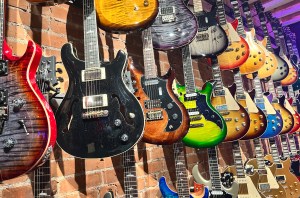
Round Hill Music, the name of the Josh Gruss-led, private-equity backed company with more than $1.1 billion in music assets under management, now adorns a physical music store in Greenwich, Conn.
The 1,100-square-foot outlet, which opened last month, hawks high-end guitars and amps as well as a healthy offering of vinyl and other merchandise in a store designed to appeal to the entire family, says Gruss, who is the store’s sole owner. In his day job, Gruss is the CEO of Round Hill Music, the music asset company that’s also a full-service music company which owns or represents rights in music written or performed by the likes of Bobby Darin, Brittany Howard, Gil Scott-Heron, Rob Thomas, Ashley Gorley, Bruce Cockburn, Massive Attack, Collective Soul, Skid Row, Craig Wiseman and Randy Bachman, according to the company’s website.
While the impetus may have been to open a guitar store, Gruss says he wanted it to have broad appeal for the whole family: “If parents come in with a son for a guitar, maybe mom will pick up a shirt or a candle. Another family had a 4-year-old daughter, and we had a kid guitar for her. While the main focus is the high-end guitars and amps, we have something for everybody.” Beyond the above items, the store’s inventory includes sunglasses, rock ’n’ roll t-shirts, hand-made jean jackets, art for sale and even an ashtray. But in the first few weeks of operation, the big eye-opener has been the strength of the record store component, says Gruss. The shop carries some 1,500 vinyl albums, all new — and that has turned out to be the surprise selling category. “Everyone loves music, and we all know vinyl has resurged in popularity,” says Gruss. While he says he was hoping that vinyl would be the secondary reason customers visited the store, “it turns out it’s the primary reason,” he reports. “So far, about 20% of our vinyl inventory is getting sold per week. So far, our No. 1 seller is a local jam band called Goose. Everyone comes in asking for them.”
Trending on Billboard
Round Hill Music Co.
Terry Moseley
In assembling the retail outlet, Gruss, who plays guitar in an original rock band called Rubikon and a cover band called Kaintuck, says he was inspired by memories from when he was younger. “My favorite thing to do as a kid was look at guitars in guitar stores, especially those on 48th Street,” he recalls, referencing the Manhattan block between 6th and 7th Avenues that, in the 1960s through the 1990s, was known as Music Row for the many musical instrument stores lining the street (the most famous being Manny’s Music).“Even today, when I travel to places like Stockholm and Paris, I check out guitar stores,” says Gruss. Over the years, he adds, “I built up an idea of what I like in a guitar store.”
It wasn’t until the COVID pandemic that Gruss decided to act on his vision. “It was during the height of COVID when I was going through town [and] I see the ‘for sale’ sign on this building,” he remembers. “With my contrarian hat on, I thought, maybe I can get a good price.” After buying the building, he set about planning for the guitar store, a category that Greenwich — although rich in various types of retail — lacked.
Round Hill Records
Terry Moseley
In conceptualizing the Round Hill Music store, Gruss explains he didn’t want it to focus on things you can find at Guitar Center, which he acknowledges as the dominant merchant of musical instruments and equipment in the U.S. As a result, he gave the store a high-end boutique slant, which, considering its location, makes sense: Greenwich is consistently ranked as one of the wealthiest communities in the U.S., with a median household income of $180,000 in 2021, according to the U.S. Census Bureau.
While there are many affordable and recognized guitar brands in the store, it also has more unique items. Case in point: a $20,000 replica of “Greeny,” a 1959 Les Paul Standard guitar named after its owner, Fleetwood Mac’s Peter Green, who sold it to Thin Lizzy’s Gary Moore and which eventually wound up with Metallica guitarist Kirk Hammett. Gruss says the store ordered the replica from the Gibson Custom shop, noting the company only made 50 as part of a limited-edition run.With guitars by Gibson, Fender, Paul Reed Smith, Taylor LsL Instruments, Ernie Ball, Rock N Roll Relics and Suhr, Gruss says he wants the store to be a haven for musicians and collectors as well as younger consumers, which is why it also carries guitars attractive to beginners. Beyond guitars, the store carries premium speakers from Devialet and Transparent and apparel by Madeworn, Daydreamer and Rowdy Sprout.
Beyond inventory, Gruss says he wanted Round Hill Music to have a different feel than Guitar Center. “We want our store to be as welcoming as possible and we want people to sit and play as much as possible,” he says. In contrast, he says Guitar Center can be intimidating for customers, with a sales staff that he believes measures whether people have money to buy a guitar and may require some kind of collateral if a customer wants to play one of the nicer models on the floor.Consequently, he says he wants the Round Hill Music store to be welcoming to all ages and hopes it will give young customers the opportunity to enjoy the same experience he had as a teenager at similar shops. He also expresses the hope that the store can be a place where music fans interact with one another.
Mike Stern Band
Ed Christman
To make sure the Round Hill store is correctly merchandised and boasts a welcoming atmosphere, Gruss says having the right staff is key, citing the “super knowledgeable” John Mahoney, who works as the store’s operations manager. He adds that his vision was carried out “by a great group of people” who previously worked in retail at other music instrument stores, including Sam Ash. In total, the store is currently staffed with six employees.At the store’s opening event, what Gruss sees as intrinsic to the store’s future success — an in-store stage — was put to good use by the Mike Stern Band, which played a high-energy set that left the crowd wanting more. “We will program the store with plenty of in-store artist events, including up-and-coming songwriters and local singer-songwriters,” Gruss says. Gruss points out that he’s also using the store to promote the Round Hill Music catalog business, noting that artists and songwriters in the music-asset company’s catalog have their own section in the shop; the inventory there includes albums by Soul Coughing, System Of A Down and Neon Trees. “The store is a great way to spread the Round Hill network,” he says. “It will really help out the rest of the business.”
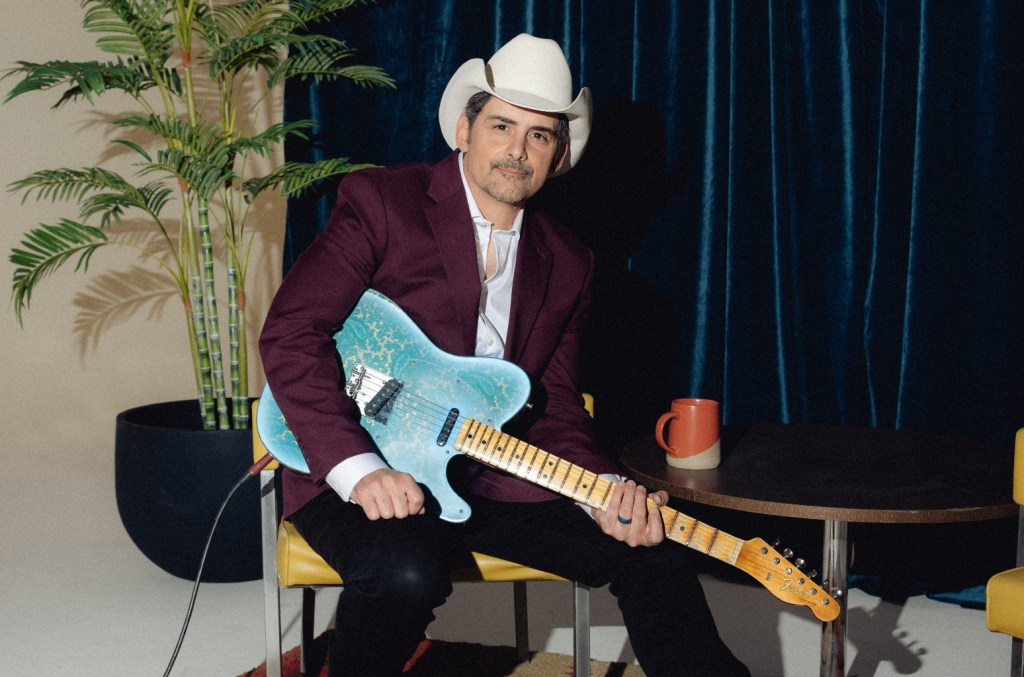
It’s a familiar pattern: paisley, to be specific about the visual; cutting and masculine, to identify the sonics.
A late-1960s version of the Telecaster guitar with that amoeba-like design and signature sound was particularly fascinating to Brad Paisley once he discovered that Fender had produced a line that matched his last name.
Now he has partnered with the company to create a limited-edition Brad Paisley 1967 “Lost Paisley” Telecaster, a select line of guitars that captures the vintage appearance and muscular tone of the instrument that was introduced to the market in 1968.
“There’s some magic involved in getting these things to feel old again and new again,” Paisley says in a small room on the second floor of Fender’s East Nashville building. “We had to really figure out what was it that made these things so cool. They are a unique moment — like, why in the hell Fender ever thought it was a good idea to make Paisley Telecasters? And then here I come, born with the strangest last name.”
The Tele was already legendary before Paisley’s national arrival, associated with the likes of Keith Richards, Vince Gill, Muddy Waters and Nashville studio veteran Brent Mason, who contributed key licks to recordings by Alan Jackson, Brooks & Dunn, George Strait and Lee Ann Womack. Country Music Hall of Fame member James Burton gave the Paisley Tele a high profile when he started playing a red model during Elvis Presley‘s concerts.
Trending on Billboard
“They became cool,” Paisley says. “Otherwise, I am Brad Plaid. I’d have had to change my name by the time I had a deal. [There’s] nothing cool about Paisley, but it was, luckily, cool thanks to James.”
The sound is cool, but there’s something nerdy about making guitars. And Paisley celebrated the retro instrument line by performing a short set at Fender for an invitation-only crowd of insiders and fellow nerds, including Steve Wariner, who joined Paisley’s band for a rollicking, extended version of “Workin’ Man Blues.”
Paisley’s guitar project owes its reemergence to one of the nerds attending that day. Canadian broadcaster Alan Cross spotted a Craigslist ad for an ammo case of blue Cling-Foil, the adhesive wrap Fender used on the Paisley Tele back in the day. Cross talked the seller from $50 down to $25 — and, to keep peace at home, told his wife he’d only paid $20 for the material.
Once that foil got into Fender’s hands, the company had the opportunity to re-create the line, and Paisley worked hand in hand with Ask Zac YouTube host Zac Childs, Glaser Instruments owner Joe Glaser and the Fender team to learn the nuances of the Paisley Telecaster production process: assembling the neck, body and pickups; applying the paper wrinkle-free; and covering it with a sleek finish.
“The finish is a key element,” Paisley says. “It’s not just the look of it. It does change everything about how it responds. So it’s really great that they were willing to sort of go down the rabbit hole with me. We’ve worked on this for a year now, trying to get it exactly right.”
In recognition of the Lost Paisley’s 1967 model year, Fender will produce 67 guitars through its Custom Shop in Corona, Calif., pricing them at $7,000. Paisley will manufacture 19 pieces with the Fender Nashville team, videoing the assembly and playing each guitar, providing its future owner an assessment of that guitar’s particular strengths and weaknesses. He’ll burn the neck of each of them with a cigar to simulate the abuse they take onstage, and the cigar label will be pasted inside the guitar cavity.
“I’m going to have time-lapse cameras set up,” Paisley explains. “As I paint each one, I will hold up the number, you’ll see me [build] it, you’ll get a little video, and then I’ll tell you what I think of it. I’ll play it once it’s assembled. They get a guitar with its birth [documented], and then a lot of case candy, the really fun stuff, too. There’s all these cool old campaigns and bumper stickers and things they did in the ’60s with Fender. They had these buttons that said, ‘Fender Lovin’ Care,’ and they had the ‘Peace, Love’ bumper sticker. Your case will be covered.”
Paisley is covering plenty of other bases as well. For starters, with the economy poised for a likely downturn, The Store — a referral-only grocery store for financially struggling Nashvillians that he co-founded with his wife, actress Kimberly Williams-Paisley — is expected to experience greater demand at a time when a portion of its donors are tightening their belts.
“It’s going to be probably a really important thing for people that didn’t expect to need it coming up, based on what things look like,” Paisley predicts. “There’s funding that went away, but at the same time, we are in a really generous town. I knew this when we decided to try this idea. There are really generous people here, and there are generous people outside of Nashville that know about it, that are committed to helping us in a lot of ways, so it’s not easy right now, but it definitely keeps me sane.”
Meanwhile, he’s optimistic about changes at Music Corporation of America, formerly Universal Music Group Nashville. UMGN chair/CEO Cindy Mabe, who was key in bringing Paisley to the label, left the company. New MCA chief creative officer Dave Cobb and senior vp of A&R Austin Jenkins successfully quelled any apprehensions about the turnover.
“New regimes at labels, which I’ve dealt with three or four times in the course of my career, can make it very clear right away whether or not they get you,” Paisley notes. “These guys have really done a great job of being like, ‘We get you, and we want to empower you to be who you want to be.’ And I’m thrilled so far.”
Paisley was prepared for the new leadership to present a game plan that might not resonate with him. Instead, the team came in with questions.
“They were like, ‘Will you play us some stuff? Will you talk to us and give us an idea of what you have, and what you are in your mind, and what you want to be?’ ” he says. “Then they came up with ideas, sitting there with me, that I went, ‘Oh, I love that.’ The next thing you know, we have days on the calendar now based on one idea in a meeting. So I’m really hopeful that this is a good thing.”
The Paisley pattern is set for its next chapter, whether it’s for the Fender guitar, the artist or both.

Marshall Amplification, known for furnishing amps to a who’s who of rock stars, is being acquired by the Swedish tech company Zound Industries, Zound announced on Thursday (March 30). Zound had previously licensed the Marshall name for more than a decade and helped spread it around the world through popular headphones and speakers.
The new combined company will be dubbed the Marshall Group. Zound’s press release trumpeted that “on day one, Marshall Group revenues will be over $360 million with double-digit profitability.”
“Combining our strengths and unique positioning… will fuel our ambition to create premium, innovative, products and experiences for musicians and music lovers around the world,” Zound CEO Jeremy de Maillard said in a statement. “Zound has proven itself as a global, fast growing, and progressive company. With the Marshall Group, we are set to accelerate our profitable growth in a $100 billion market.”
“I am proud that this deal has finally been completed,” added Konrad Bergström, founder and board member of Zound Industries until 2018. “The success that we have achieved with the Marshall brand over recent years is soon going to be seen as having been the warm-up to a new British-Swedish headline act that is going to shake the tech and music industries to their foundations.”
Jim Marshall and his son Terry created the first Marshall amp in 1962, and the gear was subsequently popularized by rockers like Jimi Hendrix and The Who. “We have always looked for ways to deliver the pioneering Marshall sound to music lovers of all backgrounds and music tastes across the world,” Terry Marshall said in a statement. “I’m confident that the Marshall Group will elevate this mission and spur the love for the Marshall brand.”
The Marshall Family will be the largest shareholder of the Marshall Group, holding on to 24%.
Zound first started licensing the Marshall name back in 2010. “We brought the Marshall brand to over 90 countries through the headphones and the speakers,” de Maillard told The Verge. “So it became a much more known brand by the masses than it was before. Before it was the in-the-know, the musicians, people who were really into music who knew about the brand. But through this partnership, we’ve managed to touch a lot more people.”
“We’re very complementary to each other and this deal will enable us to bring together the full range of products and the entire consumer experience under one roof,” de Maillard added in a separate interview with Forbes. “It will allow us to be quicker with innovation and to have a deeper and more holistic connection with musicians and music lovers.”
-
Pages