State Champ Radio
 female record producers
Trending on Billboard
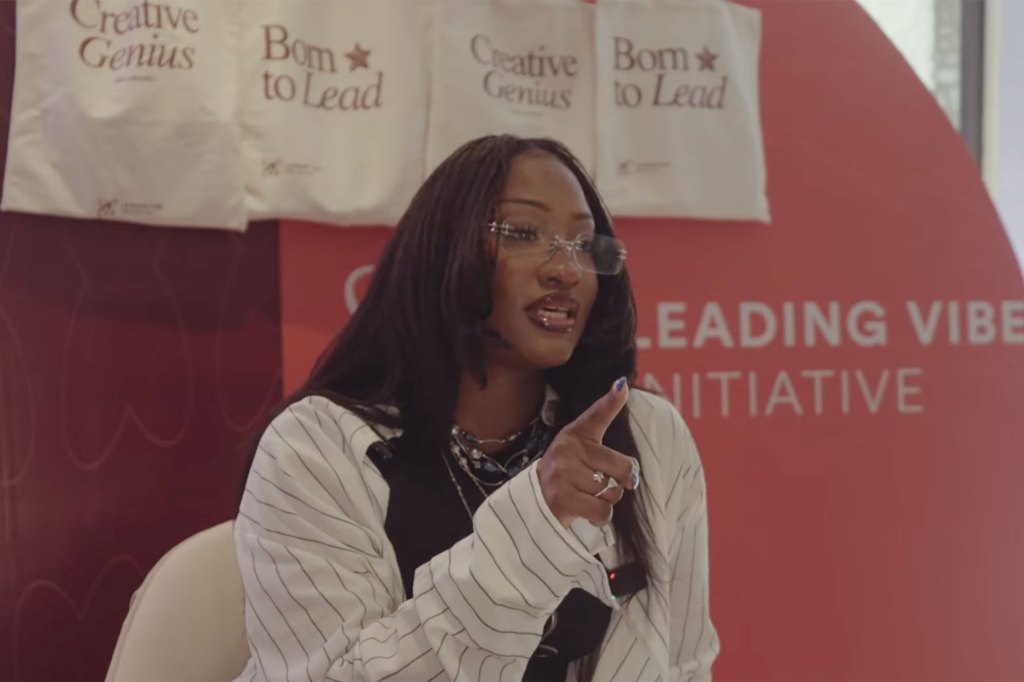
Tems‘ Leading Vibe Initiative and Native Instruments released a mini documentary on Thursday (Nov. 6) that follows three female producers in Lagos, Nigeria.
The 72 Hours in Lagos doc follows Saszy Afroshii, TinyBraz and Gbots around the “chaotic” city (as all three women, plus Tems, individually describe the hub) during the inaugural edition of the Leading Vibe Initiative, which “aims to support, connect and amplify the next generation of women in music,” according to the doc. Native Instruments contributes training, mentorship and industry-leading software and hardware. Tems is also on the Native Instruments artist board, a collective that also includes Alicia Keys, Noah “40” Shebib, Jacob Collier and Ludwig Goransson, among others.
Saszy Afroshii, who’s produced for Fave, Qing Madi and Tiwa Savage, says inspiration strikes anywhere in the midst of Lagos’ hustle and bustle, but opportunities aren’t always that easy to find. “I think it’s very important for females to support each other. This is an industry that is occupied by males and people think, ‘Ok, this is just a man’s world.’ When you walk into a session and they’re like, ‘So where’s the producer?’ And you’re like, ‘Hi! I’m here,’” she said. “It’s just trying to shift the mindset of people. Having to go the extra mile because sometimes they don’t give you as much opportunities. So it’s very, very good when you see a female doing something that people really thought, ‘Oh, maybe she can do it.’”
In her Billboard cover story earlier this year, Tems said she taught herself to produce and engineer her own music through YouTube tutorials while studying economics at IIE MSA in Johannesburg, South Africa. “Learning how to produce definitely made me solidify my sound because usually, you have a producer that gives you a beat and you have to go on the beat. But being a producer myself, it’s more authentic now. The music became more genuine and more true to me and more distinctive,” the Grammy-winning star said in the doc.
Tems launched the Leading Vibe Initiative this past August, which Billboard exclusively announced. She hosted a two-day seminar for approximately 20 women to gain hands-on training, access to world-class tools and connections to industry executives and creatives through a series of workshops, masterclasses and panel discussions. She also launched the Leading Vibe Initiative in Nairobi, Kenya in September.
Singer-songwriter TinyBraz (who’s also a DJ/producer known as Purple Halo) echoed Tems’ sentiments about authenticity, describing it as the core message behind the Leading Vibe Initiative. “That really cut deep to me because as an artist, you can tell I’m kind of androgynous. I’m in between being girly and being masculine. The label I was in really wanted me to be on that girly side. And to be honest, it wasn’t what I was feeling,” she explained. “I just wanted to find myself again because they were basically imposing their idea of what they think a female artist should be on me, and I didn’t want that. Hearing Tems say, ‘You have to double down on what you believe in’ made me realize that it was a good decision for me to say, ‘I don’t want to do this anymore with you guys. I want to go on my own. I want to be independent and find my way.’”
TinyBraz took the cameras from her current makeshift studio to her former apartment, which she called “Purple Island” “because it’s a creative space. It’s a space where I truly found the people that I was meant to align with,” such as dancers, graphic designers, engineers and artists, she explained.
Gbots, who’s worked with Olamide, CKay and P. Prime, described herself as “an outlier” because “I noticed I was one of the fewest female music producers. At that time, I even thought I was the only one making music.” In 2022, she founded the female music community, We Are ProducHERS. “Female music producers and artists and songwriters should just have a place and a safe space where they feel like because you can do it, I can do it,” she added.
Watch 72 Hours in Lagos below.
Trending on Billboard
We Are Moving the Needle, a nonprofit dedicated to closing the gender gap in the music industry, has announced the return of the Resonator Awards on Jan. 27 at Henson Studios in Los Angeles. The inaugural edition of the event was held in 2024, but the planned 2025 edition was not held due to the Los Angeles-area wildfires.
A kickoff to Grammy week, the 2026 Resonator Awards will showcase the contributions of women producers, engineers, and creators behind-the-board and will include an awards ceremony and live performances.
Related
Funds raised from the event will go to We Are Moving The Needle, a nonprofit founded by Grammy-winning mastering engineer Emily Lazar. The organization seeks to empower women and non-binary producers, engineers, and creators to succeed through scholarships and grants, mentorship, research, advocacy, and community events.
“When I founded We Are Moving The Needle, it was born from a simple belief: music should sound like the world we live in,” Lazar said in a statement. “Every voice, every story, every sound. The Resonator Awards honor the ones who’ve kicked that door down and challenge us all to keep it open.”
Lazar made history in 2019 as the first female mastering engineer to win a Grammy for best engineered album, non-classical for Beck’s Colors. Two years later, she made history again as the first mastering engineer to land three album of the year nominations in the same year for her contributions to HAIM’s Women in Music, Vol. III, Coldplay’s Everyday Life and Jacob Collier’s Djesse Vol. 3. She has also received Grammy nods over the years for work with Foo Fighters, Vampire Weekend, Sia and The Bird and the Bee, as well as on Collier’s follow-up album, Djesse Vol. 4.
Lazar founded We Are Moving The Needle in 2021. The organization has awarded more than $875,000 in scholarships to creators to attend audio education programs globally and supports more than 20 chapters on college campuses. Every scholarship recipient receives tools, gear, guidance, and mentorship from their soundboard, a community of top artists, producers, engineers and industry leaders, including HAIM, Brittany Howard, Leslie Ann Jones, Brandi Carlile, Shirley Halperin, Jenna Andrews and Molly Neuman.
Jenny Eliscu hosted the inaugural Resonator Awards, which were held during Grammy Week 2024. Honorees in attendance included Alanis Morissette, Corinne Bailey Rae, Caroline Polachek, Catherine Marks, Laura Sisk, Jennifer Decilveo, Michael Goldstone and Christine Thomas. Inaugural Hall of Fame inductees included Alicia Keys and Linda Perry.

Only nine women have received Grammy nominations for producer of the year, non-classical in the 49 years the Recording Academy has presented that award. Despite that tepid track record, you might want to bet on Brandi Carlile to be in the running when the nominations in that category are announced later this year. It will be the category’s 50th year.
Carlile produced Brandy Clark’s eponymous album, which was released May 19, and reteamed with Shooter Jennings to co-produce Tanya Tucker’s Sweet Western Sound, which is due June 2. That album is Tucker’s long-awaited follow-up to While I’m Livin’. Carlile and Jennings won Grammys as producers of While I’m Livin’, which was voted best country album.
No woman has been nominated for producer of the year, non-classical since Linda Perry five years ago. And no woman has ever won in the category, either on her own or as part of a collaboration.
The women who have been nominated for producer of the year, non-classical are Wendy Melvoin and Lisa Coleman (of Prince & the Revolution, 1984); Janet Jackson (alongside Jimmy Jam and Terry Lewis, 1989); Mariah Carey (alongside Walter Afanasieff, 1991); Paula Cole (1997); Sheryl Crow (1998); Lauryn Hill (1998); Lauren Christy (of The Matrix, 2003); and Perry (2018).
It’s a very different story in the producer of the year, classical category. Three women have won in that category, which was introduced five years after producer of the year, non-classical. And one of those women, Judith Sherman, has won seven times, which puts her in a tie with David Frost, Steven Epstein and Robert Woods for the most wins by anyone in the category’s history. Joanna Nickrenz has won twice (once alongside Marc Aubort). Elaine Martone has won once.
Carlile has become a Grammy darling in recent years. She has won nine Grammys, including three at the 65th Annual Grammy Awards in March. She produced her eponymous 2005 debut album, and co-produced her fourth album in 2012, but the rest of her studio albums have been produced by others.
Carlile moved into production for other artists with The Secret Sisters’ You Don’t Own Me Anymore (2017) and Saturn Return (2020). She co-produced both albums with Tim and Phil Hanseroth, with whom she also co-produced the 2017 Various Artists album Cover Stories. Carlile teamed with Dave Cobb to produce Lucius’ 2022 album Second Nature.
In an interview with Billboard’s Jessica Nicholson, Clark praised Carlile’s skills as a producer. “She pushed me a lot,” Clark said. “I’ve never been as challenged by a producer as I was by her.”
Clark noted Carlisle’s approach to narrowing down the songs that ultimately make up the album: “I gave her like 18-24 songs and asked her to pick about a dozen. I liked them all, but I was surprised by some of her choices. She told me, ‘I chose the songs that I thought sounded like you wrote them in your bedroom, and not in the writing room.’”
That’s the kind of sound advice that shows what a good producer can do.
-
Pages