State Champ Radio
 comedy
Page: 3
Trending on Billboard
if ( !window.pmc.harmony?.isEventAdScheduledTime() ) {
pmcCnx.cmd.push(function() {
pmcCnx({
settings: {
plugins: {
pmcAtlasMG: {
iabPlcmt: 2,
}
}
},
playerId: ‘4057afa6-846b-4276-bc63-a9cf3a8aa1ed’,
playlistId: ‘b7dab6e5-7a62-4df1-b1f4-3cfa99eea709’,
}).render(“connatix_contextual_player_div”);
});
} else {
// This should only be get called when page cache is not cleared and it’s event time.
window.pmc.harmony?.switchToHarmonyPlayer();
}
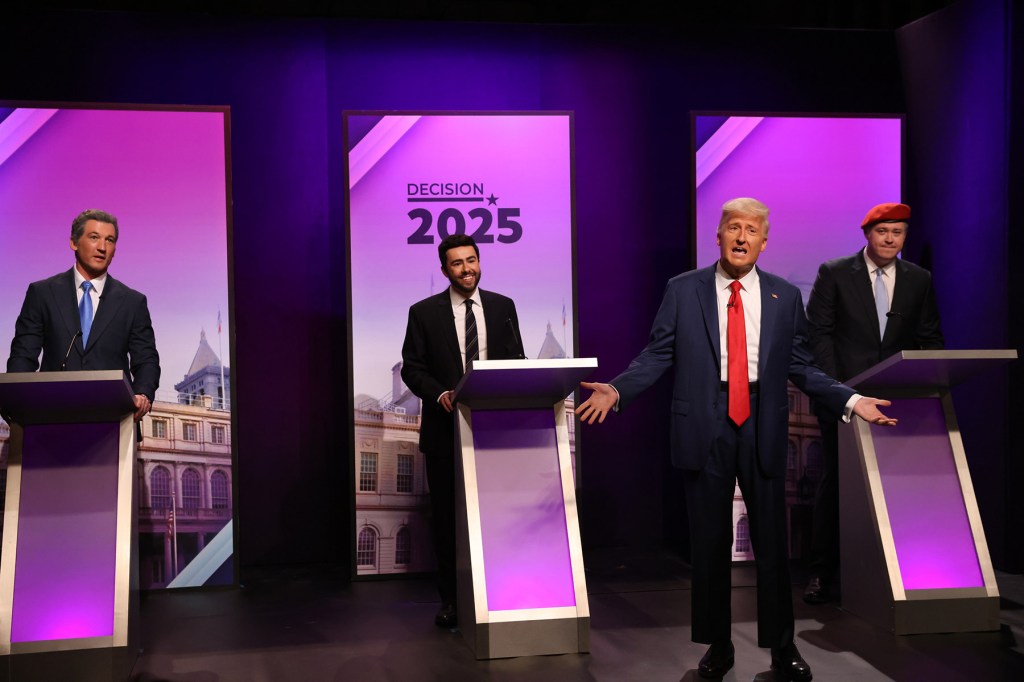
This star-studded sketch is a mini masterpiece that delivers on both a local and national level, and it’s all the better for not wearing its politics on its sleeve. Each of New York’s mayoral candidates — independent Andrew Cuomo (Teller), Democrat Zohran Mamdani (Youssef) and Republican Curtis Sliwa (Gillis) — as well as the city’s current mayor, Eric Adams (Patterson) get their own turn on the spit of this perceptive satire.
Cuomo: “I got us through Covid, and then, yada, yada, yada, honk-honk, squeeze-squeeze,” he says, a reference to the sexual harassment allegations that dog him.
Sliwa: “I’m the only candidate here who’s been dangled by my testicles off the Verrazano Bridge by a little-known gang called The Lords of Flatbush. I was also poured into the foundation of Giants Stadium and crawled my way out. And just on my way here, I was ejaculated upon at the great Stardust Diner by a Times Square Spider-Man.”
For anyone under 60, The Lords of Flatbush was a 1974 film about a motorcycle gang that starred Henry Winkler, Sylvester Stallone and Paul Jabara, and featured a scene that resembles the dangling described by Gillis. Sliwa, who is also the founder of the volunteer crime protection group, the Guardian Angels, was abducted and shot in a cab in 1992 after Gambino crime family boss John Gotti put a hit out on him, has, more recently claimed unverified threats against his life because of his refusal to drop out of the race.
Mamdani: “I’m ready to spend the next hour hearing my opponents pronounce my name in ways you couldn’t begin to imagine. And I know some of you out there are scared of the idea of a young, socialist Muslim mayor. So, allow me to put you at ease by smiling after every answer in a way that hurts my face.” (Youssef, who has one of the best high-beam smiles in show business, is the ideal man for the job.)
And in another response: “I want to be mayor so I can deliver a better New York. Free healthcare, affordable housing, free WiFi,” Youssef as Mamdani says. “As mayor, can I make that happen? I’m not sure yet. But together we’re going to find out… that the answer is no.”
The butchering of Mamdani’s name alone is pretty spectacular here: Gillis as Sliwa calls him “Zoltar Rob Zombie” and Patterson as Adams refers to him as “Zorgon Mamagrama.”
There are also plenty of inside jokes for New Yorkers, such as the debate sponsors: One is the Gristedes supermarket chain, which is owned by billionaire Republican John Catsimatidis, who was pressuring Sliwa to drop out of the race. Others include the latest bane of the city’s pedestrians: bike lanes. (“You want a new way to die? Step into a bike lane,” says Thompson as the debate moderator.)
There are so many jokes in this sketch — which lasts just over 9 minutes — that it bears repeated watching, and Johnson-as-Trump makes an appearance near the end as the answer to the question posed to the candidates: “What is the biggest problem you have to confront as mayor?” Promising to be “very hands on,” Trump motions to Cuomo and says, “This guy knows about hands on, right, Cuomo?”
Wait, there’s more! The sketch ends with Trump performing “The Music of the Night” from the Broadway hit, The Phantom of the Opera. And godd–n, Johnson can carry a tune.
Trending on Billboard
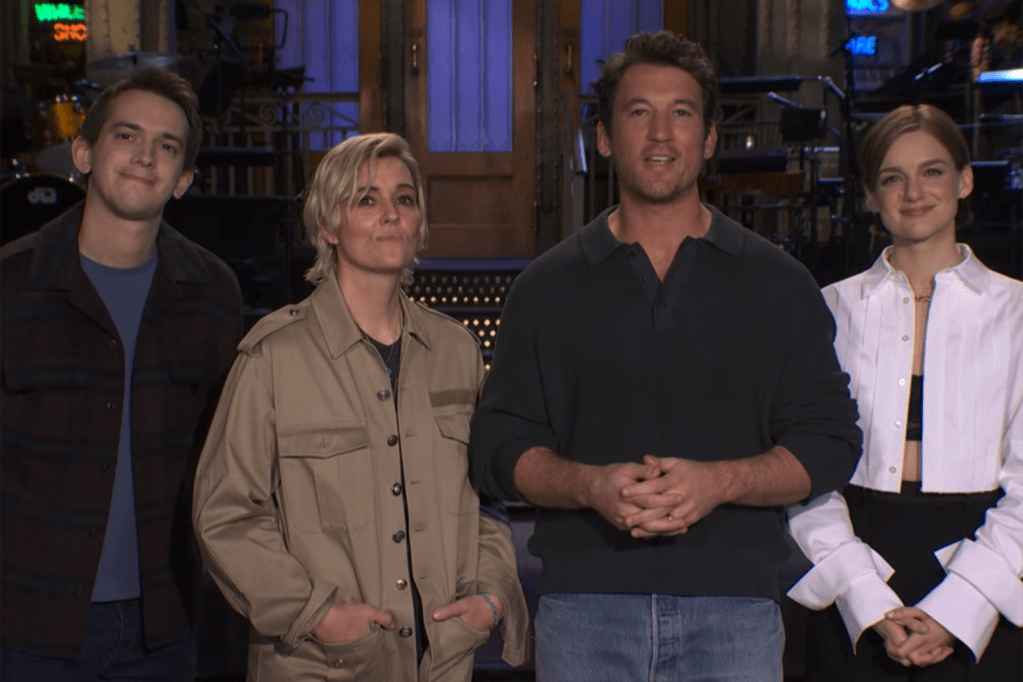
If Ashley Padilla has anything to say about it, Brandi Carlile will host this weekend’s Saturday Night Live instead of Miles Teller.
In just-released promos for this weekend’s episode, Padilla brings up her brand-new haircut — and she explodes on Teller for not noticing. “I got a haircut, and you haven’t said anything about it!” Padilla yells at the Top Gun: Maverick actor. “Yeah, sorry, I think I didn’t notice, Ashley, because we’ve never met before,” Teller responds.
But guess who did notice? Eleven-time Grammy-winning singer/songwriter Brandi Carlile. “I noticed. The second I saw you, I knew you had that new-haircut glow,” Carlile says. “Thank you, Brandi Carlile! You’re the host now,” Padilla says matter-of-factly, to which Carlile celebrates with a “Yesssss.”
“She’s joking, right?” Teller asks. But Dismukes assures the actor she’s dead serious. “I hope you can sing,” she threatens, and Teller gives a shrug: “I can sing.” (We know that at least Keith Urban agrees: Back in 2016, the country star invited Teller onstage to duet on The Temptations’ “My Girl” during an Albuquerque, New Mexico, concert.)
Watch all the new promos below:
Saturday’s episode will mark Carlile’s fourth time as a musical guest on SNL — and her second time this year. She joined Elton John on the stage back in April to perform songs from their joint album Who Believes in Angels? This time around, she’s promoting her just-released solo album Returning to Myself.
This will be Teller’s second hosting gig after he made his debut in 2022. He’s hitting the show ahead of the premiere of his sci-fi rom-com Eternity, co-starring Elizabeth Olsen and Callum Turner, which arrives Nov. 26 in theaters.
Saturday Night Live airs at 11:30 p.m. ET/8:30 p.m. PT on NBC and streams on Peacock. (See all the options to watch SNL here.)
Trending on Billboard Earlier today (Oct. 29), Billboard published the September Boxscore report, with Chris Brown repeating as the biggest touring act of the month. But while the biggest stars of rock, hip-hop and more packed stadiums, comedians were road warrior-ing their way to sold-out theaters and arenas. Here, we’re looking at the five biggest […]
Trending on Billboard
“I love to laugh. I love the feeling of it,” says Ryan Bitzer — and since 2016, he and Damion Greiman, have turned their mutual fondness for funny into a multi-format comedy powerhouse that works with the top names in stand-up. The co-founders, who started the company in 2016, estimate it currently generates just under $10 million in gross profits annually, and serves 2.3 million followers and 20 milion comedy fans monthly across its five YouTube channels and social media platforms. The Nashville-based company, which also operates an international division in London, initially worked with stand-up comedians to produce, distribute and market their audio recordings and specials to larger audiences, including such hit YouTube projects as Mark Normand’s Out to Lunch and Matt Rife’s Only Fans, as well as specials for major streamers. They include Leanne Morgan’s I’m Every Woman on Netflix and Sean Patton’s Number One on Peacock. Distribution partners include Kevin Hart’s Laugh Out Loud Network, Bill Burr & Al Madrigal’s All Things Comedy, and its own legacy label, Clown Jewels, which has released works from legends like Lucille Ball, Robin Williams, Gilbert Gottfried, The Smothers Brothers and Bob Newhart. The company is now venturing into producing scripted and unscripted movies, TV shows and documentaries. It announces new content weekly for such comics as Iliza Shlesinger, Fortune Feimster, David Spade, John Crist and Russell Peters; works with Nate Bargatze’s multimedia platform Nateland, and is a producer on the Marc Maron documentary Are We Good? 800 Pound Gorilla has also built a profitable pipeline to spotlight international comedians via its Comedy Exports YouTube channel, and earlier this month, announced that it will begin dubbing content by Rife, Anjelah Johnson-Reyes and Michael Yo in Spanish and French and releasing it on that channel as well. Early in their careers, Bitzer, who mainly handles 800 Pound Gorilla’s business affairs, and Greiman, who focuses on creative development, worked in country music — both in artist management, and Greiman, at Outback Presents, a leading promoter of country music and comedy tours.
Explore
See latest videos, charts and news
They, along with director of marketing Amanda Zuckerman, who runs point on 800 Pound Gorilla’s marketing, publicity, YouTube engagement and digital strategy, sat for a conversation with Billboard about the company’s growth, the burgeoning popularity of international comics and their methods for building comics’ fan bases. Damion and Ryan, you both come out of country music. Do you think there’s a connection between that genre and comedy?
Damion Greiman: It’s a little bit different for Ryan than it is for myself. I came from Outback Presents. We did country music concerts, but we also did a lot of comedy. We started the Blue Collar Comedy Tour, and my boss at the time, Mike Smardak, started Outback Concerts, and that company became known as the go-to company for comedy. We had other guys focused on rock shows, country shows, different types of concerts, but I gravitated to the comedy side which then led to management, which led to us starting this.
Ryan Bitzer: I was working in music artist management for, I think, 15 years. It was a lot of fun, don’t get me wrong. But one of the things about managing at that time was you weren’t as in control of your artist’s career as you can be now. There were gatekeepers along the way, and if someone wasn’t feeling it, it was, “Sorry,” and two or three years of work that you had put into something shut down overnight. Over here in comedy, it’s such a blue ocean for us because if we get behind our artists, we can elevate their careers. The work you put in, you get out.
When you say gatekeepers, can you be more specific?
Bitzer: In country music, for example, radio drives that business. You could have everything lined up — the right artist, a hit songwriter, someone who’s been on Broadway for eight years and well-polished —doing the rounds, and if the program director says, “We’re not feeling this today,” it’s like, “What do you mean? It’s working.” You do that enough times, and you just lose your zest. It’s been so much fun over here because we can put that same amount of energy into these artists and have a real impact. I’m guessing that a lot to do with Amanda and your digital strategy?
Bitzer: You got it. Post-pandemic we saw a lot of comedians blow up from their socials — like Matt Rife. Amanda, how did that strategy evolve?
Amanda Zuckerman: That’s a great example to start with. I’ve been at the company for a little over eight years now. Our pivot to video and how we handle clips on socials and position these specials in front of the audience online happened around that time. There’s a debate about what’s more important for breaking and maintaining a stand-up career: touring vs. social media. What’s your take?
Zuckerman: I would say touring is really important. Where we come in is helping to position their special online and drive that discoverability across all platforms to feed the touring and funnel back to ticket sales.
Bitzer: You can work things backwards so if someone blows up socially, depending on their art and their work ethic, they can make it work in the club. But [success as a live performer] takes a while. Whereas, if you take a Chad Daniels — someone who’s been touring for close to two decades —by the time he gets to us he’s built up this quiet fanbase.
So, when you finally put something out online properly it’s like lighting gasoline. You’ve just got to get in front of them. Matt Rife really blew up on the internet first. so that worked backwards. But he has the chops. He’s so good at crowd work and what he does online, he can do it live so well.
Greiman: When we’re talking with comics, they typically say, “I want more eyeballs on my videos, and the reason for that is I want more people coming to my shows” It’s usually not about how much money I can make. Of course, they want to make more money on their project, but more importantly, it’s about how is this going to impact my tour numbers? That is what led us to start this company. We were using it as a marketing tool for their tours.
When we were thinking about comedy audio, we didn’t even know that there was a real business there. We just thought this is another way to get an artist out into the world, so that more people go to their shows. What are the milestones that distinguish 800 Pound Gorilla’s past year?
Greiman: Throughout the life of this company, we’ve progressed organically. We started as an audio company and became the record label for Netflix, for Kevin Hart’s company, for Bill Burr and All Things Comedy. That led to us doing video projects. Comics came to us saying they needed help on video projects. We started by spending a lot of money to produce these projects and trying to sell them to major streamers. A lot of times those projects would get passed on, and that forced us to think about building an audience here.
So, that’s what we’ve been doing the last several years because we needed a home for our own projects. The benefit of that is now other comics see us as a home for these projects because we have built this audience of stand-up comedy fans. So, it’s not just about a comedian’s audio project or video project. It’s about the fans that we have that are used to watching long-form stand-up comedy. Our channels are built for that.
We were one of the producers on a Marc Maron documentary, Are We Good? We’re now working on feature films with some of the comics that we work with, so that feels like the next phase. You have five YouTube channels. How would a comedy fan navigate those?
Zuckerman: One thing that we’ve learned is that comedy fans exist online in many different places consuming comedy in different formats. We’ve built channels around those different formats to super serve each of those audiences.
Our main channel, The Whole Banana, is built for our long form stand-up specials. Then there are audiences that like to watch short-format comedy — clips and shorter chapters from the specials. So, we have the Shorts channel that’s built for that. There’s a clean comedy audience out there as well so we have a channel that we call Safe for Work, as well as an international channel, Comedy Exports, that speaks directly to U.K. and Australian audiences. And there’s still an audience for people that want to listen to audio only. So, we have a channel that’s built for that: full specials in audio-only form.
Bitzer: We also have a legacy channel called Clown Jewels and that’s playing Robin Williams, George Carlin, all the legacy acts. The thing that gets me excited now is, four years ago, we didn’t really have an audience, and today, we’re almost up to a million people a day watching something either on the website, YouTube, Facebook — wherever this content lives. Now we can put someone we love in front of a real audience and it moves them faster. We can grow them. What are some of the comedians you’ve done that with?
Zuckerman: Matt Rife is a good example. He definitely already had momentum on his own before he partnered with us. When he partnered with us, his special had about 2 million views on his channel. When he brought it over, and we put it up in front of our audience, our channel had 18 million views, and it revived the special on his own channel, where it shot up to 15 million views. We’ve seen that across the board. We call it the “same movie, different movie theater” approach. It’s the idea that comedy fans are online at different places, and our approach is meeting them where they’re at to expand the discoverability of the content. Ryan Bitzer: Greg Warren is a great example of someone who was the club level, and we did one project with him. We figured out who his audience is, then did a second project that went really well, Where the Field Corn Grows. That got us a conversation with Nate Bargatze.
When we approached Nate, he was trying to build Nateland, and we said, “Hey, let us be your backbone. We know what you want to do. We know how to do this. And you remember Greg, don’t you?” They did comedy together in New York, so it was an easy intro. We partnered up and we did The Salesman, [Warren’s special, which Bargatze directed]. Between us and Nate and Greg’s talent, that blew up. Then Nateland just did The Champion which we all worked on together again. Now when Greg goes back to cities where he might have had trouble moving 50 tickets, he sells out. And to hear that in his voice when he calls is the coolest thing in the world for me.
800 Pound Gorilla logo
800 Pound Gorilla
How does 800 Pound Gorilla differentiate itself from Punchup Live and Comedy Dynamics?
Bitzer: Punchup Live is sort of a ticketing play. We work with them — we’ll license a piece of content over there, but they’re really interested in working on the live and ticketing side so it’s a totally different company. We’re more of a media company. I think Dynamics maybe is a little closer to how we do business, but this is almost 40 people, and we’re solely focused on stand-up comedy and comedy related film or TV, where Comedy Dynamics is doing shows about toys and decade [retrospectives].
We’re comedy all the time here. We’re here on this earth to make people laugh. We’re also very focused on international. We think that’s been an underserved market. Whenever we hear, “Don’t waste your time on that, there’s no money,” that perks up my ears. It means someone went fishing in this spot with the wrong lure. Sometimes we lose, but when we started the company, we heard, “You don’t market recorded comedy audio because there’s no money in it.” Well, like I said, this is almost 40 people now.
We heard this about international five years ago. If you go over to The Festival Fringe in Edinburgh [Scotland], they’re moving more than 2 million tickets a year. There’s 100,000 people there and they’re all watching comedy shows. You just look around and you’re like, “There’s got to be a business here.” You just have to dig in, and you’ve got to be in it for the long haul. And that’s where we’re at. It took us probably three years to get profitable working in the United Kingdom — signing U.K. acts, putting them on Comedy Exports and building that audience through email. It takes time. Now it’s at a place where it’s a business, there’s an audience, and hey, they may like Kyle Kinane or David Cross, so let’s see if that works. And then vice versa. Could we take Jimmy Carr and Sarah Millican and bring them over here?Those things are working.
Damion Greiman: When we first started, our competition was some of those companies that you pointed out. Now, it feels like we’re competing with Netflix — we’re the Netflix of comedy. It used to be that we when we had conversations with comics, they weren’t going to Netflix [with a special] and wanted to put it out on their own YouTube page. Now we’re working alongside the comics. We can do things like the collab feature with YouTube or we can upload something on one of our channels at the same time, so it’s our team, plus the comic’s team. If you’re releasing on your own, you want to talk to us. Have you done investor rounds?
Bitzer: It’s 100% organic here. We haven’t taken any external money. It’s just been taking the profits and pouring them back into the company every year. Are those profits from YouTube traffic, and production fees?
Bitzer: Yeah, the royalties that come off comedy audio, YouTube, Meta, a little bit from TikTok. We sell direct to the consumer as well and generate a fee for service. I find it interesting that you’re in Nashville. Clearly there’s a comedy scene there, but New York and Los Angeles are considered the de facto capitals.
Greiman: When we first started the company, it was as simple as, we lived in Nashville. Some people in the industry were asking us, “When are you going to move to L.A.? When are you going to move to New York?” And we just said, “What do you mean?” We don’t have any intention of moving. It felt like, right around the pandemic, people really started to realize, yeah, you don’t have to be in one of those places. You can do this from anywhere.
Also, Nashville as a whole and the community here has grown for comedy. One of the biggest, if not the biggest, comic in the world, Nate Bargatze, lives here. There’s a lot of comics that either live here now or are moving here. One of the best comedy clubs in the country, Zanies, is here. So, there is this comedy community now.
Bitzer: I was just going to add the staffing talent here is amazing because you have all the kids at Belmont and MTSU [Middle Tennessee State University] being trained in the entertainment industry, and there’s only 10 jobs that open up in country music a year. So, you get these really talented young adults coming out of school looking for work. You find the one that loves whatever, Theo Von’s podcast or whoever they’re into, and they go, “Oh, I didn’t even know you guys were here.” All of a sudden, you have this amazing young staff. And it’s a lot of fun. It’s probably our greatest achievement as a company.
Trending on Billboard
Following a year of sold-out shows and more than 135,000 tickets sold nationwide, comedian Matt Mathews will keep the laughter rolling into 2026. The viral sensation and boudoir photographer-turned-comic announced 22 new dates for his Boujee on a Budget Tour, which kicks off February 12 in El Paso, Texas, and runs through June 20 in Davenport, Iowa.
Explore
See latest videos, charts and news
The newly added leg will bring Mathews’ acclaimed live show to cities including Portland, Seattle, Cincinnati, Boston, Washington, D.C., Orlando, and Baton Rouge, among others. Tickets go on sale beginning Thursday (Oct. 30) at 10 a.m. local time via LiveNation.com, with artist presales opening on Tuesday (Oct. 28).
Now nearing 100 performances, Boujee on a Budget is propelled by Mathews’ raw storytelling, southern wit, and unfiltered perspective on life as a gay man navigating small-town Alabama. His comedic material draws on his experiences as a farmer, barrel racer and boudoir photographer, connecting deeply with audiences who see both humor and heart in his stories.
The tour’s 2025 run will conclude this December with two milestone shows: a special taping at Nashville’s iconic Ryman Auditorium and Mathews’ first hometown arena performance at the Legacy Arena in Birmingham, Ala.
Beyond the stage, Mathews continues to expand his creative footprint. With more than 12 million followers and over 1 billion views across social platforms, his reach extends far beyond comedy clubs. Later this year, he’s set to release his debut self-titled music album, following the singles “What a War” and “Joke’s On Me.”
Fans can expect Mathews’ signature mix of boujee flair and down-home honesty as he brings his blend of humor and humanity to new audiences nationwide.
An artist presale begins Tuesday at 10 a.m. local time through Wednesday (Oct. 29_ at 10 p.m. local. A general onsale launches Thursday (Oct. 30) at 10 a.m. local here.
Check out the new dates for the 2026 Boujee on a Budget tour below:
Feb. 12: El Paso, Texas @ Abraham Chavez Theatre
Feb. 13: Lubbock, Texas @ Buddy Holly Hall of Performing Arts
Feb. 14: Norman, Okla. @ Riverwind Casino
Feb. 19: Portland, Ore. @ Newmark Theater
Feb. 20: Bellingham, Wash. @ Mount Baker Theatre
Feb. 21: Seattle, Wash. @ Paramount Theatre
March 26: Nashville, Ind. @ Brown County Music Center
March 27: Cincinnati, Ohio @ Andrew J. Brady Music Center
March 28: Northfield, Ohio @ MGM Northfield Park
Apr. 9: Boston, Mass. @ Boch Center Shubert Theater
Apr. 10: Hershey, Pa. @ Hershey Theatre
Apr. 11: Washington, D.C. @ Warner Theater
Apr. 30: Evans, Ga. @ Columbia County PAC
May 1: Orlando, Fla. @ Dr. Phillips Center
May 29: Baton Rouge, La. @ L’Auberge Casino
May 30: Bossier City, La. @ Margaritaville
May 31: Brandon, Miss. @ Brandon Amphitheater
June 5: Cherokee, N.C. @ Harrah’s Cherokee
June 6: Danville, Va. @ Caesars Virginia
June 18: Minneapolis, Minn. @ Mystic Lake
June 19: Madison, Wis. @ Orpheum Theater
June 20″ Davenport, Iowa @ Rhythm City Casino
Billboard’s Live Music Summit will be held in Los Angeles on Nov. 3. For tickets and more information, click here.
Trending on Billboard
Three decades ago, Bette Midler eyed trash-filled parks in New York City with a mixture of dismay and anger. But unlike most people who complain about things in NYC, she did something about it—and inspired countless others to follow in her footsteps. In 1995, the actress-singer-comedian tapped her connections and resources to form the New York Restoration Project (NYRP), which over the course of the last 30 years has cleaned up, transformed and created green spaces for New Yorkers across the five boroughs, with a focus on helping underserved communities get the green space they deserve as much as the loaded locales living across from Central Park.
Explore
See latest videos, charts and news
Part of the NYRP’s fundraising arm is its annual Hulaween gala, an explosion of costumed creativity that took over Manhattan’s Cipriani South Street on Friday (Oct. 24) night to mark 30 years of the Tony-, Grammy-, Emmy- and Golden Globe-winning icon’s nonprofit. And what better way to salute the tart-tongued talent than publicly insult her. “We’re here for the late Bette Midler,” joked surprise performer Buddy Young Jr., aka Billy Crystal resurrecting the character from his 1992 dramedy Mr. Saturday Night. “Talk about a restoration project!”
Backed by a band led by the indefatigable Will Lee, Crystal performed a bawdy tune and cracked a few Borscht Belt-styled jokes (“My wife told me to come upstairs and make love to her; I told her, ‘Make up your mind, I can’t do both!’”), clearly relishing the opportunity to dust off the deliciously kitschy character from his directorial debut and surprise an old friend. By the time Midler took the stage to accept the catalyst award to mark her environmental efforts, she was genuinely in tears, having had no idea Crystal and Marc Shaiman, another longtime friend, would be onstage paying tribute to her.
Midler herself got off a few zingers during her heartfelt speech, which saw her generously praise dozens of people who helped her nonprofit help New Yorkers over the decades. “Credit where credit is due,” she said as she thanked Rudy Giuliani (who was not present) for helping NYRP back when he was the city’s mayor—“back when he was sane,” she added, casting an eye up to the heavens: “God help that young man.”
The 2025 Hulaween theme was “New York, New York, A Helluva Town!”, which inspired dozens of knockout costumes, from a group who did Sesame Street characters to a woman who walked around in a bloody daze with a fallen AC unit smashed around her body. That theme also inspired the musical selections for the evening’s performers: Christopher Cross trotted out his Oscar-winning tune “Arthur’s Theme (Best That You Can Do)”; Ben Platt knocked a funky cover of the Drifters’ “On Broadway” out of the park; Sandra Bernhard belted a killer take on St. Vincent’s “New York” (any song with “motherf–ker” in the lyrics is gonna be a natural fit for Bernhard); Shoshana Bean sang a delightful version of the Ad Libs’ girl-group classic “The Boy From New York City”; and Marisha Wallace dazzled with a powerhouse “New York, New York” in the vein of the original Liza Minnelli version.
The event raised $2.9 million, thanks in large part to a $1 million donation from designer Mica Ertegun (the wife of late music industry titan Ahmet Ertegun) prior to her death. Generous bids from the 500-strong crowd—which included Michael Kors, Darren Criss, Andy Cohen (as Andy Warhol), host Busy Philipps (as Cher in Moonstruck), Jann Wenner, Graydon Carter and Midler’s daughter Sophie von Haselberg—also helped bring in that whopping total for the nonprofit’s 30th birthday.
“That’s what we were put on earth to do,” Midler said at one point during the night. “To share. Not to hoard.”
Trending on Billboard
Fred Armisen has few equals when it comes to committing to the bit. Whether he’s playing Prince or gold-toothed Venezuelan timbales player Fericito on Saturday Night Live, Dave, Spyke or Bryce on Portlandia, or Uncle Fester on Wednesday, he inhabits his characters so completely that they can be uncomfortable to watch—especially when those characters lack any self-consciousness, are painfully naive, talentless or annoying. It’s a trick he brought to his public persona as well, especially his bits with Seth Meyers as the drummer of the 8G Band on Late Night, explaining that he was releasing his first fragrance (a suspiciously dark liquid that smelled like ink) or launching his own celebrity circus.
So when Armisen appeared on Netflix’s Everybody’s Live With John Mulaney last March and announced he was about to release an album of sound effects on the Drag City label, it was hard to tell if it was real, a joke, or an Andy Kaufman-esque bit that lived in the space between reality and comedy. Even Mulaney seemed uncertain. And when Armisen played a few sound effects, the straightforwardness of it all only fed the uncertainty.
Turns out, Armisen was not kidding — at least not joking about releasing an album of unadorned recordings of . . . sounds. Drag City released 100 Sound Effects in late September. As the Chicago label’s co-founder Dan Koretzky put it: “Fred proposed a sound effects record, and thinking he meant a tribute to The Jam, we were thrilled! When we realized it was a record of actual sound effects, we were overjoyed!” Koretzky was referring to Paul Weller-led band’s 1980 near-masterpiece Sound Affects, and the cover of Sound Effects pays homage to that album. It is also dedicated to the late producer and indie rock icon Steve Albini, who helped Armisen find L.A. recording studios for the project before he died last year.
100 Sound Effects actually contains a 101st bonus track — a throwback to the full flowering of the CD format in the 1990s and 2000s. The recordings range from seven seconds to one minute and 49 seconds. (A nine-track compilation on Spotify combines a number of effects by subject.) Comedian friends also feature on some of the tracks, including Tim Heidecker, Mary Lynn Rajskub (remember her in that torture procedural 24?) and his wife Riki Lindhome.
In interviews for the album, Armisen has said he hopes some of the recordings will actually be used by the entertainment industry. Licensing fees are a little unlikely, given the ready availability of royalty-free sound libraries. But Koretzky does not sound like someone concerned about how much the album sells or streams. Asked why his label would commit to an album with little commercial potential, he replied via email: “We may have different definitions of commercial success.”
Given Armisen’s commitment to the project and his craft, Billboard committed to listening to and ranking the tracks on 100 Sound Effects. That said, 101 entries do not follow. Some of the sound effects are slight variations on a theme, such as breaking glass, and, for the purpose of this article, are evaluated as a group.
Fred Armisen, “100 Sound Effects”
Courtesy Photo
Track 101: “Fred Walking to Control Room”

Jack Black is set to receive the King of Comedy Award during the 2025 Nickelodeon Kids’ Choice Awards, live from Barker Hangar in Santa Monica, Calif., on Saturday, June 21, at 8 p.m. ET/PT. Black will accept his Silver Blimp from the KCA stage, before getting doused by Nickelodeon’s iconic slime.
Additionally, Alex Warren, whose “Ordinary” has topped the Billboard Hot 100 the last two weeks, has joined the list of talent scheduled to appear on the show, along with Auliʻi Cravalho, Benny Blanco, Ice Spice, Victoria Monét, Jack Griffo, Jacob Rodriguez, Katelyn West, Kel Mitchell, Kira Kosarin, Maia Kealoha, Renee Montgomery, SeanDoesMagic, Samantha Lorraine and Tony Hawk.
Previously announced show participants include KATSEYE, who will perform their Hot 100 single, “Gnarly.”
Trending on Billboard
Hosted by Tyla, the show will simulcast across Nickelodeon, TeenNick, Nicktoons, the Nick Jr. channel, MTV2 and CMT, and also air on Nickelodeon channels around the world.
Black is no stranger to Nickelodeon, having hosted the annual awards show in 2006, 2008 and 2011. Last year, he won a KCA orange blimp for his voiceover work as Bowser in The Super Mario Bros. Movie. He also won favorite voice from an animated movie for his work in Kung Fu Panda in 2009.
Nickelodeon Kids’ Choice Awards 2025 is produced by Nickelodeon Productions and overseen by: Ashley Kaplan, executive vp, Nickelodeon & Awesomeness Unscripted & Digital Franchise Studio; Paul J Medford, vp, unscripted current series; Luke Wahl, vp, unscripted creative; and Jennifer Bernstein, vp, talent. Guy Carrington & Kevin Hermanson of Done and Dusted serve as executive producers, with Rob Paine serving as co-executive producer. The show is directed by James Merryman.

Thanks to a decadeslong love of Frank Sinatra and a relationship with his family that started when Frank Sinatra Jr. guest-starred on Family Guy, Seth MacFarlane was entrusted with a gold mine of never-released material arranged for the late crooner that has become his just-released ninth studio album, Lush Life: The Lost Sinatra Arrangements.
“If you’re an aficionado of this kind of music, it’s like being a Lennon-McCartney fan and finding something that was written in like 1969 that was just never played,” MacFarlane tells Billboard‘s Pop Shop Podcast of Frank’s daughter, Tina Sinatra, approaching him with the opportunity to dig into 1,200 archival boxes of unrecorded sheet music arranged specifically for her dad. “And you hear it, and it’s like, ‘My God.’
Trending on Billboard
“You know, the songs that we have are the songs that we have from his discography; obviously he’s gone, the arrangers are gone, so there’s nothing new. And then all of a sudden, it’s like, ‘Oh, you know what? There’s one more cookie at the bottom of the bag.’”
Listen to MacFarlane’s full interview in the new Pop Shop Podcast episode below:
Below, find highlights from our conversation with MacFarlane, and listen to the full chat in the podcast above.
Did Seth know these songs before digging in?
In many cases, no one has ever heard of them, because they just didn’t exist. There’s a song called “Who’s in Your Arms Tonight” — you could travel to the ends of the earth before we did this, and you would not find a single person who knows that song, because it just was never recorded, and everyone involved with this writing is long gone. … We asked the oldest guys in the band — I mean, our bassist played for Frank Sinatra for years in the last part of his life, and he had no idea what this was. So about a third of the songs on the album are songs in which both the song and the arrangement are just completely unknown.
What stood out in these unreleased arrangements?
Particularly in the case of [Sinatra arranger] Nelson Riddle, you could instantly hear his signature trademarks, like those flutes. And that was what was so interesting. There was no question who wrote this, but it was new. It was familiar stylistically, but it was new, in the same way you watch a Wes Anderson movie that’s brand-new, you’re instantly going to know it’s him. You’re going to see his visual touchstones, but the movie’s brand-new. That’s kind of how it was. It was so clearly Nelson Riddle, but we were hearing the first new Nelson Riddle chart that anyone has heard in decades. So it was a pretty profound moment.
Is there a duet opportunity for frequent collaborator Liz Gillies or Carpool Karaoke partner Ariana Grande?
It would have been nice if we had found some, you know, Rosemary Clooney or Peggy Lee duet. I mean, Liz would have been my first call. For this kind of music, there’s just no one better on the planet, but so far, we have not found any duets. We haven’t dug through these boxes in such detail that there couldn’t be one — there may be. There are 1,200 boxes. We couldn’t play everything on that day because an orchestra is expensive. … But there’s so much in that archive that it is possible, and, yeah, if we find something, then we’ll give Liz a call.
How long could Seth be mining this material?
There are a couple [songs] that we recorded that we cut from this album, just because we had, I don’t know, some edict to get it down to 12 songs or less. All I know is we were told initially, I think they wanted it to be like six songs. I’m, like, “Guys, that’s not an album.” I don’t know, there’s all this, like, marketing data that they go by, and really, nobody knows sh–, because if they did, everything would be a monster hit. [Laughs] So I do remember us pushing back and saying, “Let’s do an album’s worth of songs for this thing.” So it’s a dozen songs, which, for a Sinatra album, was in the ballpark. And there were a couple songs that we did record that were not included that would be on the next one. … There are probably two albums’ worth of real, honest-to-God songs that can be released.
Is three days a residency? [Laughs] I once spent a week in Vegas, and I was like, “I’m forgetting who I am. I’m an insane person. The walls are moving.” That’s a lot of Vegas.
__________
Also on this week’s Billboard Pop Shop Podcast, Taylor Swift’s former No. 1 album reputation, released in 2017, jumps from No. 78 to No. 5 on the Billboard 200 following an outpouring of fan support of the project after Swift announced she had acquired her Big Machine Records-era music catalog. Plus, SEVENTEEN and Miley Cyrus’ latest releases debut in the top five, while the top slots on both the Billboard 200 and Billboard Hot 100 are static, with Morgan Wallen’s “I’m the Problem” and Alex Warren’s “Ordinary” staying put.
We also hit the biggest pop headlines of the week, including Sabrina Carpenter’s new “Manchild” single and video, Darren Criss and Nicole Scherzinger winning at the Tony Awards, David Byrne joining Olivia Rodrigo onstage at Governors Ball, and Mariah Carey returning with her new Eric B. & Rakim-sampling single “Type Dangerous.”
The Billboard Pop Shop Podcast is your one-stop shop for all things pop on Billboard‘s weekly charts. You can always count on a lively discussion about the latest pop news, fun chart stats and stories, new music, and guest interviews with music stars and folks from the world of pop. Casual pop fans and chart junkies can hear Billboard‘s executive digital director, West Coast, Katie Atkinson and Billboard’s managing director, charts and data operations, Keith Caulfield every week on the podcast, which can be streamed on Billboard.com or downloaded in Apple Podcasts or your favorite podcast provider. (Click here to listen to the previous edition of the show on Billboard.com.)
Am I the first person to feel strange calling you ‘weird’?”
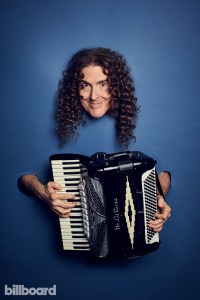
John Mayer — bespectacled, grinning goofily, very much nerding out — is sitting across from “Weird Al” Yankovic, interviewing the Hawaiian shirt-clad parody music king, who is sitting across from him for his SiriusXM show, How’s Life With John Mayer.
“You can call me Al, like Paul Simon says,” Yankovic says with smile, before adding that the most normal thing about him is, probably, his pancreas.
It’s a funny quip, but also an understatement. Let’s just get this out of the way: “Weird Al” Yankovic is, beneath his accordion-playing, polka-loving surface, exceedingly normal. He likes long evening walks to get his steps in. He enjoys seeing movies and trying out new restaurants with his wife and daughter, who just graduated college. He grumbles good-naturedly about the ongoing renovation of his home in the Hollywood Hills. (“It’s going to look almost exactly the same as it did before, except it cost a fortune!”) The 65-year-old artist’s one attempt at rock star behavior, back in his early-’80s heyday, was comically un-vain: On a touring rider, he requested, in the spirit of Van Halen’s famed ban on brown M&M’S, “one really horrible Hawaiian shirt for every show I did.” (On that run, he did 200, and a collection that now extends to a storage unit somewhere in greater L.A. began.)
Trending on Billboard
Still, if not precisely weird, Yankovic is truly singular. His catalog can be divided into two types of songs: intricately crafted, meticulously arranged, hilarious yet never mean-spirited parodies of hits by acts ranging from Michael Jackson to Coolio to Nirvana to Lady Gaga, and original pastiches, for which he deep dives into artists’ catalogs to create songs that, with eerie accuracy, mimic the sounds and idiosyncrasies of those genre-spanning artists.
Between the two, he has accomplished feats usually reserved for the very artists he parodies. During each of the first four decades of his career, he has had entries on the Billboard Hot 100, and eight of his albums have reached the top 20 on the Billboard 200 — including his most recent studio release, 2014’s Mandatory Fun, which became his first No. 1 on the chart. He has won five Grammy Awards and an Emmy. Billboard estimates he has sold 12 million albums in the United States (based on RIAA certifications pre-1991 and Luminate data from 1991 on).
Incredibly, he’s done all this without ever changing his essential “Weird Al”-ness. “From day one, there was never even a discussion that would not be about following his singular vision,” says Jay Levey, Yankovic’s manager of 43 years and sometime creative collaborator (notably, they co-wrote the now nerd canon comedy UHF, which Levey also directed). “It’s hard to find any career where there’s literally no compromise, but we might be able to count on one hand the number of compromises he’s made in his career.”
Joe Pugliese
Sometimes, that’s meant turning down lucrative deals, like the $5 million beer endorsement that Yankovic passed on in 1990 because, he feared, the brand was “trying to make me into Joe Camel.” Many times, it’s meant standing up to record-label executives, like when, amid his “draconian” first album contract with Scotti Brothers (an indie then distributed by CBS), he was asked to shoot 10 music videos on a $30,000 budget simply because he’d proved he could do one for $3,000. (“I’m like, ‘No. No, I can’t!’ ”)
But just as often, it’s meant embracing an open-to-anything spirit that seems to almost always work out in his favor. Yankovic decided very early in his career to ask permission of any artist he parodied — not because the law required it (it doesn’t) but because he simply had no interest in making enemies. With very few exceptions, it turned out, the artists said yes, even supposedly impossible-to-convince ones like “American Pie” scribe Don McLean, who OK’d “The Saga Begins,” Yankovic’s 1999 parody that essentially summarizes the plot of Star Wars: Episode I — The Phantom Menace. “When I heard his version, I thought it was better than the original. The sound quality was superb,” says McLean, who calls Yankovic a “straight-ahead good boy” who “could be on Leave It to Beaver.”
Thanks to that combination of earnest good intentions, work ethic, backbone and obsession with quality, Yankovic finds himself in an unusual position today: He’s no novelty relic of the ’80s, but a truly cross-generational artist. In the past six years alone, he’s portrayed Rivers Cuomo in Weezer’s “Africa” music video, played accordion (and appeared in the video) for teen rock band The Linda Lindas’ 2024 single “Yo Me Estreso” and lip-synced dramatically in a tux in Clairo’s “Terrapin” video. “Growing up with his videos was a massive thing in my generation,” says Clairo, 26. “Back when YouTube was really simple, it really hit home for us in middle school to watch his parodies. He always knew how to draw people in.”
He and his team will prove just how true that still is when Yankovic heads out on the Bigger and Weirder Tour this summer. It’s his fastest-selling, biggest-grossing tour yet, according to his agent, Wasserman Music’s Brad Goodman, and his biggest by other metrics, too: an eight-piece band (his largest yet) onstage; first-time venues bigger than any he’s played before, including New York’s Madison Square Garden and L.A.’s Kia Forum; a mini-Las Vegas residency (the tour will open June 13 with six sold-out nights at The Venetian); and stops both expected (Red Rocks Amphitheatre) and less so (Riot Fest) on the route. And the concert itself is a trademark Weird Al spectacle: part rock show, part revival tent, part Broadway musical, all “joy bomb,” as actor and longtime fan Andy Samberg puts it.
Whether it becomes a springboard for the next Weird Al era is anyone’s guess — including Yankovic himself. Right now, he has no further plans to release albums; and since Mandatory Fun arrived over a decade ago, he’s only sporadically released new music, most recently the 2024 “Polkamania!” single (the latest in his long-running series of madcap polka medleys, this one recapping the past decade’s pop highlights, all sung in Yankovic’s manic tenor). Around that time, his contract of roughly 20 years with Sony ended, and he decided not to renew with the label, or sign with anyone else.
“Nobody owns any piece of me,” he says, exhaling. “I’m at a point in my life where if something isn’t going to be fun or a pleasant experience, I have no problem saying no, even if it’s a lot of money or a lot of eyeballs. I can do literally whatever I feel like doing.”
Then again, for Yankovic, that’s always been true.
“When I was a kid, I used to fantasize about being the next Weird Al, like it’s a position he applied for and got,” says Lin-Manuel Miranda, a lifelong fan who’s now also friends with Yankovic. “And then you grow up and realize, ‘Oh, there’s only one of that guy.’ We’re not going to see another Weird Al.”
On an overcast April afternoon a few days after the Mayer taping, Yankovic meets me for lunch at Crossroads, a vegan spot in West Hollywood where, years ago, he ate his first Impossible Burger. He’s quick to jokingly note that he is not a member of the city’s “vegan elite” — still, as he walks in, a man walking a golden retriever stops his phone conversation to stare and declare, “It’s that Al Yanko-vich guy!”
Despite his talent for writing songs about junk food (“My Bologna,” “The White Stuff”) and the fact that he once consumed the world’s most ungodly snack, a Twinkie Dog, in UHF (watch and barf a little), he’s been vegan since the early ’90s.
Chalk it up to veganism, staying out of the sun (“I melt in direct sunlight”) or following the directions of his longtime hair stylist, Sean James, very well (he never blow-dries those famous ringlets, hence their eternally bouncy and well-defined nature), but Yankovic has an ageless quality that lends many of his fans to liken him to mythological figures. “He’s Santa Claus for nerds of a certain stripe,” Miranda says, a comparison Mayer had also made (as well as to Forrest Gump). His curls may be a little grayer, but his ultra-expressive face — acrobatic eyebrows in particular — reflects his eternal curiosity and up-for-anything-ness.
As we settle in for almond ricotta-stuffed zucchini blossoms and meatless bolognese, Yankovic is particularly animated recounting his previous weekend, when he made his latest surprise appearance: his Coachella debut. To close out its surreal set, the crew from the cult-favorite kids show Yo Gabba Gabba! brought out a cast of characters both human (Thundercat, Portugal. The Man’s John Gourley) and not so much (cartoon mascots like Sleestak, PuffnStuf and Duo the Duolingo owl) to sing “The Rainbow Connection” with its composer, Paul Williams — and, on lead vocals, Yankovic.
“I’ve had a pretty bizarre life, so it wasn’t like, so unusual,” Yankovic reflects. “But it was definitely a little bit of an out-of-body experience.” He admits that the “hey kids, let’s put on a show” energy was fun and that the invite wasn’t a total shock (having appeared on a season-three episode as an accordion-playing circus ringmaster, he’s tight with the Gabba group). Still, he speaks of such invites with a kind of humble awe.
“Nothing I’ve ever done was me thinking, ‘Boy, I hope kids discover this 40 years from now,’ ” he says. Starting in the ’80s, he released an album almost every year “because I was afraid I would be quickly forgotten. It was drilled into me: ‘You’re a comedy artist, you’re a novelty artist, you’re lucky if you’re a one hit-wonder — you’re not destined to have a long career.’ I wanted to grab that brass ring every time I went around.”
Joe Pugliese
Coming up concurrently with the birth of MTV, and savvily taking advantage of it, helped Yankovic snatch that ring. He had a keen ear for (and good taste in) hits at a time when, thanks to both MTV and top 40 radio’s prevalence, a monoculture reigned — and perhaps even more importantly, he knew the power of a viral video before such a thing existed.
Tweaking hits like Jackson’s “Beat It” (“Eat It”) and Madonna’s “Like a Virgin” (“Like a Surgeon”), Yankovic created new songs that, thanks to his painstaking re-creations of their arrangements, were immediately recognizable but rewarded repeated consumption — as did their accompanying videos, in which Yankovic demonstrated his incredible eye for detail and formidable acting chops. “MTV was on like video wallpaper in the background 24 hours a day,” he says of that time. “They were hungry for content, and I was anxious to give them content.”
Since then, Yankovic’s understanding of the promotional power of visuals has remained prescient — take when, leading up to Mandatory Fun’s arrival, he insisted on releasing a music video on YouTube each day (not all at once, as some advised) to whet fans’ appetites for the album. And his genre-agnostic approach to making music has proved ahead of its time, too. Before hip-hop was widely accepted as pop, he was especially drawn to rap. “A lot of pop songs are very repetitive,” he says. “How can I be funny in seven syllables, you know? But rap songs, I mean, it’s nothing but words, and it’s easy to craft jokes that way.”
Parodies like “Amish Paradise” (Coolio’s “Gangsta’s Paradise”) and “White and Nerdy” (Chamillionaire’s “Ridin’ Dirty”) are among his most streamed — though he’s been equally adept at literally any microgenre he takes on, from just-electrified Bob Dylan (“Bob,” entirely comprising palindromes) to arty new wave (the Devo pastiche “Dare To Be Stupid”) to crunchy Detroit garage rock (“CNR,” a tribute to Charles Nelson Reilly through the lens of The White Stripes).
“The more you listen to him, the more you get access to making [any genre of parody] sound legitimate,” says Samberg, who calls Yankovic the biggest influence on his own comedic music group, The Lonely Island. “The nature of what he does is incredibly populist. He’s not snooty about it; he’s like, ‘This is what the kids like, and as long as I have a good angle comedically, I’m going to do it.’ And because of that, it’s always appealing to young people.”
Growing up in Compton-adjacent Lynwood, Calif., Yankovic listened to rock radio, but as a teenager found playing the accordion a bit solitary. (His friends’ rock bands weren’t really interested in an accordionist joining up.) “When you take accordion lessons, I think the high-water mark is ‘Maybe someday I’ll play in an Italian restaurant or at a wedding,’ ” he says with a laugh. “I guess I was shameless. I grew up a complete nerd in high school. And when you’re not somebody that’s socially acceptable, you kind of have nothing to lose. I kind of held on to that mentality: Like, you know, ‘Who cares?’ ”
“Weird Al” Yankovic photographed April 17, 2025 at Dust Studios in Los Angeles.
Joe Pugliese
He didn’t look to any particular musician’s career trajectory as one he could follow. “It was more cautionary tales” — and one was especially haunting. One of his idols was Allan Sherman, the satirical singer best known for his 1963 summer camp send-up, “Hello Muddah Hello Fadduh!” “He was the last person to have a No. 1 comedy album before me,” Yankovic continues. “He had three No. 1 albums on, like, the pop charts — incredible! But within a few years, he completely burned out. He made some terrible choices in his personal and professional life and just went off into obscurity and sadly died a few years later. So I was always more concerned about, ‘Don’t mess it up. Keep doing what you’re doing and just try not to make bad choices.’ ”
“In a way, we’re almost always looking over our shoulders at that,” his manager Levey says. He cautiously admits that he and Yankovic have finally reached a level in his career where they’re “no longer at the point where every year [of continued success] is a surprise,” then adds, “I don’t actually even like saying that out loud because it sounds like you’re taking something for granted.”
But if Sherman was a rocket that blasted off only to burst into flames, Yankovic has been the opposite: one that, as Levey puts it, has kept steadily traveling through space — maybe sometimes at a slower speed than others, but never plummeting back down to Earth, buffeted by the most unexpected boosters. Like, say, Weird: The Al Yankovic Story, the 2022 parody of a music biopic that Yankovic co-wrote, starring Daniel Radcliffe in the titular role. Despite at first airing only on the Roku Channel, it won almost universal acclaim and a prime-time Emmy, while expanding Yankovic’s universe yet again.
“His longevity is a testament to his ability to be himself and stick to what his taste is, because it’s so specific,” Radcliffe says. (“Bob” is his favorite Yankovic track, and he took the opportunity on set to ask his hero how he came up with all the palindromes.) “He threads a really hard-to-thread needle between wholesome fun and something … genuinely deranged and very, very strange. And in a way that is not affected.” At a time when the culture values authenticity above all else, Yankovic is a walking example of it — never not himself.
Unwittingly proving the point, Yankovic gasps in glee as our lunch ends. “Mochi doughnuts!” He shows me a photo his wife has just texted him: a box of the treats for dessert later. Somewhat sheepishly, he explains the occasion: “Eric Idle is coming over for dinner tonight. That’s my big flex for today.”
Later that afternoon, Yankovic meets me in a park near Coldwater Canyon called Tree People. He looks a little like a more aged version of his faux-Indiana Jones in UHF: Hawaiian shirt (a Goodwill buy), sensible shoes, safari hat shielding the waning sun.
“I’m gearing up for a big tour, so I’m mostly just making sure I don’t have a heart attack onstage or pass out or something,” he says of the walks he takes in spots like this. “I think I’ve lost 20 pounds in the past couple months just because I’m not, like, eating junk food at midnight anymore.”
Yankovic’s last tour outing didn’t require much of a physical regimen. In 2022 and 2023, he took to smaller venues for The Unfortunate Return of the Ridiculously Self-Indulgent, Ill-Advised Vanity Tour, a follow-up to the first Vanity Tour in 2018. The idea, he recalls, occurred to him when “I was putting on my ‘Fat’ suit for the thousandth time and I thought, ‘Wouldn’t it just be nice to like, go out onstage and play the songs, sit on a stool and have an intimate evening with fans?’ ”
Joe Pugliese
So Yankovic eschewed the usual production level of his tours — costumes, wigs, the parody hits — for a concept, his agent Goodman says, that the musician himself wasn’t entirely convinced would work. Instead, it allowed him to visit new, smaller major-market venues (Carnegie Hall, Tennessee’s The Caverns) and strengthen his presence in off-the-beaten-path markets (like, say, Huntsville, Ala.) while superserving his ride-or-die fans. When the concept returned in 2022, he played 162 Vanity shows globally (extending into the next year).
“I loved it, the band loved it, the people who showed up loved it, and it definitely scratched that itch,” Yankovic says. “And now,” with the Bigger and Weirder Tour, he’s back to “doing a show for everybody.”
For Bigger and Weirder, Yankovic is in self-described “overpreparer” mode, the hyper-organized creative core of his team. “I came up with the setlist a year ago. I gave the band” — three of whom, as of our meeting, he has yet to meet — “their marching orders and said, ‘Here’s the setlist, here’s your charts, here’s the demos, here are the rehearsal days.’ ” He personally chooses and edits all the show’s video content — clips of Weird Al in Pop Culture (say, on The Simpsons or 30 Rock) over the years that will play between songs and give him and the band time for the most frantic element of the show, which the audience never sees.
“We have stage props, wigs, a lot of costume changes, and a big portion of what we need is a quick-change area behind the scenes onstage, usually 40 by 20 feet,” says Melissa King, his tour manager of nearly 20 years. On Bigger and Weirder, Yankovic will do 20 costume changes, give or take a jacket or hat; his band members will do nine; and all will occur in 45 seconds maximum.
That backstage planning ensures that in front of the audience, the man who has spent his career parodying rock and pop stars is free to embody one himself. “When I speak to [talent] buyers and say, ‘Have you seen the show?,’ if there’s a pause, for sure I know the answer is no,” Goodman says. “Because if you’ve seen the show, it’s just an immediate ‘Yeah, of course, it’s incredible.’ ”
Onstage, Yankovic isn’t just physically “working his ass off,” as Samberg says. “As a vocalist, he’s f–king incredible,” Radcliffe marvels. “He has this amazing, clear tone. His range is so impressive — he does things to his voice that, as somebody who sings a bit in musicals sometimes, if I tried that I’d hurt myself.”
Joe Pugliese
Despite the “bigger” aspects of this tour — like how it will use three trucks instead of the usual one — King is still one of just 11 people comprising the crew. “It’s very lean, but it works because we all work together,” she says. “Al’s a genuine, kind person, and because he is, that’s the way everyone in our camp is.” That ethos extends to both the fans who’ll attend (“There aren’t many arseholes who are Weird Al fans,” Radcliffe observes) and how Yankovic treats them: According to Goodman, he’s kept maximum ticket prices for Bigger and Weirder to $179.50 and has always refused to engage with platinum ticketing.
Right now, the tour is Yankovic’s focus. When he decided against renewing his Sony contract, Levey says, they tested the waters with “very limited outreach” to a mix of indie and major labels. “And we got great offers and I brought those offers to him, and he thought about it and said, ‘I’m really loving this feeling of not being under contract to anybody … Please tell these people how appreciative I am of their generous offers and we’re just not going to accept any of them.’ ”
He’s now independent in the truest sense: He has an imprint, Way Moby, that’s technically now his label, but he describes it more as existing for theoretical recording purposes. He figures he’ll put out a single here and there, contribute to soundtracks if he’s asked and, as always, remain open to what may come — like making a surprise appearance last November to duet with Will Forte on Chappell Roan’s “Hot To Go!” at a charity event or developing a Broadway Weird Al jukebox musical that he says is in the very earliest creative stages, a “bucket list” project.
“When [he had] the No. 1 album in the country, that was such a triumphant moment. I remember us celebrating,” Samberg recalls. “It just shows you — I don’t think anyone else will really touch that space. It’s his space. No one is going to say, ‘I’m going to do what Al does,’ ’cause good luck. He owns that until he doesn’t want to do it anymore.”
The world, Yankovic knows, is also not the same as when he first became famous. “I got a record deal, I got on MTV, and I kind of had the market to myself,” he reflects. “Now the playing field has been so leveled that anybody can upload their material to YouTube or various portals like that. And if the stuff is good, chances are people will eventually see it. I’d like to think that if I was coming up now, I’d still do OK, but it would just be more of a challenge.”
It’s a generous sentiment, a reminder that, as Miranda puts it, one of Yankovic’s many talents is also “reading the room.” But in its humility, it’s also a reminder that, flooded as the market may now be with funny people on the internet, none of them, still, are doing it like Weird Al: the 65-year-old who once thought he’d play accordion at weddings and Italian restaurants, who’s about to make his Madison Square Garden debut.
This story appears in the June 7, 2025, of Billboard.