 State Champ Radio
 Billboard Live Music Summit
Trending on Billboard
This article was created in partnership with VENU.
Billboard’s highly anticipated Live Music Summit presented by VENU made its return this year, marking its second gathering and celebration since its hiatus in 2019. The summit’s comeback is in response to high demand to refocus on the thriving touring industry.
Attendees experienced a dynamic mix of panel discussions, live performances, workshops, and industry mixers, all culminating in the Touring Awards Ceremony. Among the star-studded panel lineups were Usher, Rauw Alejandro, and top industry executives. It was an invaluable opportunity for those in the music business to gain insights from industry leaders while celebrating the milestones many touring artists have achieved this year.
Explore
See latest videos, charts and news
Rashida Zagon for Billboard
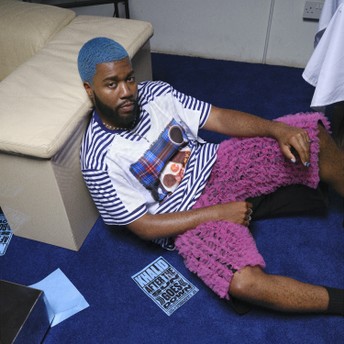
The Live Music Summit made its highly anticipated return with exciting new awards and recognitions including the Disruptor Award, presented to Khalid by visionary entrepreneur, J.W. Roth, Founder and CEO of premium live entertainment company, VENU. Over the past 9 years, Khalid has taken the industry by storm, embodying the very definition of a “disruptor.” His bold approach has challenged both fans and music executives to see artists through a new lens.
Accepting the award, Khalid said, “I can remember doing my first venue and there was 125 people at a coffee shop and to be able to see the things that I’ve seen in my career is just such a blessing.” adding, “It wouldn’t have been able to be done without support. So, I just want to thank everyone for supporting me. Especially, me coming into myself as an individual in the public but I’ve seen nothing but love and I hold it with grace and humility.”
Khalid Donnel Robinson in the Green Room during the Billboard Live Music Summit at 1 Hotel West Hollywood on November 03, 2025 in Los Angeles, California.
Christopher Polk/Billboard
Also disrupting the live-music world is Venu Holding Corporation (“VENU”). It isn’t your typical live entertainment company. Rising fast throughout the live entertainment space, the company has built its brand around delivering premium experiences, opening multiple venues nationwide and redefining not only how audiences experience concerts, but how they can own a piece of live entertainment. They’re more than destinations to see your favorite artists. VENU is a fan-founded, fan-owned, artist-inspired movement creating unparallelled, immersive spaces, designed to elevate every part of the concert journey for fans and artists alike. Their mission is to create nationwide, top-tier live music destinations that change how the world experiences and connects with music, shaping the future of live entertainment.
Rashida Zagon for Billboard
After the Billboard Live Music Summit, some of the industry’s top executives gathered at the Sun Rose in West Hollywood for a Music & Money Dinner to reflect on the conversations of the day and engage in insights for the future of live entertainment. During which, VENU Founder, CEO, and Chairman J.W. Roth and industry veteran Tommy Ginoza engaged in a thought-provoking fireside chat, moderated by Billboard’s Editorial Director, Hannah Karp, about the state of the music industry, the evolution of live entertainment, and VENU’s continued expansion of its destination network across the United States. With over three decades of experience as a talent buyer, Ginoza spoke candidly about the future of artist development and the critical role of fan engagement in shaping the live music experience. Roth, meanwhile, highlighted that while recent investment trends have heavily favored music publishing catalogs and master recordings, the live music sector has seen comparatively less attention from investors in recent years.
Rashida Zagon for Billboard
Acknowledging this shift, Roth emphasized that the current landscape presents a unique opportunity to redirect investment toward live entertainment, such as VENU’s unique ownership opportunities in Luxe FireSuites, Aikman Clubs built in partnership with NFL Hall of Famer, Troy Aikman, or common shares, stating, “If you’re going to be innovative in this space, not only do you have to have a concept that is going to be attractive to our customer but you’ve got to figure out a way to finance it… So, we’re not just building amphitheaters. We’re building venues that are multiseasonal, multiconfigurational, and more importantly they are multisensory.”
The event was a true celebration for accomplishments in the live music world and the heights to which this community intends on taking the art of live entertainment in the near and distant future. The prospects of live music are looking bright and Billboard and VENU plan to be a part of every step of the way.
Trending on Billboard
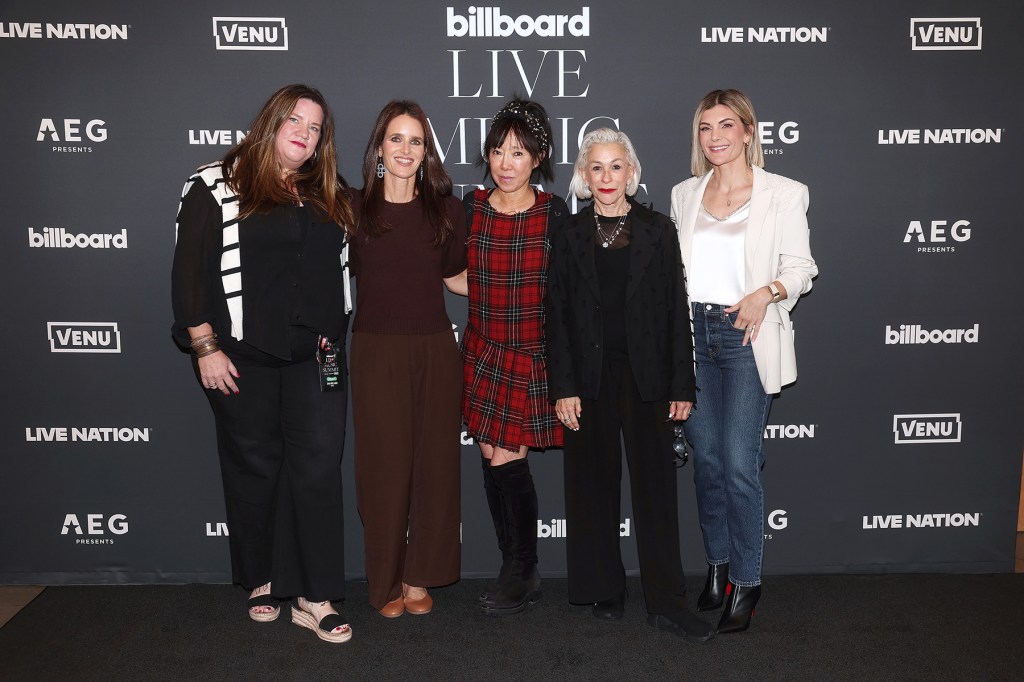
Agents Jenna Adler of CAA, Marsha Vlasic of Independent Artist Group, Sara Williams of WME and Elisa Vazzana of UTA took part in a conversation about the current challenges and trends in touring — and what it’s like being a female agent in 2025 — at the Billboard Live Music Summit on Monday (Nov. 3) in West Hollywood, California.
In a panel moderated by Billboard editor-in-chief Hannah Karp, the four agents — who collectively represent artists including Green Day, Neil Young, Luke Combs and Megan Maroney — discussed the expansion of the micro-residency model as one of the ways the live business is likely to change over the next few years.
Adler remarked that “micro-residencies are only going to get more and more expansive; micro-residencies meaning it’s no longer a 45-date tour across the country, it’s more like four or six markets and we’re going to do multiple days. I think it not only saves on costs, because it’s so expensive to tour these days, especially as a mid-level and young artist, that these micro-residencies actually really help curtail that.”
Adler also noted that global touring is now a major priority for artists, “so as we’re planning 24-month calendars. I think that we’re looking at all of it and making sure there’s breaks in between and just really being mindful for the artist, because it’s grueling out there.”
Vazzana noted that with this emphasis on global touring, it’s important for artists to grow their international fanbases earlier in their careers, as “it hurts a lot more when you have a much bigger team to go and try to do it then, than if you had just done it from day one and taken those incremental steps. I also think that international audiences really appreciate the early investment.”
The agents also discussed the state of the glass ceiling for women agents. Vlasic, who began her career 40 years ago, when she was often the only woman in meetings, reflected that “there are more women in our business than ever. When I started out there were three. It has tremendously [improved].”
“Learning form the past, being in rooms with women who have taught us to come into the room and bring another woman into the room and have those conversations,” is important, Williams continues, “because it’s not over. It’s much better, but it’s not over. The number of times we might be one of the only women on a screen or in the room is significant in this business, still.”
“I feel like we’ve come such a long way, but there’s so much more to do,” added Adler. “We do belong in the room, and we have to advocate for ourselves, and we have to continue to advocate and fight.”
“But you must do it,” said Vlasic. “You cannot expect to have the path laid for you; you have to create it yourself.”
“Sometimes I just feel like we just have to continue to fight for each other and to be there and show up for each other,” Adler continues, “because as much as people try to pit us against each other, I just feel like we just need to be screaming and amplifying from the rooftops that we do belong in the room, because it’s systemic at times.”
“I’ve always said that it’s not a disadvantage to be a woman, and I firmly believe that,” continued Vazzana. “I was raised by a dad who was like, ‘Get in there, do the job, be smarter than everyone else,’ and by the way, sometimes I maybe have to yell a little louder, but I don’t see that as a negative. I see it as a necessity, and if it helps move women forward, so be it.”

Trending on Billboard
Shakira received the inaugural Billboard Global Touring Icon Award in honor of her historic Las Mujeres Ya No Lloran World Tour, and as part of the 2025 Billboard Live Music Summit held Monday (Nov. 3) in West Hollywood, California.
“As your longtime tour manager, I am so proud and truly honored to present the first annual Billboard global icon tour award to you,” said tour director Marty Hom, who’s also worked for Fleetwood Mac, Barbra Streisand and The Rolling Stones, among others. “We get to witness every day how hard you work to do the best show possible for all your fans.”
Shakira, who received the news backstage during the rehearsals of her recent show in Cali, Colombia, dedicated the award to her entire team, including dancers, band and crew, for “working as hard as I do,” she noted.
The Live Nation-produced tour’s first 64 dates (of 82) grossed $327.4 million and sold 2.5 million tickets, according to Billboard Boxscore, converting Las Mujeres Ya No Lloran into the highest grossing Latin tour ever by a woman and the second highest grossing Latin tour ever (behind only Luis Miguel’s 2023-24 outing, which grossed $409.5 million).
Additionally, the Colombian artist sold 65,000 tickets per night during her historic 12-concert run at Mexico City’s Estadio GNP Seguros (formerly known as Foro Sol), according to promoter OCESA, for a total of 780,000 tickets sold.
“It’s encouraging and inspiring,” Shakira said to Hom. “I never thought, not even in my wildest dreams, that I would fill every stadium. It’s incredible and motivating at the same time, I feel like I’m just starting my career, and it’s crazy because it’s been 30 years … This has been the best tour of my life, it’s been just as we dreamt it. We worked so hard, overcoming every obstacle, it hasn’t been easy, we worked many, many long hours to make everything as good as people deserve it.”
Backstage at her show in Cali — where she performed for the first time in 20 years — Shakira also discussed her personal life: “I’m completely dedicated to my boys and my career. That’s all I need, my boys, my fans and my music, and creating, it’s fulfilling a big part of my life right now.”
Trending on Billboard
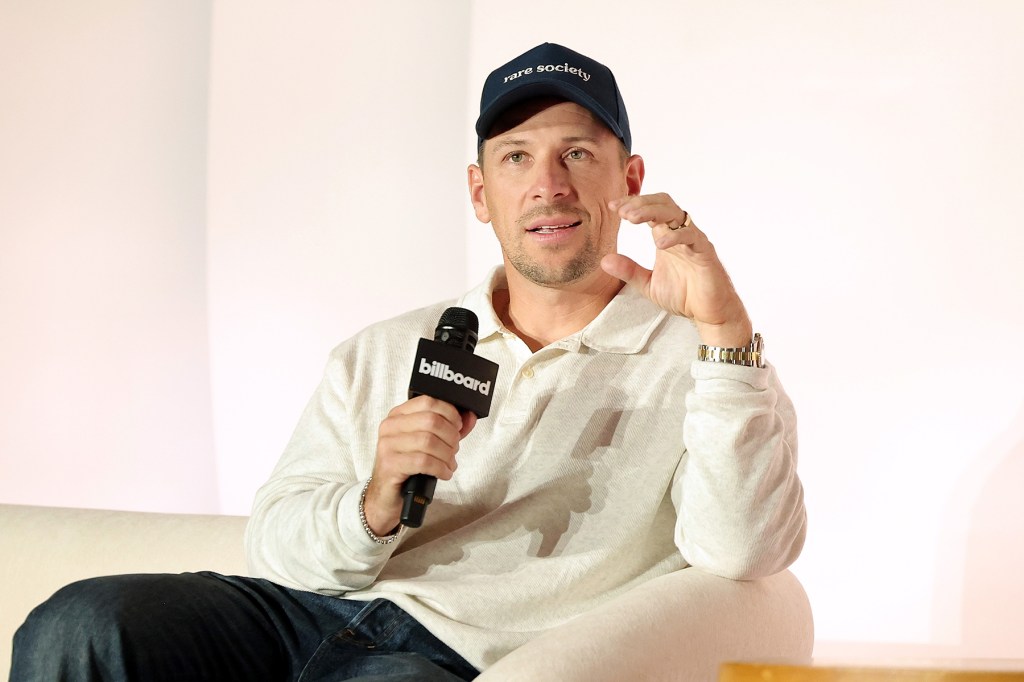
What’s the future of the kiss cam at concerts? Nick Groff, manager of German electronic producer Bunt., offered some insight when he took the stage at the Billboard Live Music Summit on Monday (Nov. 3) in West Hollywood, California.
Speaking with Billboard editor-in-chief Hannah Karp, Groff discussed giving fans control of the cameras capturing crowd footage at shows, an initiative that sparked a viral moment at an Oct. 18 Bunt. show at The Shrine Los Angeles when one of the phones was used by a couple to show themselves kissing.
“We didn’t plant that kiss,” said Groff. “We gave that phone out to fans.”
For Bunt. and his team, giving fans the ability to film themselves for the big screens at shows is a way to incorporate fans into the performances, especially as Bunt.’s concerts have grown bigger and the team has had to put barricades around the producer for crowd control.
“We had this really awkward problem where we got to this place by celebrating the fan, but how do we bring the fan into a larger show?” Groff said during the Summit.
To address the issue, the Bunt. team linked with a technology company, who reported that they’d created a system that allows specially prepared iPhones to be linked with venue systems, so that footage captured on these phones can be broadcast on the venue’s big screen. At the Oct. 18 Shrine show, these phones were given to longtime Bunt. fans that the artist and his team had a pre-existing relationship with.
The goal with the initiative, Groff said, is “celebrating the fan by capturing them in their moment.”
The Summit discussion referenced the now-infamous viral moment that happened at an August Coldplay concert, where a couple engaged in an affair were captured on a kiss cam. “Although the novelty of that moment, which was scandalous, happened, the reality is that the kiss cam was a novelty idea at live events because it actually celebrated this simple, pure, human emotion of love,” said Groff.
Groff pointed out that this method could also help solve an issue that’s particularly problematic in dance music, where fans stick their phones in the faces of DJs while they’re playing, interrupting the show and affecting the overall mood. This system being employed by the Bunt. team makes it so that phones are now turned back around on audience members, rather than being pointed at artists.
Still, the widespread adoption of this system may be a ways off, as Groff said putting it together was expensive and is technically “really complicated right now.” While the overall system is “still in its infancy in terms of being able to build out,” the team is planning to use it at some of Bunt.’s bigger upcoming dates, including a Nov. 13 set in Munich.
Trending on Billboard
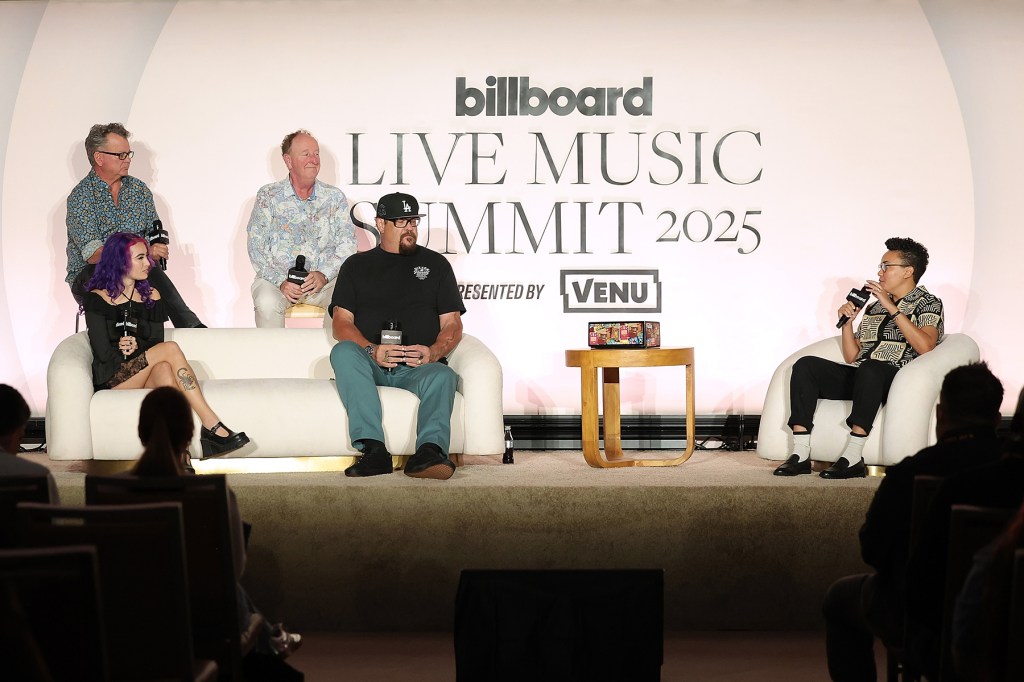
When Warped Tour kicked off in 1995, we’re guessing founder Kevin Lyman didn’t have any idea he’d be mounting a 30th-anniversary edition of his traveling rock fest in 2025 — or that he’d be named Billboard‘s 2025 Visionary at Monday’s (Nov. 3) Billboard Live Music Summit for all the ways he’s helped revolutionize the industry. In fact, he joked onstage that he thought he’d be receiving a different honor: “When you called, I thought it was maybe the ’64 Under 65′ now, and I finally made the list.”
During a panel titled “How Warped Tour Built A Lasting Legacy – And Returned In 2025” at West Hollywood, California’s, 1 Hotel, Lyman was joined by Steve Van Doren, an executive from the tour’s presenting sponsor Vans, as well as Warped vet Fletcher Dragge from the SoCal punk band Pennywise and first-time performer-but-longtime attendee Devin Papdol from L.A. pop-rock band Honey Revenge for a conversation moderated by Billboard editor Taylor Mims.
Below, find the best quotes from each panelist about what makes Warped Tour so special and how it’s evolved across three decades.
Warped Tour founder Kevin Lyman
It was always about trying to get people out to their first festival. You know, having the show end by sunset was a big part of it too. Because to me, 90% of the problems were caused by 10% of the people under cover of darkness at shows. So if we could bring it into the sunshine, we eliminated some of the problems we had, maybe of certain things in punk rock, but it gave people a chance to listen to the music and really observe. … Everything we did from the reverse daycare center [letting parents attend for free in a “Parents’ tent” so teens could attend], all these things I developed were how to get these young people turned on to this music at a younger age, so they can stay with us. I always said they stayed with us until they were 19, and then they wanted to go to a festival and burn up their student loans and do modeling in the desert.
Vans’ Steve Van Doren
I wanted to get skateboarding from Florida, Texas and California to the rest of the country. He [Lyman] wanted to get music in the rest of the country, 35 to 45 stops each year. I thought it’d be perfect. And no room for rock stars — learned that one early. Everybody’s treated the same. Being able to meet [Pennywise’s] Fletcher in the early days, where he invited me over to the barbecue area, and that’s where you get to meet everybody. Everybody’s done at 8:30, 9 o’clock at night. The buses aren’t leaving until 11 o’clock or 11:30, so everybody’s hungry, come back there. And every day is a little bit different.
Pennywise’s Fletcher Dragge
I never went to summer camp, but it was the best summer camp on the planet. So why wouldn’t you go do what you love to do: play music and hang out with the coolest people and do the coolest sh–? Kevin and these guys would always arrange off days, like river trips or wherever you were, and everyone would come, like, all crew, all bands. It was just completely, undeniably some of the best times of my life. So it was like a no-brainer. “You want to come?” Yes. Ten years later: “Now you want to come?” Yes.
Honey Revenge’s Devin Papadol
I went to my first Warped Tour in 2013 and it was kind of the first opportunity for me to be around so many people that liked the same music as me. … Going to Warped opened up this incredible community that I didn’t know was real locally to me; it kind of felt far away until I went. And I went every year until it stopped. … It was how I found all of the music I ended up listening to, and all the music that ended up influencing Honey Revenge.
Trending on Billboard
Rauw Alejandro took a day off between stops on his Cosa Nuestra tour to attend the 2025 Billboard Live Music Summit in Los Angeles to explain how a new partnership with Live Nation helped him create a theatrical spectacle that could “travel through the whole world.”
Alejandro — who came straight from a Sunday (Nov. 2) show in Monterrey, Mexico and has to fly right back for a Tuesday (Nov. 4) performance in Mexico City — took the stage for a spotlight conversation with Billboard’s Leila Cobo and Live Nation senior vp of global touring Hans Schafer at the 1 Hotel West Hollywood on Monday (Nov. 3).
Related
The Cosa Nuestra tour is a high-concept, 1970s New York-inspired spectacle supporting Alejandro’s 2024 album of the same name, which hit No. 6 on the Billboard 200. The tour grossed $91.7 million across spring and summer legs in North America and Europe before heading to South America and Mexico. Alejandro will conclude at the end of this month with a five-date residency at San Juan’s Coliseo de Puerto Rico José Miguel Agrelot.
During the discussion, the cover star of Billboard’s touring issue explained that after attending live theater in New York, he was inspired to create what he called “the biggest Broadway show on earth” — though it’s not so easy to bring Broadway to an arena. Enter Live Nation.
“I consider myself the best, so I want to work with the best team,” said Alejandro of joining up with the concert giant for the tour.
As Alejandro explained, Live Nation helped him bring his vision to life using maximum precision. “We could sell stadiums,” said Alejandro, but ultimately, he and his team decided to schedule his tour in arenas to “focus on the art.” The tour also eschewed outdoor venues, preferring the dark environment of an indoor arena to better evoke the feel of a Broadway theater.
Related
A huge priority, said Alejandro, was to create consistency across markets. As he put it, he didn’t want South American fans to watch one version of Cosa Nuestra on TikTok during the U.S. leg and then be disappointed when a different show came to their cities.
“I had to find a show that I can take everywhere, because I think my fans deserve the best of me,” said Alejandro. “For me, it was really important to put our minds together and find this perfect show that I can travel through the whole world, and I think we did it.”
Schafer, who runs Latin touring for Live Nation, said he was galvanized by Alejandro’s desire to prioritize performance quality over all else.
“The greatest is when you partner with an artist team and they are not looking to make it the biggest, they are looking to make it matter,” said Schafer.
Monday’s panel also covered the way Alejandro was inspired by salsa music for Cosa Nuestra and how he stays in shape for the demanding, dance-heavy show. He said he eats clean — “salmon, white rice, vegetables” — works out and doesn’t drink or smoke on show days.
Alejandro also hinted at what’s next for his touring career. The reggaeton star said he does intend to play stadiums — and that in the future, he aims to take his shows to even more markets than he did this time around. “We want to conquer Asia,” he said.
Trending on Billboard
When it comes to convincing major artists to use sustainable merch on tour, it doesn’t take much work, says Bravado president Matt Young. As he puts it, a little competitive spirit goes a long way.
“For us, it’s just about using the platform to tell the story,” Young said at the Billboard Live Music Summit on Monday (Nov. 3) in West Hollywood, California, noting that stars including Billie Eilish, Paul McCartney, Shawn Mendes and Lorde used sustainable merch options on their most recent tours. “And it gets our competition to follow suit. The artists are saying, ‘Hey, how come we can’t do that?’”
Related
Young was speaking during the panel “Building Touring’s Sustainable Future With Maggie Baird.” Moderated by Billboard senior music correspondent Katie Bain, the panel also featured Adam Gardner, frontman of the band Guster and co-founder of the environmental music nonprofit REVERB; and Maggie Baird, founder of nonprofit Support+Feed and mother of Eilish — arguably the most outspoken major artist on the subject of sustainability.
Below are four major highlights from the panel.
The price point for sustainable merch is trending down as more artists adopt it.
While noting that sustainable merch tends to be “a few dollars more” than non-sustainable, Young said that once artists and their teams realize it’s an option, they tend to be open to it.
“The ultimate sell is, ‘This is the right thing to do,’” said Young. “A few months ago, we did a summit in Nashville, where we were sitting down with partners in town and just talking about the options. And half the time, they go, ‘I didn’t realize that.’ And the other part about this is, because we’ve done so much over the last three or four years, we’re starting to see the price gap close a bit.”
Related
Added Gardner, “Once enough artists are asking for the same things, they make permanent change.”
Offering plant-based meals at concerts is actually cheaper.
You know which sustainable option is actually less expensive than the status quo, according to Baird? Plant-based food. That’s helpful when it comes to her organization, Support + Feed, selling organizations on offering more non-meat options.
“One of the whys [to offer plant-based options] is you can save money,” said Baird. “That’s really an important part of the storytelling, is getting arenas to understand it’s actually cheaper to serve whole, plant-based foods. And then we offer tools — tools about menu guidance, creating dishes, how to sell more of them. You don’t just put the vegan option at the bottom [of the menu]…you want it to be No. 2.”
Some sustainable options take a little more convincing than others.
In attempting to sell artists and their teams on battery-powered vs. traditional diesel-powered generators, Gardner says it took proof of concept to get more artists on board. That proof of concept came courtesy of Eilsh, who partially powered her headlining seat at Lollapalooza 2023 using zero-emissions battery systems, charged using solar power, without a hiccup.
Related
“The first step was just convincing folks that it was feasible and that it was okay,” said Gardner. “Because obviously, when you’re talking about powering the stage, nobody wants the power to go out during a concert. So it is scary, and yet it’s also necessary.”
Once Eilish’s 2023 Lollapalooza set proved it could work, the festival “has continued to use battery[-powered generators] since that year.” In 2025, Lollapalooza announced its main stage would be entirely powered by a hybrid battery system — a joint effort by REVERB, C3 Presents and Live Nation’s Green Nation sustainability initiative.
This is just the beginning.
While some strides have been made on the sustainability front in the touring business, there’s still a lot more work to be done. As Young optimistically put it, “The beauty of this is, every day, there’s a new, innovative, entrepreneurial company trying something new in this space.”
He added, “We’re just getting started.”
Trending on Billboard
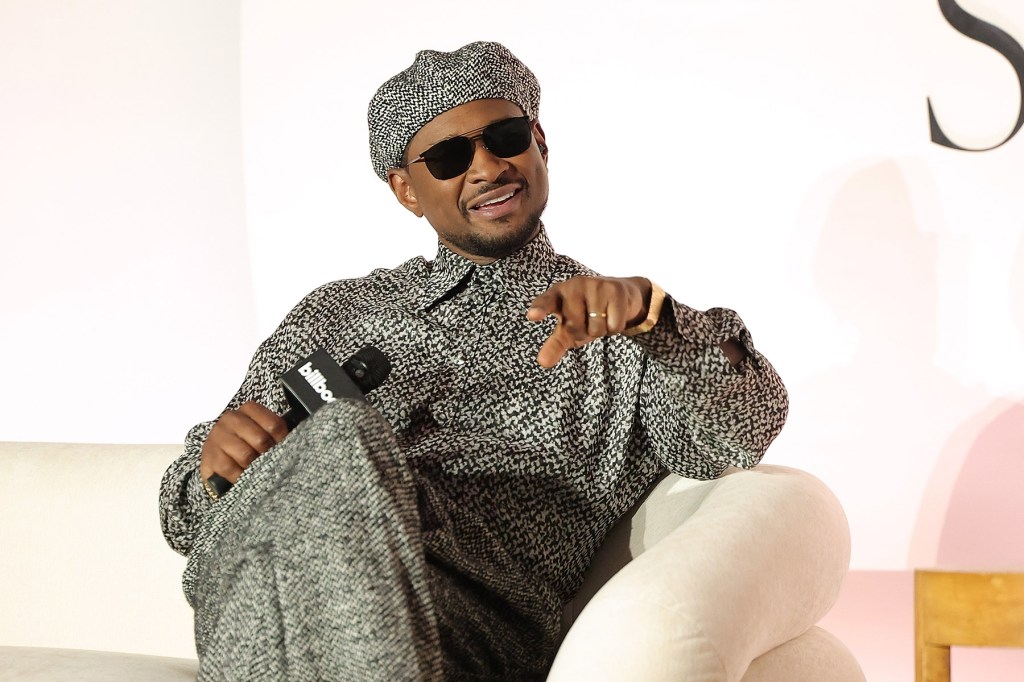
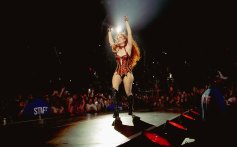
Usher took the stage at the 2025 Billboard Live Music Summit Monday afternoon (Nov. 3) to reflect on all of the stages he’s taken over during his 28-year touring career.
The R&B superstar and Gail Mitchell, Billboard executive director of R&B and hip-hop, walked out to his 2001 Billboard Hot 100 No. 1 “U Got It Bad” at the 1 Hotel in West Hollywood, Calif., which Mitchell reminded he previously said in his 2024 Billboard cover story that it was his favorite song to perform live. “I think because of the connection between me and the audience,” he said at the time. Today, he added: “I want to impress them. I would like to be as theatrical and use my imagination as much as I possibly can to lift the song higher than what it was when I delivered it as a piece of intellectual property.”
Following his two Las Vegas residencies from 2021 to 2023 and his Super Bowl LVIII halftime show performance (also in Vegas) last year, Usher embarked on his most recent Past Present and Future Tour. The 83-date international jaunt became his highest-grossing and best-selling tour yet, according to Billboard Boxscore, by grossing $183.9 million and selling 1.1 million tickets over 80 shows. He has a reported career gross if $422.6 million from 3.3 million tickets over 334 shows.
But before becoming a marquee act, Usher served as an opener for Diddy‘s 1997 No Way Out Tour, Mary J. Blige‘s 1997-98 Share My World Tour and Janet Jackson‘s 1998-99 The Velvet Rope Tour. “I had another notch on my belt in terms of what I was capable of being able to handle, so that when I went to try to headline my own tours, we knew that we had the ability to hold a crowd,” he explained.
He told industry audience members a story about his time opening for Diddy: As his 1997 hit “You Make Me Wanna…” was steadily climbing the Hot 100 (where it eventually peaked at No. 2), the crowd coming to see Usher gradually grew from 10 people to a packed house. Diddy told Usher he wanted him to come out during his headlining set, but Usher recalled saying, “Nah, I’m cool. I’m gonna stay right where I’m at because I wanna earn my keep. I’m here for a reason. I want to someday be where you are.”
By the time Usher embarked on his debut headlining tour, the 8701 Evolution Tour in 2002, he remembered “the importance of paying tribute” during those shows. “I’m an artist who was inspired by the legends. If I study the legends, then hopefully one day, I will be one,” he said, adding that he performed covers of Bobby Brown, Babyface and Jimmy Jam and Terry Lewis because he didn’t have enough of his own hit records at the time and wanted to still captivate his audiences.
The Coming Home artist also teased “something coming. I’m in the midst of working on something that may shine a light on a very specific period of my life and around performance. Just stay tuned. There is true value in live,” he said. He later argued that there’s also true value in R&B. “I want people to continue to celebrate the music and legacy that is the foundation that I am. It comes from soul music, it comes from the South. It comes from a very wide collective of being exposed to many different artists from many different genres, but most importantly, R&B.
“In the same way that I think all other industries have managed to monetize what they are — whether it’s hip-hop, rock & roll, country — I want the same thing for R&B,” he continued. “That is the thing that I haven’t done yet. I want us to celebrate the legacy of what it is that we created, not just look at these nostalgic things that have come and gone, but be able to savor them and savor their legacy.”
Mitchell later presented Usher the Legend of Live Award following the panel. He isn’t the only superstar panelist during the Live Music Summit. Billboard cover star Rauw Alejandro and Hans Schafer, senior vp of global touring at Live Nation, will sit down with Billboard Español/Latin chief content officer Leila Cobo later this afternoon to discuss the reggaeton artist’s emergence as one of the live sector’s most sought-after stars.
Trending on Billboard
When scrolling through TikTok following the onsale of Chappell Roan’s Visions of Damsels & Other Dangers Things tour dates, Foundations Artists Management’s Lauren McKinney noticed something interesting: In a stark contrast to most fans of major artists in 2025, the reviews were overwhelmingly positive.
McKinney and Roan’s team at Foundations scrolled the social media site to find “fans being excited they got tickets, and saying how calm the process was and how nice it was that they weren’t having to battle other fans,” McKinney told the audience at Billboard’s 2025 Live Music Summit in Los Angeles on Monday (Nov. 3) during a panel titled “No Bots Allowed: Inside Chappell Roan’s Fan-First Ticketing Strategy.” She added, “Our team was just so happy with that.”
Related
Wasserman Music Nashville’s Kristen Mitchell echoed McKinney’s excitement about the results of the ticketing strategy that they, along with AXS ticketing, implemented to ensure tickets for Roan’s nine-show summer run made it into the hands of fans instead of resellers. “I was obsessively reloading the AXS mobile reporting app, and I saw that at the Kansas City show, it was a 97% check-in. So, there was very little attrition. That’s incredible,” said Mitchell.
In 2025, concerts across the country are seeing higher-than-normal attrition rates (where far fewer fans show up to shows than the number of tickets sold) because many tickets are purchased during onsale and immediately placed on the secondary market for double or triple the face value. When fans are unable or unwilling to pay those exorbitant prices, those seats are left empty at the venues.
When tickets went on sale for Roan’s stadium dates, she and her team knew the demand for tickets would far outweigh the demand, so they turned to Fair AXS for a slower approach to selling tickets.
As Billboard reported in the 2025 touring issue, Roan’s fans signed up over a three-day period, after which AXS used a proprietary system to verify that each registrant was a real person, including those who had purchased Roan tickets in the past. AXS then delivered a list of registrants who met the criteria to her agents at Wasserman. The AXS team subsequently released a batch of ticket-purchasing invitations to fans across 24 hours. Based on the ratio of those fans who actually purchased the tickets, they subsequently released a second batch the following day, and a third the day after that.
“It requires a lot of trust in the fan to be patient in that process and know that they will have to sign up, wait a week, maybe receive an email,” McKinney said during the panel. “Overall, we learned that people are willing to be patient and willing to jump through some additional steps, if they can feel like the end result is equitable and that it’s a fair process all.”
AXS head of North American venues Dean Dewulf added that with Fair AXS, “we’re essentially deconstructing [the onsale] process.”
“We essentially are having a unlimited registration window where everybody can register. And what’s really important about that is that fans have two to four days, depending on the configuration of the program, to register when it’s convenient for them,” Dewulf explained on the panel, moderated by Billboard’s touring director Dave Brooks. “Once the registration ends, then we run it through our process to essentially hand pick and invite specific fans to buy the tickets.”
The process is a lot more intensive than a typical onsale and requires a lot more human power. As Mitchell joked, “AXS was not sleeping.”
“This was such a great passion project for a lot of the folks that worked on this,” said Dewulf on the panel. “We loved every minute. Honestly, this is why I got into the business. I don’t know about any of you, but getting tickets in the hands of real fans is really cool.”
When asked about how they deal with tickets that do end up on the secondary market, Mitchell said Wasserman has worked with AXS to combat the high prices by fighting fire with fire.
“AXS has something called AXS Distro, which actually allows you to — it sounds counterintuitive — but you’re feeding tickets to the secondary market. But you’re undercutting the pricing,” Mitchell said. “So, what happens when you undercut the pricing is people aren’t purchasing those higher price tickets.”
“I don’t know that that exists across other platforms, but I personally think that might be the future of what we’re looking at in ticketing,” Mitchelle continued. “I’m not saying that we want scalping, but it’s going to be there no matter what. So, it’s really on us as an industry to figure out how we’re dealing with that, and, in some cases, competing with it.”
Trending on Billboard
In today’s music economy, where streaming royalties remain thin and ticket prices continue to escalate, one of the fastest-growing and most resilient sectors is merchandise — and few companies are as prominent in the space as Universal Music Group’s wholly owned Bravado, which oversees the world’s largest music merchandise operation.
Bravado aims to unite artists and fans through products that aspire to be more than souvenirs, and at the center of its machine is its president, Matt Young. A 25-year merchandising veteran who joined Bravado four years ago, Young has shepherded the company through an era of unprecedented demand and logistical complexity, helping Bravado grow into a revenue engine that UMG says now generates over $900 million in annual business. But those top-line numbers tell only part of the story.
“We’re building bridges,” Young says, “allowing fans to touch something physical that represents the emotional connection they have to the music.”
Matt Young will participate in a panel at Billboard‘s Live Music Summit, held Nov. 3 in Los Angeles. For tickets and more information, click here.
Related
Young’s path to Bravado traces the broader arc of the merch industry. He began at Roadrunner Records in the late 1990s, when the label had started to flirt with what would become known as “360 deals,” which bundled merchandising with recording and touring rights. From there, he spent time at an independent merch company before moving on to Warner Music and helping it build its merchandise division. “I’ve seen this industry from every angle: indie, major, startups,” he says.
By the time Young joined Bravado in 2021, the merch sector had begun to mature into a sophisticated global business with its own supply chains and sustainability strategies. In his role, he oversees customized blueprints for artists who range from global superstars like Billie Eilish and The Rolling Stones to emerging bands on the club circuit. About one-quarter of Bravado’s roster is non-UMG acts, and the company’s model spans from tour merch sold directly at concerts to retail partnerships with American outlets like Hot Topic and others in Europe and Asia.
“Tickets and T-shirts,” Young muses, are now twin pillars of the touring economy, with some artists selling hundreds of thousands of dollars’ worth of items in a single night. For certain acts, particularly those with deeply engaged fans, the merch table rivals the box office as a source of income. This shift has also forced the industry to rethink product design, moving away from one-size-fits-all T-shirts toward fashion-forward collections, sustainable fabrics, upcycled inventory, exclusive colored vinyl, collectible collaborations and even action figures.
Billie Eilish posing with her merchandise at the Billie Eilish x American Express Hit Me Hard and Soft Pop Up on May 8, 2025 in Berlin, Germany.
Marcus Lieder
Meanwhile, the evolution of VIP experiences has further blurred the line between merch and fan engagement. Bravado’s premium programs for artist tours range from simple early-entry packages to elaborate meet-and-greet activations that command thousands of dollars. For bands like Pierce the Veil, VIP passes that grant barricade access and exclusive goodie bags have become essential fan experiences, while legacy acts like Def Leppard and KISS have offered photo ops and once-in-a-lifetime perks.
Yet challenges remain. The company must navigate tariffs and geopolitical disruptions to supply chains and shipping routes while managing its inventory and combating bootleggers — both the ones who have long hawked counterfeit shirts outside arenas and those in the Wild West of digital merch, where Instagram scammers selling fake band shirts is an ongoing issue. For Young, though, these obstacles underscore the stakes. In his view, merch is not only about revenue diversification but also about cementing culture through everyday objects that can transform passive listeners into active community members. Merch — and Bravado’s products — are both commerce and cultural currency. “This isn’t just what I listen to,” Young says. “It’s who I am.”
How big is Bravado’s business today?
Universal’s earnings reports show that merchandise generated north of $900 million last year. It’s a substantial piece of UMG’s overall revenue, and it means our side of the business gets attention at the highest levels.
You often describe merch as more than just souvenirs. What do you mean by that?
Music creates an emotion, and merch is the last tangible thing you can hold, wear or display that represents that feeling. A vinyl record — even for someone without a turntable — can be merch. A hoodie or a T-shirt is an identifier: It says, “This is who I am, this is the culture I belong to.” That’s more powerful than a simple transaction.
KISS posing with fans during a VIP experience on the band’s End of the Road Tour in 2023.
Keith Leroux
What does your job look like week to week?
It’s a mix. We run teams in cities across the globe — New York, L.A., London, Berlin, Tokyo, Sydney, Madrid, Nashville. So there’s operational management. But there’s also signing new artists, pitching them ideas, collaborating with labels and making sure our products fit each fan base. We also spend a lot of time on sustainability: upcycling leftover inventory, using recycled materials and building new processes to reduce waste.
How does upcycling work?
We partner with a company called Hallotex. They take old tour stock — unsold shirts, tote bags, whatever — break down the fibers and respin them into new cotton. That gets turned into new blank [shirts] for fresh merch. Or maybe it’s taking old tote bags and turning them into a blanket. It’s about turning excess into opportunity and cutting down on the warehouse full of leftovers that used to define this business.
How do the economics of merch work for artists?
There are three main buckets: tour sales, online stores and retail. On tour, there’s usually a truck following the band with inventory, and most of that money goes directly to the artist on a net-split basis. Online and retail work more like a royalty system since we handle production and logistics. Across the board, the splits are heavily in the artist’s favor — often 80% to 90% after costs. It’s often the No. 2 source of revenue [for artists] after ticket sales. It’s not unusual for a major tour to transact hundreds of thousands of dollars in merch in a single night.
What makes for a successful merch strategy?
Culture. If a band has a lifestyle built around them, merch thrives. Look at Billie Eilish, who insists on sustainability and explains it to fans every night. Or Olivia Rodrigo, who wore her own merch onstage. When the artist truly believes in it, sales follow. It becomes part of their identity and their fans’ identities.
What kinds of products are trending now beyond T-shirts and hoodies?
Exclusive vinyl colorways for tours, blankets for amphitheaters, memorabilia books like Olivia Rodrigo’s, collectible action figures like we did for Rihanna, Slipknot’s masks and jumpsuits. It’s all about matching the lifestyle of the artist with the passion of the fan.
Rihanna collectible action figure, “Rhenna”.
Courtesy of Bravado
How do global challenges — tariffs, Brexit, supply chain issues — affect you?
They definitely add complexity. Brexit alone changed how we move goods in and out of Europe. Tariffs can impact pricing and margins. But we have logistics teams built to handle that. We try to be nimble and find ways to keep delivering.
What about risk? Not every product is going to be successful. How do you deal with demand uncertainty?
The key is smart inventory control. We measure sales every night on tour and adjust orders quickly so we don’t get stuck with piles of leftovers. Years ago, I inherited a warehouse in Nashville that was literally two football fields wide full of unsold merch. That doesn’t happen anymore. We recycle, upcycle and design smarter so we’re not flooding the market. And when there is excess, we’ll sometimes move it online for fans who couldn’t get to the show.
How much do fashion trends dictate what you create?
A lot. Kids today don’t want the same cuts we sold 10 years ago. Right now, shorter, wider shirts are in. A few years ago, it was skinny fits and super-thin fabrics. Hip-hop audiences might prefer heavyweight blanks, while pop audiences want pajamas or skirts. It’s about curating for each fan base — answering their call rather than handing them a generic black T-shirt.
Machine Gun Kelly wearing a shirt from the collection he collaborated on with his hometown football team, the Cleveland Browns, at the start of the current football season.
Sam Cahill
Do you work outside music, with comedians or podcasters?
Yes. We do VIP and merch for Kevin Hart, and we also work with Shane Gillis, who’s one of the biggest comedians in the country right now. Comedy is different — comedians don’t pile into vans for long tours; they fly in for weekends. But they have catchphrases and bits that translate perfectly to merch. We also work with YouTubers and media personalities if it makes sense for our demographic.
Do macroeconomic shifts — inflation, politics, consumer confidence — affect your numbers?
On tour, not really. Since COVID, merch numbers have been the highest we’ve ever seen. People are celebrating being back in shows and merch is part of that. At retail, yes, you see slowdowns when inflation hits or tariffs drive up prices. But live is resilient. People are buying hoodies, vinyl and collectibles as part of the celebration of going to a concert.
Bootleggers have been around forever. Are they still a problem?
Always. If you’re buying from a guy in the parking lot, it’s not legit. And while the shirts might be cheap, they fall apart. But there’s also a fascinating subculture of vintage band tees. Original Nirvana or Nine Inch Nails shirts from the ’90s can sell for thousands of dollars today. That market is booming, and in some ways, it fuels demand for new designs, too.
Looking ahead, where’s the growth?
Digital. We’re learning as we go in video games and online platforms — it’s still the Wild West. There’s also a fight against online piracy, with fake ads on Instagram and Facebook. Beyond that, it’s about converting casual fans into superfans with unique, culturally relevant products. At the end of the day, it’s about making sure fans feel closer to their favorite artists.
This story appears in the Oct. 25, 2025, issue of Billboard.