State Champ Radio

by DJ Frosty

Current track

Title

Artist

Current show

State Champ Radio Mix

12:00 am 12:00 pm

Current show

State Champ Radio Mix

12:00 am 12:00 pm


Author: djfrosty

Page: 625

Wisp performed for the first time at Coachella, and she shares her experience of debuting her new single “Get Back to Me” at the festival, her favorite part of Coachella and more!

Are you excited for her new single? Let us know in the comments below!

Tetris Kelly:So from the Hot Hard Rock songs No. 10. Like, you were top 10 there, and now playing Sonora stage with so many other amazing rock acts. How was it?

Wisp:It was amazing. I had so much fun. 

And then, what is that … the vibe over there? Because I feel like in that specific stage, like everybody’s just having a good time. 

Yeah, I was so relieved that I was playing Sonora stage because it’s so enclosed and it’s dark, and I feel like that’s the perfect vibe for my music. So it was really fun. It was packed, too.

Yeah, it was packed for your set. And I mean, you also debuted some new music. 

I did!

So how was it to play “Get Back to Me”?

It was amazing. I love that song, and I’m really excited for it to come out. 

And then, what have your fans felt when they were … how did you feel when they’re, like, did you debut a new song and like, they’ve never heard it before?

Yeah, I don’t know. Sometimes it’s hard to tell what people are thinking, but I feel like they were pretty well received today, so I’m happy.

And then, how has Coachella been, in general? Because this is your very first Coachella. 

It is.

So, like, how has it been walking around? What’s been your favorite part?

It’s been so fun. My friends are here as well. So we’ve seen a couple sets yesterday. Clairo was my favorite. She was amazing. 

Keep watching for more!
The inaugural MUSIC AWARDS JAPAN ceremony, the largest music awards in the country, is set to take place in May in Kyoto. Embodying the theme of “Connecting the world, illuminating the future of music,” the new international music awards is hosted by the Japan Culture and Entertainment Industry Promotion Association (CEIPA), an association jointly established by five major organizations in the Japanese music industry.
This year’s MAJ will recognize works and artists in more than 60 categories, including the six major awards for Song of the Year, Artist of the Year and more, which have gained significant attention and recognition from Jan. 29, 2024 to Jan. 26, 2025. The entries for each category were announced last month and the nominees for each category was revealed Thursday (Apr. 17).

Trending on Billboard

The third installment of Billboard Japan’s series exploring the trends and characteristics of MAJ will focus on the entries in the Best Cross-Border Collaboration Song category that honors songs written in collaboration between domestic and overseas artists. Let’s take a look at how Japanese music interacts with the world, using data of the entries for this award.

The Artists’ Involvement in the Creative Process is Key

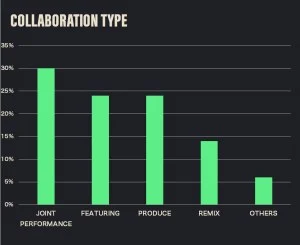
We divided the 50 entries into five types and calculated the percentage of songs in each. “JOINT PERFORMANCE” refers to co-writing as well as joint performances, and “FEATURING” refers to guest appearances (remixes of existing songs fall under “REMIX”). More than half the entries fall under JOINT PERFORMANCE or FEATURING.

“PRODUCE” refers to tracks where artists from overseas participate as producers in songs by Japanese artists, and accounts for 24% of the total. This includes Fujii Kaze’s “Feelin’ Go(o)d”, f5ve’s “UFO” (both produced by A.G. Cook), and ONE OR EIGHT’s “Don’t Tell Nobody” (produced by Ryan Tedder of One Republic).

For many of the songs that fall under JOINT PERFORMANCE, FEATURING and PRODUCE, the artists themselves participated in the creative process, such as writing the lyrics and composing the music. In the second installment of this series, we noted that the entries in the Top Global Hits from Japan category seem to be slightly more oriented towards artists who write and perform their own works compared to those up for the Song of the Year award, which honors songs popular in Japan. The same can be said for collaborative works that span countries and regions. It seems that, compared to within Japan, it’s more important for artists to be actively involved in the creative process overseas, both from the perspective of listeners and creators.

Affinity With the Collaborators’ Nationalities

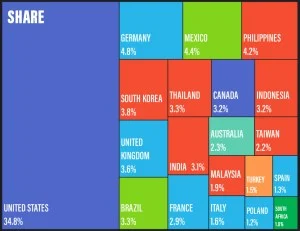
The above shows the share of each country/region excluding Japan, calculated by adding up the number of streams of all entries in the Best Cross-Border Collaboration Song category during the tallying period. The country with the highest share was the United States, and it also leads the list of the collaborators’ nationalities, which we’ll touch on later, but the order below second place didn’t match the collaborators’ nationalities at all. This shows that the collaborators’ nationalities and the countries/regions where the songs are actually listened to do not necessarily match.

For example, “Bekhauf,” the collab between BABYMETAL and the Indian metal band Bloodywood, accounted for 1% of the streaming numbers in India. Meanwhile, “RATATATA,” the collab between BABYMETAL and the German metal band Electric Callboy, accounted for 49% of the streaming numbers in Germany. One reason for this difference is that the market for metal music in Germany is more mature than in India. From this trend, we can see that affinity with the collaborators’ nationality is also an important factor in maximizing the effect of collaborations.

Countries/regions Interested in Collabs Between Japanese and Foreign Acts

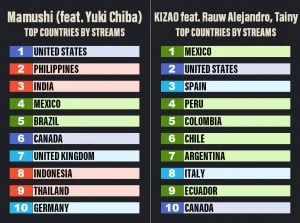
Megan Thee Stallion’s “Mamushi (feat. Yuki Chiba)” was the collaborative number with the most streams among this year’s entries, with an large share in multiple countries/regions including the U.S. (68%), the Philippines (79%), India and South Africa (both 87%). When there’s a song with such an overwhelming share, the overall share is greatly influenced by the trend of that song.

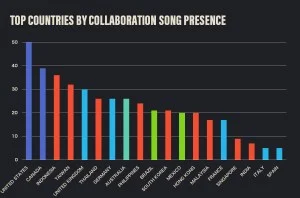
So to identify countries/regions with high interest in collaborative songs in general, rather than a specific one, we extracted the top 10 countries/regions for each song’s streaming numbers and compiled the number of songs that charted in the top 10 by country/region. Countries/regions ranked multiple times in the top 10 of each song’s list likely have strong tendencies to consistently support collabs between Japanese and overseas artists.

Top Countries Excl. Japan by Streams According to Luminate

Total Number of Entry Songs in Top 10 by Country/Region

Canada, Indonesia, and Taiwan came in at Nos. 2, 3, and 4. These are all countries/regions that didn’t rank high in terms of collaborators’ nationalities and streaming numbers. These countries/regions are considered to have high interest in songs featuring Japanese artists, regardless of who they collaborate with. Taiwan, in particular, had 32 songs in the top 10 despite its relatively small population.  

The Properties of Collaborative Songs

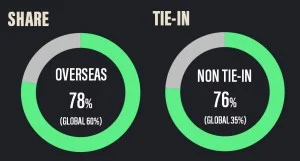
Next, looking at the domestic and international streaming shares of the entries in the Best Cross-Border Collaboration Song category during the tallying period, 78% of the total streaming count for all 50 songs combined came from outside Japan. This is higher than the percentage of overseas streams for the entries in the Top Global Hits from Japan category, an award for Japanese music being listened to outside the country (59%), indicating that collaborative songs are more actively listened to overseas. Approximately 80% of the songs weren’t linked to other works or products, suggesting that whether or not a collaborative song is a tie-in doesn’t influence its popularity.

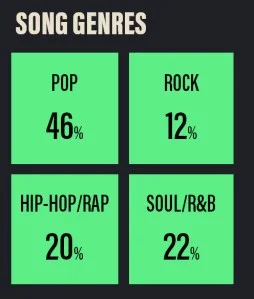
The chart above shows the genre breakdown of the entries. Soul/R&B accounts for 22% of the total, largely due to the six songs by SIRUP that made the list. Hip-Hop/Rap accounts for 20%, and here, all tracks except for two by Chanmina are by different artists. Notably, the share in this genre is 15% more than the 5% in Top Global Hits from Japan. 

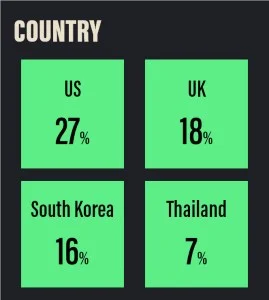
The percentage of the collaborators’ nationalities was calculated based on the number of artists. The United States (27%) had the highest percentage, with many collaborations with rappers such as Megan Thee Stallion and Big Sean. The United Kingdom (18%) featured artists associated with Hikaru Utada, such as Sam Smith and A.G. Cook.

South Korea has entries featuring rappers such as ASH ISLAND and Zion.T, as well as collaborative tracks with dance and vocal groups like ATEEZ. Three songs have entered from Thailand: BALLISTIK BOYZ from EXILE TRIBE’s “Meant to be feat. F.HERO & BOOM BOOM CASH,” ATARASHII GAKKO!’s “Drama (feat. MILLI),” and HYBS x SIRUP’s “I’m Blessed.”

Cross-border collaborations are becoming an important channel connecting Japanese music with the world, and the Best Cross-Border Collaboration Song award is a symbolic category that captures this global trend. We hope this award will serve as an opportunity to further enhance the presence of Japanese artists in the international music scene.

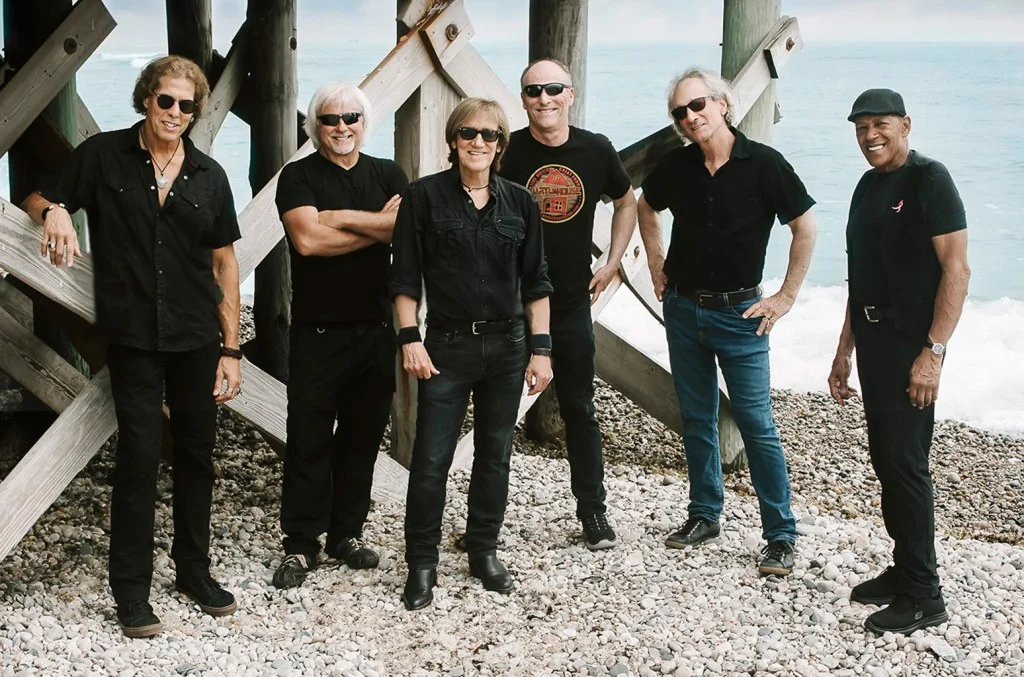
John Cafferty and the Beaver Brown Band, the journeyman rockers who brought bar-band authenticity —and hits like the real-life top 10 Billboard Hot 100 smash “On the Dark Side” — to the group portrayed in the 1983 film Eddie and the Cruisers, have returned with Sound of Waves, their first album of all-new songs in […]

After opening for Taylor Swift at some of the biggest venues in the world, Gracie Abrams says she hopes to return as a headliner someday.
In her Billboard cover story published Thursday (April 17), the 25-year-old singer-songwriter was candid when asked by staff writer Hannah Dailey whether she aspired to someday tour through stadiums amid her recent career spike, which has found Abrams leveling up from playing shows in theater-sized venues to full-on arenas in a matter of months.

“Hell yeah,” the “That’s So True” musician replied immediately, before confessing that she didn’t always feel that way. “I could have never imagined myself admitting to that. I think having had the privilege of opening for Taylor in the stadiums that we played, to now have a visual reference and a real sense of what it feels like to be on a stage in that environment … It’s something that I miss and desperately hope to earn over time,” she added.

The interview comes about two years after Abrams opened her very first show on the “Anti-Hero” singer’s global Eras Tour, which kicked off in spring 2023. In between headlining her own treks for albums Good Riddance (2023) and The Secret of Us (2024), the “Risk” artist would go on to spend a collective six months supporting Swift in stadiums all over North America.

Trending on Billboard

Shortly after playing her final Eras show in December, Abrams embarked on her first-ever arena trek that began with a month of European shows earlier this year. She’ll continue over the next few months with legs in Asia and Australia, and this summer, she’ll return to the U.S. for more arena dates, including two nights at New York City’s Madison Square Garden.

Abrams has been open about how studying Swift on the Eras Tour has taught her ways to improve her own performances, but in her Billboard cover story, the former also shared how simply observing the latter has helped her stay afloat amid the new level of fame she’s hit. “It’s like, I really don’t have it that bad in terms of invasion of privacy, you know what I mean?” Abrams marveled. “I feel like I learned a lot from [Taylor], obviously, but one of the things that I’ve felt lucky to observe is how extreme it can be [for her].”

She added, “It helps right-size my own s–t.”

The Grammy nominee also gushed about another one of her past tourmates: Olivia Rodrigo. “She gave me such a shot, opening for her on the Sour Tour,” Abrams raved of the “Vampire” singer. “I adore her with my whole heart for forever and ever.”

“Gracie has such a singular voice when it comes to songwriting,” Rodrigo said in return. “I think it’s rare to be so young and already have developed your very own lane.”

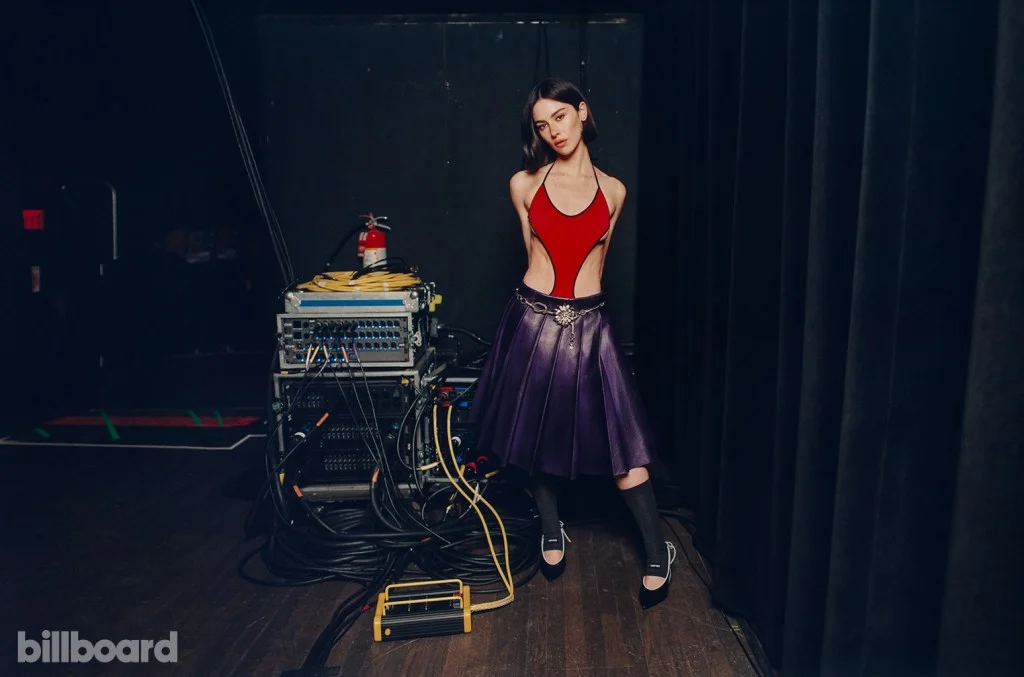
See Abrams on the cover of Billboard and photos from the shoot below.

Mrs. GREEN APPLE’s “KUSUSHIKI” rises 6-1 on the Billboard Japan Hot 100, on the chart released April 16.
The three-man band’s latest single is being featured as the opener for the anime series The Apothecary Diaries Season 2 Part 2. The song was digitally released on April 5 and debuted on the chart last week at No. 6 despite having only two days to count towards the chart week. Looking at each metric, the track rules streaming (313% week-over-week) and comes in at No. 2 for downloads (92%) and video views (275%), and No. 4 for radio airplay. Other songs by the hitmakers also only saw slight decreases in points and 17 continue to chart on the Japan Hot 100.

HANA’s “ROSE” drops a notch to No. 2 after bowing atop the chart last week. Downloads and video views for the brand-new girl group’s debut single are down to 42% and 78%, respectively, but streaming and radio have gained to 131% and 168% week-over-week. Perhaps due to the impact of its debut at No. 1 last week, the track is spreading across various platforms. 

Explore

Explore

See latest videos, charts and news

See latest videos, charts and news

Mrs. GREEN APPLE’s “Lilac” slips to No. 3. Logging its 53rd week on the Japan Hot 100, downloads for the Oblivion Battery opener have gained to 112% and only show slight decreases in other metrics: streaming at 99%, radio at 73%, video at 94%, and karaoke at 87% compared to the week before.

Trending on Billboard

NMB48’s “Chu Strike” bows at No. 4. The group’s 31st single launches with 253,080 CDs, more than its predecessor, to rule sales this week and comes in at No. 63 for radio.

Sakanaction’s “Kaiju” follows at No. 5. Radio airplay for the track is up to 114% compared to last week and karaoke to 118%. The Orb: On the Movements of the Earth opener comes in at No. 14 for downloads, No. 5 for streaming, No. 22 for radio, No. 4 for video, and No. 18 for karaoke.

Snow Man unleashed its catalog on digital platforms during the chart week (April 7) and six tracks by the popular boy band have charted. “Brother Beat” currently leads the pack, hitting No. 48 on the Japan Hot 100 (No. 12 for downloads, No. 51 for streaming), “Tapestry” is at No. 52 (No. 8 for downloads, No. 62 for streaming, No. 93 for video), “Dangerholic” is at No. 64 (No. 23 for downloads, No. 66 for streaming), “D.D.” is at No. 77 (No. 26 for downloads, No. 79 for streaming), “EMPIRE” is at No. 87 (No. 19 for downloads, No. 88 for streaming), and “SBY” is at No. 98 (No. 21 for downloads, No. 57 for streaming).

The Billboard Japan Hot 100 combines physical and digital sales, audio streams, radio airplay, video views and karaoke data.

See the full Billboard Japan Hot 100 chart, tallying the week from April 7 to 13, here. For more on Japanese music and charts, visit Billboard Japan’s English X account.

MUSIC AWARDS JAPAN (MAJ), the largest music awards in the country, is set to take place at the ROHM Theatre Kyoto on May 21 and 22.
With this year’s theme “Connecting with the World, Illuminating the Future of Music,” the inaugural international music awards is hosted by the Japan Culture and Entertainment Industry Promotion Association (CEIPA), jointly established by five major organizations in the Japanese music industry, including Recording Industry Association of Japan, Japan Association of Music Enterprises, the Federation of Music Producers Japan, Music Publishers Association of Japan, and All Japan Concert & Live Entertainment Promoters Conference. 

Although the entities are in the same industry, the five organizations have rarely collaborated until now because of differences in business and objectives. But the crisis faced by the entertainment and live music industry due to the COVID-19 pandemic, as well as the spread of streaming services and the success of Japanese entertainment spaces such as the world of anime, prompted the five organizations to unite to work for the future of the country’s music industry.

Explore

Explore

See latest videos, charts and news

See latest videos, charts and news

The content industry, which includes music, is worth 4.7 trillion yen and gaining momentum. That’s a sizable figure compared to the sectors in Japan’s export sales, as the automobile industry is worth 17.3 trillion yen, the semiconductor industry is worth 5.7 trillion and the steel industry is worth 5.1 trillion. The Japan Business Federation has positioned content as a key industry for the country and proposed that it be increased from 4.7 trillion to 20 trillion yen by 2033. The export of entertainment from Japan to the world is set to become a full-fledged industry. And with the aim of supporting and promoting the globalization and sustainable growth of the country’s music industry, CEIPA joined forces with TOYOTA GROUP to launch the MUSIC WAY PROJECT. In March, the project hosted a showcase event in the United States featuring Ado, ATARASHII GAKKO! and YOASOBI called matsuri ’25: Japanese Music Experience LOS ANGELES. It was presented by CEIPA x TOYOTA GROUP “MUSIC WAY PROJECT,” and the MUSIC AWARDS JAPAN ceremony is part of this endeavor.
So, why was the MUSIC AWARDS JAPAN created in the first place? The answer lies in the changes in Japan’s unique music market, which sits on the border between opportunity and challenge. According to the RIAJ, physical sales accounted for 62.5% of Japan’s content sales in 2024. According to the IFPI, Japan maintains the world’s second largest market and its market structure differs from that of other countries. The temporary increase in disposable time due to the stay-at-home orders during the pandemic led to the expansion of the streaming market worldwide and a change in market structure has also occurred in Japan. Today, the number of artists gaining recognition in the U.S. and East Asian countries is increasing, and the revenues of the streaming and live music industries continue to rise. The Japanese music industry and companies are seeing potential in the fact that the number of Japanese songs and artists being listened to outside the country are only gaining traction.

When it comes to nominations, MUSIC AWARDS JAPAN places importance on four factors: transparency, global collaboration, celebration and creativity. The awards place the highest importance on trust and fairness, both from the artists and creators involved, as well as from the listeners who support the music. The criteria for selection, including the chart data from Billboard Japan, of approximately 3,000 works entered in the 62 categories include the six major awards for Song of the Year, Artist of the Year and more. The considered works are ones that have gained significant attention and recognition between Jan. 29, 2024, to Jan. 26, 2025. The entries for each category were announced in March, and the nominees will be revealed on Thursday, April 17. The detailed rules and schedule for how these works are selected as final nominees are listed on the website. The overseas voting members include Hannah Karp (Editorial Director, Billboard), Lucian Grainge (Chairman and CEO, Universal Music Group), Rob Stringer (Chairman, Sony Music Group) and Robert Kyncl (CEO, Warner Music Group).

Now, CEIPA is calling on music industry professionals eligible to vote to consider the future of Japan and music when choosing works they think deserve an award. This means there is nothing wrong with artists voting for their own work or for those of other artists. There are also categories where fans can vote for the artists they support, too.

The nominated works chosen through this process have just been announced and can be seen onthe awards’ official website. After another round of voting, the winners will be announced at the awards ceremony, which will be broadcasted live on YouTube so viewers across the world can have the opportunity to hear the selected works. This will be a step toward helping artists in their activities overseas. Although the majority of awards are targeted at Japanese works, there are also awards that celebrate Asian artists in collaboration with other Asian countries, and awards that recognize foreign artists who are listened to in Japan.

As the inaugural awards aim to deepen the connection between Japanese music and the rest of the world, Yellow Magic Orchestra (YMO) has been honored with the Symbol of Music Awards Japan 2025. Founded in 1978 by Haruomi Hosono and the late musicians Ryuichi Sakamoto and Yukihiro Takahashi, YMO is one of Japan’s most beloved acts who toured successfully overseas from the early days of their career and gained popularity around the world. The “Rydeen” group’s timeless, innovative music, activities and style make them a “symbolic presence that teaches us the future” that the MAJ strives to aim for. A YMO tribute concert will take place at the Kyoto International Conference Center on May 20.

“We want to use matsuri ’25 and MAJ as springboards to promote Japan’s wonderful music content,” Tatsuya Nomura, president of the Federation of Music Producers Japan and chairman of the Music Awards Japan Executive Committee, said at the matsuri ’25 JP Music Industry Mixer & Panel press conference hosted by JETRO. “And we want to create the future of the Japanese music industry through a cycle in which Japanese artists are inspired by these projects and create wonderful works.”

Global music exchange will influence fans around the world and will lead to the enrichment of the global music market as a whole. As the Japanese music industry prepares to make a strong move toward repositioning itself in the world market, it’s surely worth paying attention to the direction it’s taking.

Last month, Billboard was invited to the Spotify offices in Downtown Los Angeles to meet its top editors and curators and get an inside look at how Spotify’s playlists come together, genre-by-genre. And leading that team is Sulinna Ong, global head of editorial at Spotify. Over time, Ong has held a variety of roles at companies like Live Nation, Sony BMG Music and French streaming service Deezer, before joining Spotify in 2019. After coming aboard, she served as its Head of Music (UK) and Head of Artist and Label Services (UK) before taking the helm of editorial.
In her role, Ong has worked to evolve what playlists can be — from launching the ephemeral and personalized options like Daylist and AI DJ, to further building out the worlds of longstanding flagship playlists RapCaviar and Today’s Top Hits. These days, most of all, Ong is interested in adding more context to the playlists, as she senses Spotify users becoming increasingly interested in having more of a human touch to those listening experiences.

Trending on Billboard

To explain her strategy with Spotify’s editorial in 2025, Ong sat down with Billboard for an extended interview to explain her stance on AI music in playlists, changing user behavior, future growth markets and why she wants to bring her team of editors into the spotlight more than ever.

What are some of your goals for Spotify’s editorial team in 2025? 

We’re thinking about how to make the playlists more engaging, and we think it’s a combination of short-form video and editorial. We refer to our roles as editorial, but they also involve curation. Editorial is the storytelling, the context: “Why is this important? Why is it culturally relevant?” The curation is, “What song? What artist?” There’s an art to combining both. As we look to the future, the editorial side is becoming even more critical. We are doubling down as human music editors in music discovery and trend forecasting in 2025.

What will this editorial short-form look like? And is it something that’s interactive, allowing for comments, likes, etc.? 

We format this in what we call editorial Watchfeeds. That will include written track commentary, editor videos and more. We’ve been thinking about how do we incorporate social and community elements? Whether that’s commenting, liking — it’s a combination of all those things.

Spotify used to have more social-like features, like the direct message feature, which has since been removed. Do you see this move towards more social elements as a way to retain users in-app? 

We want to broaden the ecosystem. We want to have our users spend as much [time] as possible and interact with one another as well. One of the editorial Watchfeeds that we did, as an early example to test the hypothesis, was Carl Chery [head of urban editorial] during the Drake–Kendrick battle. We kept getting asked, especially Carl, about what was happening. It was all coming so fast. So we did an editorial Watchfeed where we explained it in sequence. That did really well. Some of the feedback from users was, “I didn’t have to go elsewhere to find this information.” That was really interesting for me. 

Why did you decide that short-form video was the right way to editorialize these playlists? 

In a world where people’s attention spans are short, it made sense. Are users really going to sit and watch a 30 minute diatribe monologue before getting into the playlist? That’s not realistic.

TikTok, Reels and Shorts have been in the short-form video space for years now. Is Spotify getting on this trend too late? 

We’re not a social media platform. This is a tool to expand the storytelling experience of the music and the recommendations, which is why it’s not all short-form video. It’s just one part of our toolkit. Text and track commentary is also something we want to do, so it’s not all short-form video content. 

For a long time, it was Daniel Ek’s goal to make Spotify the destination for audio. More recently, that goal has expanded to video. The Watchfeed is not the first time Spotify has experimented with video. What have you learned from previous successes and failures with video on Spotify? 

We experimented with longer-form video a few years ago, and it didn’t really connect. I think actually podcasts were something that were really interesting for us to watch. It was interesting to see how core video actually ended up being to the podcast experience and the podcast audience. Yes, podcasts are longer-form, but might that be interesting for a playlist experience to try some kind of video for editorializing? I come back to editorializing because that’s what podcasts do — they provide context on a topic. We thought the next step is to do that for music. It’s not exactly the same experience, it’s not like for like, but there are components of that technology that became Watchfeed.

Until now, Spotify’s curators have largely worked anonymously. Why change that?

A lot of thought went into it. When you think about the era that we’re in in terms of AI and machine learning, people want to know — is this AI or human? What’s your point of view? AI doesn’t have a point of view. We found that people actually are interested about the people behind the playlist. 

Over the couple of years, Spotify has leaned into cutting edge tech-driven features like Daylist or AI DJ. In 2025, though you’re leaning into editorializing playlists. How do you see the balance between human and algorithmic aspects of playlisting today? 

They live together. I’ve never seen it as an either/or situation. I think you need both and both have unique strengths. Over time the editorial role has grown. But we are still focused on the strengths of each and combining the two. 

AI has played a key role in some of your newer features, like AI DJ, but how does the editorial team treat generative AI music that ends up on Spotify? Do you have any rules against playlisting it? 

We are focused on human artists and the music they create. That is what we feel is really important. We did curate, though, Kito’s track [“Cold Touch”] that used Grimes’ AI voice on it. But Kito is a bonafide artist that had the blessing of another artist to use her AI likeness and voice. That is different to us. But we think very thoughtfully about our focus on supporting real, human artists. To this point so far, I have not seen a generative AI artist or track take off. That’s not to say that it won’t happen in the future, but right now, that’s not what we’re seeing.

What markets do you think will grow significantly in the next few years? 

India will only be a more important player. Same with Southeast Asia. It’s interesting to look at Southeast Asia because we see Western artists actually getting their foothold in countries like the Philippines. In general, local-language content continues to grow. 

I’ve been asking all of your editors the same question: What is the most common misconception about the role of a Spotify curator? 

There are two. There’s that we are in service to labels and we curate what we’re told; that can’t be further from the truth. There’s an editorial independence that the editorial team has. The second misconception is that you can pay to get on an editorial playlist. I still see people claiming that they can get you on one for a price. It’s a scam. We have a code of ethics for our editors. 

What are some things that are part of your code of ethics, and has your code of ethics evolved over time? 

We have strict rules to protect our editorial independence, like if we get invited to a gig or a festival, and there’s an offer to cover our flights or travel, we’re not allowed to accept. If there is a reason, a business reason, for us to be there, Spotify will cover our travel. We don’t want to be beholden to anyone. And we are constantly reviewing [our code of ethics]. It’s a yearly process of, like, “Do we have the right guidelines and guardrails in place?”

There are reports that there is a super-premium tier on the way for Spotify users willing to pay an extra subscription cost. In return, they will receive new features. Are there any extra editorial offerings in the upcoming new tier? 

I don’t have any info to share with you other than what you already know. We are obviously always thinking about what superfans want and what would entice them to go onto that super premium tier, but I’ve got no details to share. 

Dating back to a Music Business Worldwide story in 2016, there have been reports that Spotify has used company-owned music or so-called “fake artists” or “ghost artists” in its playlists, like Peaceful Piano or Ambient Chill. Those allegations resurfaced this year in the book Mood Machine. Can you provide any comment or clarification on those allegations? 

My team curates purely editorial lists. We curate playlist music from artists. Our team doesn’t touch that.

How much creative freedom do editors actually have? How often do they get the ability to go with their gut? 

They’ve got a lot of freedom to do that, but you do need to critically explain why you believe in something. There’s a balance between our personal tastes and what we think will resonate with a listener. You need to understand the shift between the two. As an editor, it’s important to understand what your biases are and make sure you are not curating with bias. What I mean by that is overdoing it because I really love this artist, or [underdoing it] because I don’t. That’s why we also curate in groups, so we challenge each other. “Why is that there? Why is that not there?” It’s actually part of our training.

It sounds like the playlists operate in a tier structure. Like, an artist can get on Fresh Finds, and if it does well, then maybe the artists get onto All New Indie next. Is that right? 

Yes, we have a playlist pyramid. It’s like working an artist up through the ecosystem. You can’t slam an artist into a big flagship. There needs to be a strategic approach as to how you introduce someone to a new audience.

When Spotify’s social media accounts started posting about the editorial team’s song of the summer predictions in 2024, global head of editorial Sulinna Ong noticed a lot of commenters asking the same question: Is this artificial intelligence? “I actually went in and said, ‘I can assure you we’re not AI,’ ” she says, adding that she then found herself wondering, “Do people care whether it is [AI]?” The answer was a resounding yes. Ong recalls commenters were overjoyed to be able to identify her as a warm-blooded source of the faceless predictions. The reaction amounted to a collective “This is great. You’re human!”
Having focused on high-tech improvements to playlisting over the last few years, such as the AI DJ that subscribers can utilize and improved personalized Daily Mixes, Daylist and other features, Ong says she realized listeners value human input and connection more than ever and decided to recalibrate the “equilibrium” between AI and Spotify’s flesh-and-blood tastemakers.

Trending on Billboard

“A big tenet of editorial is this idea of reflecting culture and also being able to propel culture forward,” says J.J. Italiano, head of global music curation and discovery.

As a result, Spotify’s editorial team is leaning further into its top playlists with new “Watchfeeds” — written and video content that contextualizes its choices. There’s also more freestyling involved, such as the throwback songs that Spotify head of urban music, editorial Carl Chery slips into RapCaviar on Thursdays, or the newsletter that head of indie/alternative Lizzy Szabo writes for Lorem. Ong says interactive elements such as likes and comments may be added in the future.

To further individualize their work, Spotify’s editorial team came together for a photo and spoke to Billboard about their backgrounds, their work and their favorite music. “We know that cultural knowledge is really important. AI and machine learning excel in passing large data sets and scaling, but when it comes to cultural understanding, that’s where human editors really excel,” Ong says. “But we are still focused on the strengths of both [tech and human features] and combining the two.”

Sulinna OngGlobal head of editorial

Sulinna Ong

Yuri Hasegawa

Raised in the United Kingdom, Iran and Australia, Ong caught the music bug when she heard Kim Gordon singing Sonic Youth’s “Kool Thing” as a 13-year-old. She worked in a wide array of roles for Live Nation, Sony BMG Music and French streaming service Deezer before joining Spotify in 2019. Prior to assuming her current position in 2021, Ong served as the streaming platform’s U.K. head of music and U.K. head of artist and label services.

Favorite Spotify playlists?

Misfits 2.0, Liminal.

What are your 2025 goals for the editorial team?

We’re thinking about how to make the playlists more engaging, and we think it’s a combination of short-form video and editorial. We refer to our roles as editorial, but they also involve curation. Editorial is the storytelling, the context: “Why is this important? Why is it culturally relevant?” The curation is, “What song? What artist?” There’s an art to combining both. As we look to the future, the editorial side is becoming even more critical. We are doubling down as human music editors in music discovery and trend forecasting in 2025.

Until now, Spotify’s curators have largely worked anonymously. Why change that?

AI doesn’t have a point of view. We found that people actually are interested about the people behind the playlists.

Read Ong’s full interview here.

Carl CheryHead of urban music, editorial

Carl Chery

Rebecca Sapp

After working at hip-hop magazine XXL, Chery joined Beats Music in 2012, which was folded into Apple Music in 2014. He oversaw hip-hop and R&B at both streaming services before moving to Spotify in 2018, where he leads curation for its urban music playlists, including RapCaviar.

Favorite Spotify playlists?

Locked In, Gold School.

What trends are you spotting?

I’m interested in seeing what happens with sexy drill. Drill’s been around for a long time, and it keeps morphing. If you go back five years, that’s when it really broke through with Pop Smoke and Fivio [Foreign] and the Brooklyn drill scene. Part of the conversation around drill is that its subject matter is so hardcore it’s potentially [limiting the style]. But sexy drill has a lot of appeal. I’m keeping an eye on whether this is going to finally break through as the sound du jour in hip-hop.

What are some common misconceptions about Spotify editors?

Some people think playlisting is based on favors. They don’t pitch songs based on their merits or performance. They think building a relationship with editors enhances their chance of getting playlisted. That’s never been the case. [Others] think that playlisting is based on personal taste. Technically, it doesn’t matter if we like it. One of the most important qualities for editors is to be objective, [though] this doesn’t mean that personal taste doesn’t come into play. The sweet spot is when you get to support something that is at the intersection of your taste and what the audience likes.

Ronny HoHead of dance & electronic, editorial

Ronny Ho

Yuri Hasegawa

Though Ho booked concerts and hosted radio shows in college, she first worked in investment banking, and her initial job at Spotify was in business development. During her first years at the company, she got to know the members of the editorial team because she sat next to them. After moving to Spotify’s music team as a business manager, a role opened up in editorial, and she was given a tryout despite her unorthodox résumé.

Favorite Spotify playlists?

Tech House Operator, Marrow.

Given the global popularity of dance, how do you coordinate with curators around the world to make the best playlists?

We have global curation groups. Dance was one of the first ones that started. It happened naturally with us just reaching out to curators in other markets to see what they’re seeing. We talk now on a weekly basis about new music coming out, trends that are popping off, local subgenres or communities we find interesting.

How are you discovering music for your playlists?

It’s a mix. We get inbound pitches from the Spotify for Artists pitch tool, but I am also going to shows all the time. A lot of DJs are rinsing tracks that aren’t released yet live. I’ll watch and see what the reaction is. If there’s something that really hits with a fan base, I’ll make note of it. Also, I look on the internet.

J.J. ItalianoHead of global music curation and discovery

JJ Italiano

Yuri Hasegawa

Italiano entered the music industry as an artist manager, then shifted his focus when he took a job as head of streaming at talent agency YMU in 2016. He joined Spotify’s editorial team the following year.

Favorite Spotify playlist?

Lorem.

How do you curate New Music Friday?

New Music Friday is a bit like the newspaper. We’re trying to create opportunities for people to discover new stuff that we think they will like so, yes, there’s going to be a handful of high-profile releases that you would expect. Then everyone from their respective genres comes together and brings the tracks they think are most relevant, as well as their favorite songs. Through a process of democracy and a little bit of chaos, we get it out the door.

How do you compile Spotify’s biggest playlist, Today’s Top Hits?

One of the core tenets is that it is not a chart. Yes, we want them to be 50 of the biggest songs that week, but we’re also looking at user behavior. We look at all other playlists — how songs perform with different audiences. It’s more of a science than an art, but it is still both.

Does anyone listen to songs submitted through the pitch tool?

We get pretty decent coverage by humans. There’s over 100 people at Spotify whose job it is to listen to music. We use a combination of the tools we’ve built to sort through it and hiring the right people. Also, we pay attention to songs over time and can identify things that are trending upward or being saved a lot post-release.

Alaysia SierraHead of R&B, editorial

Alaysia Sierra

Yuri Hasegawa

After cutting their teeth as a playlist curator for Apple Music, Sierra was recruited by former Apple Music colleague Carl Chery to spearhead R&B curation.

Favorite Spotify playlist?

Riffs and Runs.

What’s the process of making a playlist?

A few years ago, I noticed there was a sound that emerged out of trap-soul, like Bryson Tiller, PartyNextDoor, Brent Faiyaz. Mostly, when people think of R&B they think of women, but this subgenre of R&B caters to men. I thought, “How do I create a space for them to lean into their R&B-loving?” So we created DND, or Do Not Disturb, to feature that laid-back, masculine feel. I wrote up my ideas, what artists would make sense in the space, what it would look like and presented it.

What changes have you brought to R&B playlists?

When I came in here, I felt like there could be a fresher perspective to R&B that can cater to the TikTok era. There’s a romanticization of ’90s and pre-’90s R&B, but there are all these kids coming up who love and are inspired by the genre. I wanted to evolve R&B at Spotify to showcase that the genre can be so many things today.

Any emerging trends you are particularly excited about?

I’m really excited about U.K. R&B right now. Streaming has globalized music, and I think it’s given a lot of opportunity to that scene. We show that scene on Riffs and Runs.

John SteinHead of North America, editorial

John Stein

Yuri Hasegawa

With almost 12 years at Spotify under his belt, Stein has been involved with playlisting from the beginning. He joined Spotify when the streaming platform acquired his previous employer, the now-defunct curation app Tunigo. Stein and his team became the curators of Spotify’s Browse page, and he worked his way up to his current position.

Favorite Spotify playlist?

Fresh Finds.

How has Spotify’s editorial playlisting evolved?

Back in those early days, we were very broad — much more moods- and moments-focused. There was a real emphasis on being an alternative to terrestrial radio. We wanted to introduce some new options: “Let’s think about activities and curate for those in addition to genres.” Over time, we created strong flagship genre playlists to be anchors, but we’ve also wanted to build out spaces that hit other moments in people’s lives — hopefully pushing forward the idea of blending genres.

What’s the balance of data and human curation in playlists today?

We’re coming to a point where the algorithmic side and the human side are coming together in a really balanced, beautiful way. As a company, we’re trying to embrace the fact that AI is really good at scale and serving you what we know you already like. But [identifying] moments of surprise and serendipity and cultural awareness is really difficult for it. You need a human editor to contextualize it in a way that brings emotion to it.

Lizzy SzaboEditorial lead, indie/alternative

Lizzy Szabo

Yuri Hasegawa

Szabo got her start in music as an agent’s assistant before becoming the executive assistant for former Spotify global head of creator services Troy Carter. She wrote an essay asking to move to the editorial team and detailing what she could do to expand the company’s playlists. It worked: Szabo became an editorial coordinator and worked her way up to helm the service’s indie and alternative coverage.

Favorite Spotify playlists?

All New Indie, Wine Bar.

How do you define the term “indie”?

More and more the question is, “What even is genre?” So we try to think in terms of audiences. With All New Indie, Lorem and those playlists, we are really fluid. Some weeks we question, “Is Caroline Polachek pop or indie?” You can make the case for either, but [we conclude] she would likely work best in indie.

With smaller artists, how do you balance human curation and metrics?

It is a challenge because it feels like there’s a new breakthrough every week in indie. It’s hard to predict. When we’re looking at priority releases for the year, the truth is you might not know. Someone could come along in two months that’s going to change the game. What’s incredible about something like the Fresh Finds program is that it encourages us to go with our guts on the really tiny stuff and have somewhere to put it [for] an audience craving music discovery.

Antonio VasquezHead of U.S. Latin, editorial

Antonio Vazquez

Courtesy of Spotify

A 15-year music business vet, Vasquez began his career doing digital marketing for legacy musicians in Mexico City as social media and Facebook advertisements began to take off. Spotify then hired him as its first editor on the Mexico team. After a year, he moved to New York to start a U.S. Latin team. He’s now based in Miami.

Favorite Spotify playlists?

Fuego, Hanging Out and Relaxing.

How does the Latin editorial team work?

On the U.S. Latin team, we have a small but mighty team of three people. We have balanced our skill sets and music expertise to make sure we are covering the most Latin genres as possible. Antonella [Bocaranda] handles pop and tropical music. DC [Daniel Calderon] has his ear to the ground in Los Angeles with all things música mexicana. We always make sure that everyone has a bit of say in editorial decisions so we don’t fall [victim to] bias. Almost all priority markets in [Latin America] have their own editors locally. We work closely with them almost every day to exchange music and create a strategy.

What’s a Latin trend you’re tracking?

We’re starting to see stronger local scenes. So we need to be communicating even more across countries to make sure we are aware of what’s happening.

What’s a common misconception about Spotify editors?

That everything is data-driven. That really takes away from the heart and soul we put into our playlists every day.

Cecelia WinterEditorial lead, pop

Cecelia Winter

Yuri Hasegawa

Winter got her start in the music curation business with Spring, an app founded by elite runners that gave music fans song recommendations based on how fast they wanted to work out. After working as YouTube’s pop editor, she joined Spotify’s editorial team in 2023.

Favorite Spotify playlist?

Pop Sauce.

How do you define “pop” music?

Pop, by its traditional definition, wouldn’t allow space for smaller artists, so we are really working to create spaces where artists who are making music that sounds pop — hook-driven and following a certain structure — can grow and find their audience. It’s hard to define, but you know it when you hear it. Pop music is not as tied to commercial success as it once was either. There’s top 40, which skews pop, but those metrics of success are not accessible to the vast majority of pop musicians. [With playlists] there is now an emerging mid-tier.

What is a market that tends to lead to pop trends that later emerge in the United States?

There’s a lot of interesting music coming out of the Nordics, and there are a lot of interesting stories where American or British artists who have trouble [breaking through] in their home market really explode in the Nordics first. We saw that with Benson Boone. Our editor in the Nordics flagged him really early on.

This story appears in the April 19, 2025, issue of Billboard.

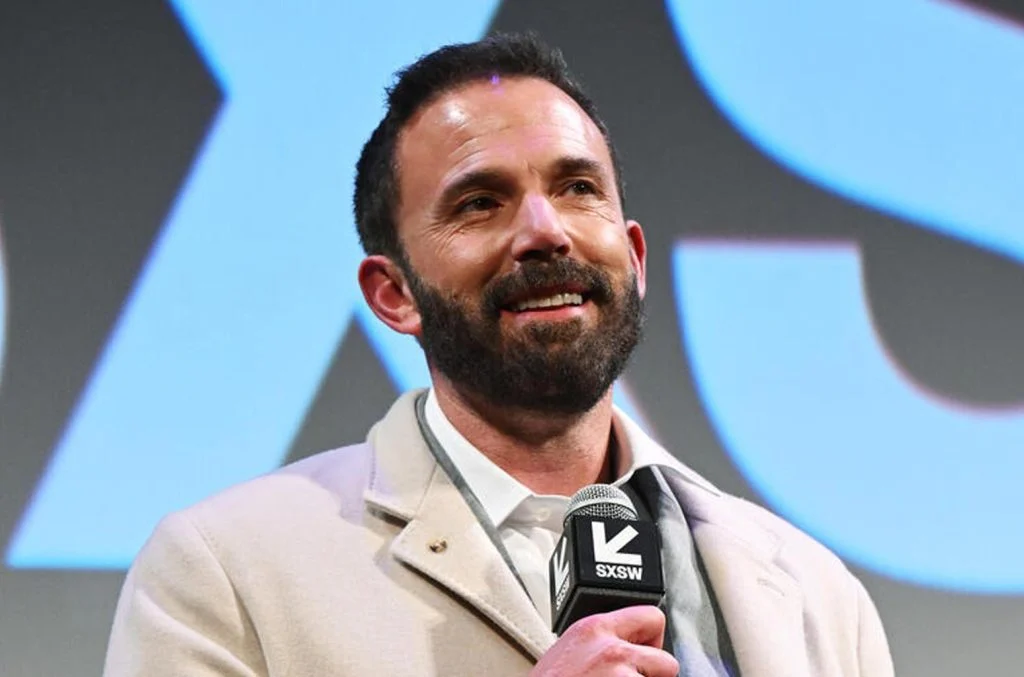
Ben Affleck has nothing but nice things to say about his ex Jennifer Lopez. More than a year after Lopez filed for divorce following the couple’s whirlwind second shot at romance, the actor told Entertainment Tonight that the “Dear Ben, Pt. II” singer remains a vital, loving part of his family’s life.
“For the record, Jennifer Lopez is spectacular, great to my kids, great ongoing relationship with them,” he said on Wednesday night’s (April 17) red carpet for his action-packed sequel to his 2016 drama about an autistic CPA who does forensic accounting for criminal gangs. The praise appeared to be in reference to Lopez’s ties to Affleck’s three children with ex-wife, actress Jennifer Garner, Violet, 17, Seraphina, 16 and Samuel, 13.

Trending on Billboard

Affleck intimated that he also has affection for Lopez’s children, 17-year-old twins Max and Emme, whom she shares with her ex-husband singer Marc Anthony. “I love her kids. They are wonderful,” he said. “She is enormously important, [a] tremendous person of a lot of integrity who I adore and am grateful to.” The Oscar-winning actor and producer also noted that he was “thrilled” to have his kids and Lopez’s children with him at the movie’s premiere in Los Angeles.

“That’s the kind of thing where the relationship that you have with children like that is a joy in my life,” he said, noting that he was “very excited” to have the whole blended family out with him. “Those kids are amazing and I’m glad that this is a movie they want to come to… I love when all the kids come out.”

Despite the tabloid-magnet allure of the couple’s relationship over the past few years, Affleck noted that he doesn’t, “read the stuff online much and sometimes I get the sense that people perpetuate this idea of like, I don’t know, they want to find something negative to talk about.” Affleck and Lopez, both 55, first began dating in 2002 and got engaged before calling things off in 2004.

They reunited in 2021 and got married the following year. Lopez filed for divorce in February 2024, just months after the release of This Is Me Now: A Love Story, a movie co-written by the couple that was loosely based on their real-life love story. A candid behind-the-scenes doc, The Greatest Love Story Never Told, was also released at the time, opening up a window into their private lives. The couple’s divorce was finalized in January.

In March of this year, Affleck opened up for the first time about their second split, saying he had “nothing but respect” for Lopez, adding that there was “no scandal, no soap opera, no intrigue” about their divorce.

04/17/2025

The non-singles worth remembering from our favorite albums of 20 years ago.

04/17/2025