Author: djfrosty
Page: 180
Trending on Billboard
When Baz Halpin first spoke with Justin Timberlake to plan the star’s Forget Tomorrow World Tour, the concert production designer suggested: “Let’s talk broadly about concepts and what you want to say on the tour.” Timberlake cut him off. “No,” he said. “I want to understand lighting, special effects, pyro, video. I want you to tell me everything that’s new.”
Halpin compiled a 100-page deck, including links to the latest video technology, for the pop superstar to study. Together, they concocted the centerpiece of the 14-month tour, which concluded in July — a massive, five-sided monolith, 17 feet by 30 feet by 7 feet, festooned with tiny LEDs for elaborate videos. At the end of every show, Timberlake surfed atop the giant rectangle, floating above the audience as it displayed gravity-defying bubbles on every side. “Screens have gotten infinitely lighter. They’ve gotten infinitely cheaper,” says Halpin, founder and CEO of Silent House, a Los Angeles design and production company that has worked with Tyler, The Creator, P!nk, Doja Cat and others. “A lot of things came together to make the process easier and more achievable.”
Billboard‘s Live Music Summit will be held Nov. 3 in Los Angeles. For tickets and more information, click here.
Related
No longer are video screens confined to the giant postage stamps bookending every live stage. Because LED technology has rapidly advanced over the last 30 years, artists can display more detailed scenes bounded only by their imaginations, spread across screens of all shapes and sizes, for audiences. SZA sits on a ledge, silhouetted beneath a moon, clouds and stars that seem like a real night. Phish jam at Las Vegas’ Sphere amid psychedelic canvases ranging from the ocean floor to the cosmos to abstract patterns. And some concerts employ the fast-growing technology to simply magnify the fans in attendance, like that infamously canoodling couple caught on a circular stadium kiss cam in July at a Coldplay show.
“The quality of LED in terms of image projection is insane these days,” says Adrian Martinez, co-founder and creative director of STURDY, which has designed visuals for such stars as Bad Bunny, Kendrick Lamar and Drake. “We’re getting to the point of watching HDTV.”
Coldplay’s Music of the Spheres tour, which broke worldwide attendance records in January with two concerts in India, anchors its stage with huge screens — circular ones on either side of the performance as well as a half-circle constantly running behind the band. It’s no wonder that amid the nonstop larger-than-life video stream of frontman Chris Martin, neon rainbows and explosions of light that the unwitting couple found themselves on the kiss cam.
“Privacy is a big issue, but we’ve always looked into, ‘How can we get the audience to actually be part of the show?’ ” says Joris Corthout, CEO of Prismax, a visual production company that recently worked with promoters Insomniac and Tomorrowland to create the EDM show UNITY at Sphere. Prismax is developing an on-site concert photo booth that transfers fans’ snapshots (with their permission, of course) to a huge stage combining lights and Polaroids. According to Silent House Studios president Alex Reardon, camera technology has improved to “pick up people in lower-light scenarios than [it] used to,” which helps artists integrate fans into the video aspect of the show. Silent House client Maroon 5 plans to do the same for its upcoming tour, “capturing the audience and trying to use those images as something emotional, something musical,” Halpin adds. “Think of it as another paint in the paint box.”
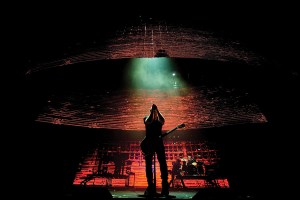
Nine Inch Nails perform during the Lights in the Sky Tour at the Mohegan Sun Arena on August 7, 2008 in Uncasville, Connecticut.
Courtesy of Moment Factory
Video technology for today’s concerts is basically limitless, thanks in part to groundbreaking tours like Nine Inch Nails’ 2008 outing Lights in the Sky, which spread tapestries of striking LEDs throughout all sides of the stage and ceiling, sometimes in the form of brightly colored grids or swirling mist. “LED in 2008 was very rare,” says Daniel Jean, producer/director of the music department for Moment Factory, which designed that tour. “It was more expensive and it was low resolution.” Ten years later, Childish Gambino’s Pharos concerts in New Zealand were among the first to present an elaborate animated world, toggling between fish, burning trees, colorful coral shapes and industrial sculptures. “I likened it to a planetarium,” says Christian Coffey, tour director for those shows and others by Lamar, A$AP Rocky and more. “The band is performing, but you’re watching the screen for so much of it.” In 2024, multiple suspended screens displayed flickering lights and images of Billie Eilish singing throughout her video-heavy Hit Me Hard and Soft tour.
It was in 1997, while watching colorful LEDs flash behind U2 during Las Vegas dress rehearsals for the band’s seminal PopMart stadium tour, that special-effects whiz Frederic Opsomer turned to his wife and said, “You are now looking at the future for the rest of my career.” According to Opsomer, CEO of the 30-year-old production company PRG, PopMart was when concerts first took advantage of the blue LED, invented by Japanese engineers in 1993. Enabling use of every color rather than just red and green, the development kicked off the LED era in lighting and video, replacing Jumbotrons using heavy and expensive cathode-ray technology.
By the time PopMart rolled around, Opsomer adds, video equipment that historically required 14 touring trucks needed two. And installation time took two hours rather than two days. “Suddenly, all the possibilities are open,” he says. “We’ve been playing with it ever since.”
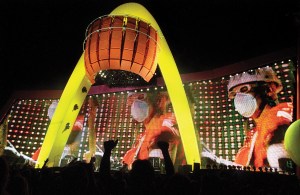
The U2 PopMart Tour stage set at Sam Boyd Stadium on April 25, 1997 in Las Vegas, Nevada.
Rob Verhorst/Redferns
In addition to unlocking limitless shapes, sizes and images at concerts and festivals, state-of-the-art camera and LED technology has let production experts be more nimble and improvise along with the artists. For its four-night 2024 run at Sphere, Phish hired producers at Moment Factory, which also works with stars like Eilish and Olivia Rodrigo, to “play the visuals in real time,” as Jean puts it; in one widely shared moment, an intricate, rainbow-colored forest transformed into fireworks exploding above the stage. “We’re playing miniature video games,” adds Manuel Galarneau, the company’s multimedia director. “Depending where we were at in the music, we could have trees grow, turn into fireworks.”
As video technology has expanded, production companies have boomed alongside it. High Scream, which puts on large events starring David Guetta and DJ Snake, among others, has increased its employees from two in 2012 to 240 today. “We went very, very big for the last five, six years,” says Romain Pissenem, the company’s founder and show producer. “It’s a lot of work, not a lot of sleep.” Moment Factory launched with six workers in 2001 and employs 480 today.
A crucial period for some concert video specialists was the coronavirus pandemic, when they could stop focusing on the day-to-day grind of setting up shows and contemplate innovation. Corthout pivoted to virtual festivals, including a digital iteration of Tomorrowland, and when traditional live events returned, “We just decided to work on that methodology we created for the virtual festivals,” he says. “We used to be and mix video files, but now we build a whole world.” Artificial intelligence, Corthout adds, has been a “fantastic tool” that reduces production costs.
Almost every video designer refers to some aspect of world-building. For this year’s Grand National stadium tour co-starring Lamar and SZA, the rapper’s world was “street and concrete and very raw,” according to tour director Coffey, while the R&B star’s landscape was “very lush.” The challenge, he says, was to use screens and high-resolution video content to “transport one world to another and make it seem seamless so it’s not jarring.” Corthout adds: “That’s the future of live entertainment — you can transport people to a completely different world.”
Phish perform during night three of their four-night run at Sphere on April 20, 2024 in Las Vegas, Nevada.
Courtesy of Moment Factory
With all the fantastical potential, for many in the touring business, one risk is overstimulating the audience. “The resolution and the processing have gotten better,” says LeRoy Bennett, the longtime concert production designer currently working on Paul McCartney’s tour, in which the singer duets seamlessly with his late Beatles partner John Lennon on “I’ve Got a Feeling,” with assistance from documentary director Peter Jackson. “But we’ve got 30 songs in the show, so there’s not all content all the time. We try to give it a break. It becomes redundant if every single song has video on it.” Shows at Sphere, Bennett adds, are perfect for EDM artists who don’t necessarily need the audience to look at them, whereas pop and rock stars want to avoid “the whole audience looking up at the ceiling and not looking at you.”
Still, Sphere lets designers innovate in ways they can’t on traditional tours. “Sphere allows us to immerse people 100% as far as the eye can see,” Corthout says. “An old stage would give you physical boundaries. Sphere takes those boundaries away.”
Sphere productions like UNITY use innovative ideas that point the way for others to follow. “I haven’t personally worked with an artist who has said, ‘Look what Sphere is doing, I want to do that,’ ” Coffey says. “But Sphere is pushing the envelope forward.” In this way, according to Martinez, Sphere productions offer “proof of concept” for experimenting with video ideas. “The bar has been set so high,” he says, “it has opened the door for those of us on the creative side to say, ‘We know this works. How about we try this?’ ”
This story appears in the Oct. 25, 2025, issue of Billboard.

Trending on Billboard Ariana Grande is celebrating the release of her Positions (Vevo Official Live Performances) in honor of the fifth anniversary of the singer’s sixth studio album, 2020’s Positions. Tracks on the six-song EP use audio from Grande’s 2021 Vevo Official Live performance taping of the songs “POV,” “Positions,” “Safety Net” (feat. Ty Dolla […]
Source: Prince Williams / Getty
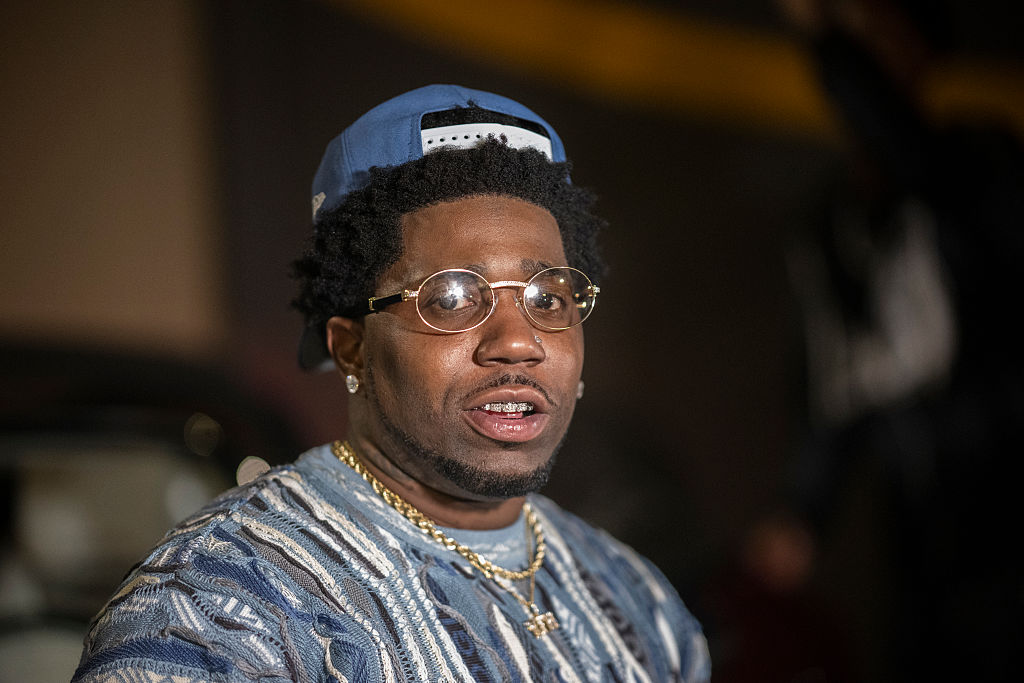
YFN Lucci hops on Big Bank’s Podcast and shares an interesting story about Young Thug.
650 Lu made it clear from the beginning of his career that he would stay ten toes down and never tell. Regardless of whether it’s family or even a foe. On his new album, “ALREADY LEGEND”, he talks about staying solid on his song, “PIECES ON MY NECK”, saying, “While n*ggas painting they nails, and living fairytales, I was sitting up in my cell, I chose not to tell.”
Very on brand for the Summerhill rapper. During his sitdown with Big Bank, he reveals that the Fulton County District Attorney Fani Willis allegedly tried to twist his arm to cooperate against Young Thug. Dangling less time behind bars, and an early release if he sang. Lucci claimed that this happened “plenty of times,” that Fani Willis asked him to provide information against his former op.
Since both Lucci & Thuggers’ release, they have squashed their longtime beef. Which was huge for not only Atlanta, but Hip-Hop altogether. Even make guest appearances on each other’s albums. The two leaned into the drama and used it to their advantage during the album rollouts. Seemingly playfully dissing each other on Instagram, to turn around 24 hours later and have each other on their albums.
YFN posted a picture of Thug saying, “ALBUM AIN’T NUN FOR A MILLION UGLY AHH MAN @thuggerthugger1 #ALREADYLEGEND FRIDAY F*CK BUDDY”
After the two Atlanta rappers released their projects, they both bumped into each other in the club and dapped it up for the first time in public. Cementing that, the beef was over, and both superstars made amends.
Trending on Billboard
When Chappell Roan began contemplating her return to the stage after the biggest year of her professional career — one that included a series of record-breaking festival performances and culminated in a Grammy for best new artist — she had a clear vision for how she wanted to do it.
“She loves the feeling of a festival-style show, where people can dance and be free of fixed systems,” says Kiely Mosiman, one of Roan’s agents at Wasserman Music. “So we came up with the initial idea of, essentially, building festival sites — but just for Chappell’s show.”
Members of Roan’s live team will speak at Billboard‘s Live Music Summit, which will be held Nov. 3 in Los Angeles. For tickets and more information, click here.
Related
Together with Mosiman and Roan’s team at Foundations Management, Roan devised a series of fall pop-up performances in New York, Los Angeles and Kansas City, Mo. — the biggest city in her home state — directly catering to her biggest fans. But Roan’s camp was concerned that, rather than reaching the hands of those fans, the bots and scalpers that troll high-demand concert on-sales would scoop up tickets for the shows, looking to flood the secondary market with up-charged tickets and make a healthy profit on resales.
Roan outlined that focus in a July Instagram post announcing the eight dates that would begin Sept. 20 in New York and run through Oct. 11 in L.A. “Because we’re only coming to three cities,” she wrote, “I wanted to make sure 1. we’re keeping ticket prices as affordable as possible and 2. we’re trying to keep them away from scalpers.”
That’s easier said than done. In an era of soaring concert ticket prices and a bot issue that has become so pervasive that Congress has gotten involved, star artists — particularly those who exploded in popularity as quickly as Roan did over the past 12 months — are often frustrated by the difficulties in reaching their biggest fans and catering to those who supported them from the beginning.
To do so, Roan and her team turned to Fair AXS, a program by ticketing partner AXS that aimed to deliver on her vision. As opposed to typical tour rollouts, which usually employ a presale and a general on-sale and are often inundated by bots that buy out inventory instantaneously and astronomically inflate prices on the secondary market, Fair AXS took a slower, more methodical approach. Fans signed up over a three-day period, after which AXS used a proprietary system to verify that each registrant was a real person who maybe even had purchased Roan tickets in the past. AXS then delivered a list of such registrants to her agents at Wasserman. The AXS team released a tranche of ticket-purchasing invitations to fans across a 24-hour period and then, based on the ratio of those fans who actually purchased the tickets, released a second tranche the following day and a third the day after. The result takes much longer than a traditional on-sale — and naturally eschews the “instant sellout” publicity rush — but the demand for Roan was such that there never needed to be a fully open public on-sale, and the process delivered on her goals.
“When you have an artist that wants to do something like this and then you have really strong agents and managers in their corner who will take the time to agree on a plan, it’s incredibly effective,” says Dean DeWulf, head of venues, North America at AXS. “She chose to focus on fairness for her fans, even when she could have priced tickets higher.”
Still, for Roan, the result paid off handsomely: The first six shows of the run — four at Forest Hills Stadium in Queens and two at Liberty Memorial Park in Kansas City — grossed $15.4 million and sold 123,000 tickets, according to Billboard Boxscore, with the two L.A. dates yet to be reported. The process took around two weeks, between the three-day registration window, the seven days during which AXS vetted millions of registrations and the three days of offering the approved fans tickets. But just as important to her team at Foundations, Wasserman and AXS was the response to the shows, where almost every attendee was outfitted in cowboy hats, glitter and hand-made costumes.
“It really did feel like everyone was a part of a community in a way that I haven’t felt at a show in a really long time,” Mosiman says. “I think sometimes it gets lost how much Kayleigh [Amstutz, Roan’s real name] really does care about fans and their experience. And she absolutely was part of this process, putting in the work from day one to do it at this scale.”
Scale, now, is the big test for this program. It has been around for several years but has been used most often for one-off specialty shows, such as big-name underplays at small venues (Paul McCartney used it, for example, when he played California’s 4,500-capacity Santa Barbara Bowl in September) or at special venues like Red Rocks in Colorado. Acts such as ODESZA, Vampire Weekend, Billy Strings and Sturgill Simpson have used it, while perhaps the biggest proof of concept came from Zach Bryan’s tour in 2023, which utilized the program across its entire 32-date run, with face-value resale exchange. In late October, the Iowa festival Hinterland announced that it will use Fair AXS for its 2026 edition, becoming the first festival to deploy it.
And while artists may be leaving money on the table — the general admission price for Roan’s shows was $99 when they could have easily been priced much higher — there are other benefits the program provides artists, in addition to fostering community and rewarding the loyalty of devoted fans. “Artists are so disintermediated from their fans today,” DeWulf says. With this program, “they can actually know who the fans are. Being able to give that information to not only the artist camp but also to the promoter is very helpful for them to understand where the fans are, to route the tour to bigger venues next time and add more shows.”
Roan’s next move, as she put it in her announcement, will be “going away to write the next album.” And when she tours behind that release, it will be on the arena — or, perhaps, even the stadium — level. But her connection with her fans in the live environment has now been cemented — and AXS may have a solution to the increasingly impersonal process involved in establishing that connection.
“Ticketing, over the last 20 years, has become so monolithic, so opaque, so confusing, and it’s made it easy for bad actors to completely arbitrage the tickets, create scarcity and inflate prices,” DeWulf says. “But at the end of the day, ticketing is deeply personal. We’re in the fan connection business, and people care so deeply about these artists. That connection that we’re powering is so human and personal. And this is a very personal approach.”
This story appears in the Oct. 25, 2025, issue of Billboard.

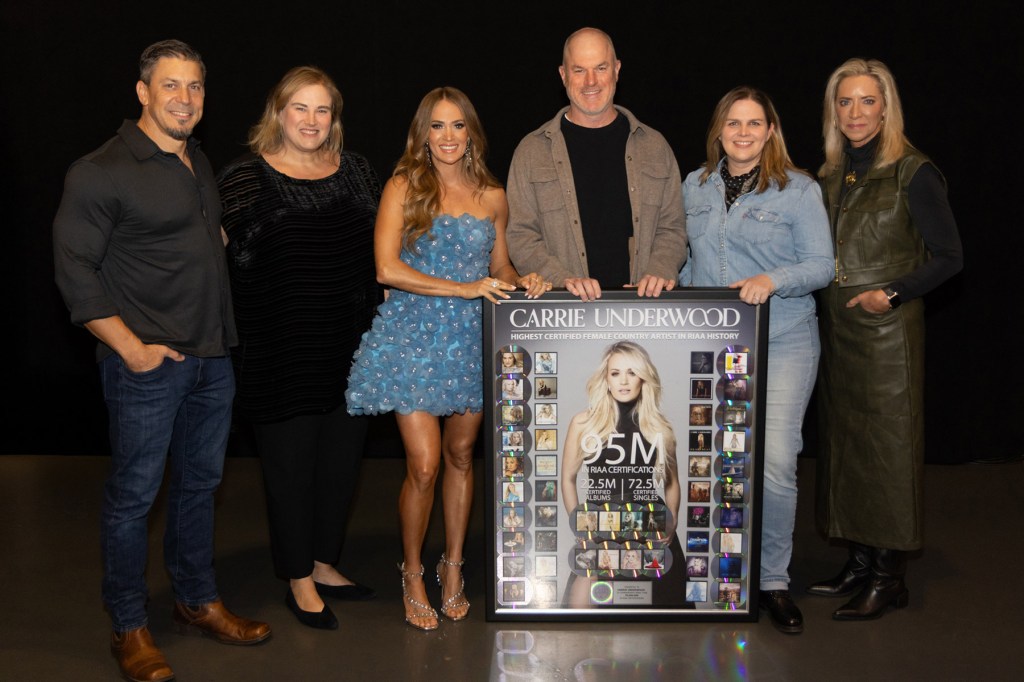
Trending on Billboard Carrie Underwood has hit a new career milestone: She’s been named the highest Recording Industry Association of America-certified female country artist of all time, with over 95 million units (22.5 million in albums and 72.5 million in singles) in the United States alone, inclusive of solo titles and collaborations. Among Underwood’s RIAA […]
Trending on Billboard
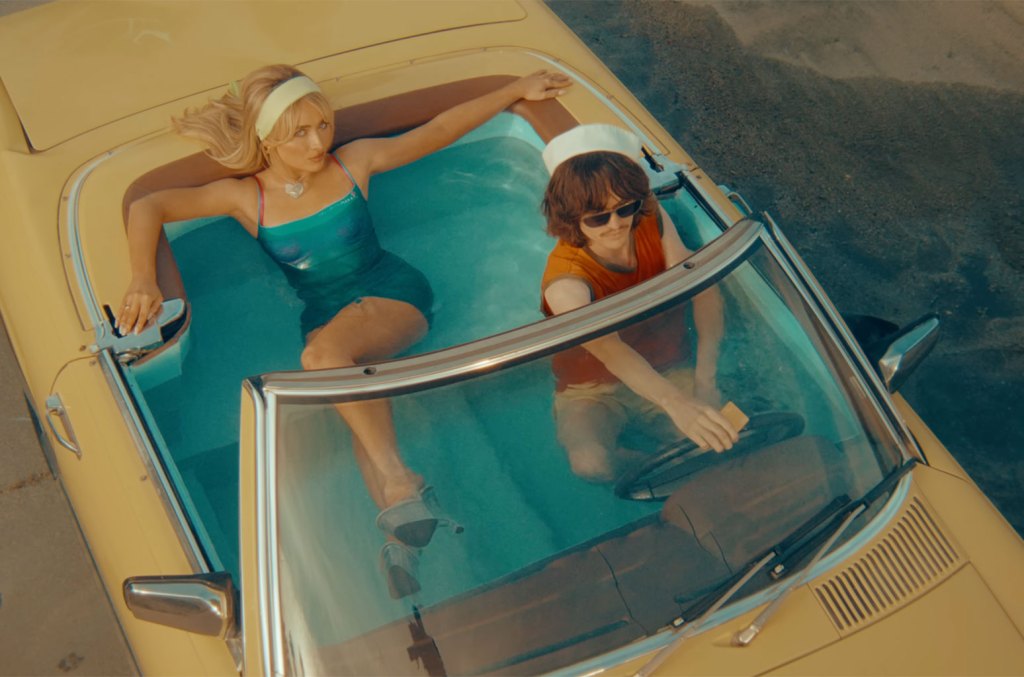
Sabrina Carpenter’s “Espresso” was the earworm of 2024, an inescapable pop smash that miraculously retained its charm even after hundreds of listens. But did you ever think a scholarly look at the song would win a Deems Taylor/Virgil Thomson Award?
One just did. The 2025 Virgil Thomson Award for outstanding music criticism in the pop music field is presented to Dan Charnas for his Slate article “The Musical History Lesson Buried Beneath the Song of the Summer.” ASCAP says the article looks at “the popular but ‘nameless’ musical genre that is the foundation” for Carpenter’s smash. (For the record, the song, which Carpenter co-wrote with Amy Allen, Steph Jones and Julian Bunetta, ranked fourth on Billboard’s 2024 Song of the Summer chart.)
The winners of the 56th annual ASCAP Foundation Deems Taylor/Virgil Thomson Awards were announced Thursday (Oct. 30). Awards are presented for outstanding books, articles, liner notes and broadcast programs on the subject of music. Established in 1967 to honor the memory of composer, critic and former ASCAP president Deems Taylor, the awards are made possible by the support of the Virgil Thomson Foundation.
Here are this year’s other winners:
Deems Taylor/Virgil Thomson Award recipients for articles published in 2024:
The award for an article in the pop music field goes to Robert Michael Marovich for his article on the prolific Black songwriter Ted Jarrett, “The Black Songwriter Who Took Nashville by Storm,” published by Zocalo Public Square.
The award for an article in the concert music field goes to Jonathan Kregor for his article “Remembering Clara Wieck in Vienna: Gender, Genius, and Genre in the Post-Beethoven Biedermeier,” published in Women’s Agency in Schubert’s Vienna.
The award for outstanding music criticism in the concert music field is presented to Kevin Bartig for his article, “Olin Downes and the Soviets,” published by the Journal of the American Musicological Society.
A runner-up award in the above category goes to Andy Zax for “Extinctophonics: The Game of Jim,” published in Third Man Records & Books’ Maggot Brain.
Deems Taylor/Virgil Thomson Broadcast/Media Award in pop music:
Director Alex Stapleton, writer Stephen Witt and producer Philip Byron for their documentary, How Music Got Free. The Paramount+ film tells the story of how technology-driven disruption changed music in the late ‘90s and early 2000s. Additional producers included Marshall “Eminem” Mathers, LeBron James, Paul Rosenberg, Maverick Carter, Jamal Henderson, Steve Berman, James Chapman, Bruce Gillmer, John Janick, Dan Sacks, Bridgette Theriault, James Thayer, Naomi Wright, Steve Stoute, Anthony Seyler, Stevenson Waite, Michael Maniaci and Malik Johnson.
Deems Taylor/Virgil Thomson Broadcast/Media Award in concert music:
Producer David Osenberg for the weekly program “Sounds Choral,” a production of WWFM, The Classical Network. The program explores the choral art form and is hosted by a rotating roster of choral conductors, composers and scholars including Ryan Brandau, Gabriel Crouch, Jason Max Ferdinand, Jacqueline Horner-Kwiatek, Christopher Jackson, James Jordan, Amanda Quist, Steven Sametz, Deborah Simpkin-King and Ethan Sperry.
ASCAP Foundation Paul Williams “Loved the Liner Notes” Award:
Lauren Du Graf for “Alice Coltrane: The Artist in Ascension” from The Carnegie Hall Concert on Impulse Records.
Runner-up awards in the above category are also given to Elizabeth Nelson for “Hours in the Colosseum: Notes on the 1974 Tour” from The 1974 Live Recordings by Bob Dylan & The Band on Sony Legacy and Shana L. Redmond for Paul Robeson – Voice of Freedom: His Complete Columbia, RCA, HMV and Victor Recordings on Sony Classical.
The “Loved the Liner Notes” Award was established in 2016 and is funded by ASCAP Foundation President Paul Williams.
Deems Taylor/Virgil Thomson Book Awards in pop music:
Joe Boyd for And the Roots of Rhythm Remain, a history of music from all over the world that influenced jazz, rhythm & blues and rock ‘n’ roll, published by Faber & Faber
Brian Wright for The Bastard Instrument: A Cultural History of the Electric Bass, published by University of Michigan Press.
A runner-up award in this category goes to Sheila Curran Bernard for Bring Judgment Day: Reclaiming Lead Belly’s Truths from Jim Crow’s Lies, published by Cambridge University Press.
Deems Taylor/Virgil Thomson Book Award in concert music:
David Suisman for Instrument of War: Music and the Making of America’s Soldiers, published by University of Chicago Press.
A runner-up award in this category goes to Mikel Rouse for The World Got Away: A Memoir, published by University of Illinois Press.
More information about The ASCAP Foundation Deems Taylor/Virgil Thomson Awards is available at their site.
Trending on Billboard
SoundCloud, a leading platform for independent artists and their fans, is debuting new features to make streaming more financially rewarding for its customers. On Thursday (Oct. 30), the company announced new components to its all-in-one offerings that will put more money into artists’ pockets.
“We’ve got an opportunity to solve the problem that streaming is not enough for artists or fans, because this is going to be new dollars on the table for artists and new ways for fans to express their fandom,” CEO Eliah Seton tells Billboard.
Related
For music distributed through SoundCloud, artists signed up to the Artist and Artist Pro plans will now keep 100% of royalties from streams on other platforms such as Spotify, YouTube Music, Apple Music and TikTok. Previously, SoundCloud took a 20% cut of those royalties as a distribution fee. This change mirrors the existing 100% payouts on royalties generated from streams on the SoundCloud platform.
In addition, SoundCloud is launching a new patronage feature. Artists will also keep 100% of the money received from a new feature on artist profiles, Fan Support. Fans can donate from $1 to $1,000 at a time in exchange for their names being acknowledged on the artists’ pages. At launch, Fan Support is available only to Artist Pro subscribers in the U.S.
Early results of Fan Support have been promising. According to Seton, artists who have tested Fan Support have earned more than they’ve received from streaming in their entire careers. “This can really unlock a major new opportunity for a middle class of artists that a lot of people have been talking about for a long time,” he says.
Related
The Artist plan is billed annually for $39 and allows distribution of up to two tracks per month. The $99-per-year Artist Pro plan offers distribution of an unlimited number of tracks. The new distribution terms and Fan Support feature are not available on the free Basic tier, which does not include distribution to other streaming providers.
SoundCloud’s latest moves are an attempt to address the financial problems faced by independent artists on its platform. Music streaming has revitalized the larger music industry, attracting major investors to artist and songwriter catalogs and driving the global industry’s decade-long winning streak. For many independent artists, however, streaming itself isn’t financially sustainable.
More than 40,000 new creators upload music to SoundCloud each week, according to Seton, and new music accounted for 50% of streams on the platform in 2024, according to the company’s Music Intelligence Report from March. But the volume of new music is itself seen as a hindrance: 67% of independent labels believe the glut of new tracks uploaded to streaming services — including AI-generated music — makes it harder to develop new artists, according to MIDiA Research.
Related
In a prior attempt to make streaming more equitable, in 2021, SoundCloud changed how it pays royalties to help emerging, less popular artists. Called “fan-powered” royalties, the scheme gives artists a share of the fees from users who stream their music. That’s different from the traditional “pro-rata” method, which pools subscription fees and pays royalties based on aggregate streams. In a pro-rata model, independent artists share a revenue pool with superstars. SoundCloud’s approach, which attracted Warner Music Group and independent rights organization Merlin, is more favorable to independent artists, according to a 2024 report.
Artist and Artist Pro have additional components, such as on-demand vinyl manufacturing through a partnership with Elastic Stage that was announced in July. Both tiers also allow artists to create merch storefronts on their pages. The goal, Seton explains, is to provide a menu of options for artists to build a career in different ways. “We want to be able to unlock all those possibilities,” he says.
Thursday’s announcement is a bet that giving artists a larger share of royalties will be good for business. Unlike most streaming platforms, SoundCloud is a two-sided marketplace that generates income from both artists and listeners — a symbiotic relationship that creates a “virtuous circle,” Seton explains. Luring and retaining artists with career-building tools and attractive terms not only generates more income, it makes SoundCloud a more attractive destination for fans.
“We feel like we’ve really begun to crack the code on being a two-sided marketplace and what really distinguishes us,” says Seton.
Trending on Billboard
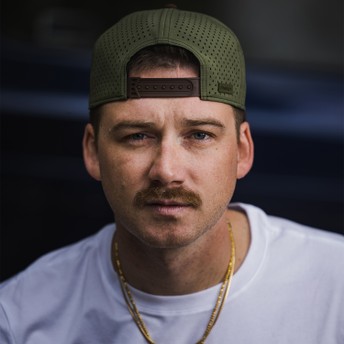
Morgan Wallen is set to bring his high-octane, hit-filled show to 11 cities in 2026, when his 21-date Still The Problem Tour 2026 launching on April 10 in Minneapolis.
Explore
See latest videos, charts and news
Wallen’s new tour will visit stadiums in Las Vegas, Indianapolis, Chicago, Philadelphia, Denver and Pittsburgh, among other stops. He will play two nights in most locations and will play three major college football stadiums, including Florida’s Ben Hill Griffin Stadium, Michigan’s Michigan Stadium and one night only at Alabama’s Saban Field at Bryant-Denny Stadium. The 19x Billboard Music Awards winner is bringing with him a top-shelf, rotating lineup of openers, including Brooks & Dunn, HARDY, Ella Langley and Thomas Rhett as direct support, Gavin Adcock, Flatland Cavalry and Hudson Westbrook as second-of-four and Jason Scott & The High Heat, Zach John King, Vincent Mason and Blake Whiten as first-of-four.
Still The Problem is inspired by Wallen’s I‘m The Problem album, which released May 16, 2025 on Big Loud/Mercury Records and spent 12 non-consecutive weeks atop the all-genre Billboard 200 albums chart, becoming Wallen’s third consecutive album to spend at least 10 weeks at the pinnacle of the Billboard 200.
Like previous Wallen tours, a portion of each ticket sold will benefit his Morgan Wallen Foundation, which supports programs for youth in sports and music. With those donations, the Morgan Wallen Foundation contributed more than $600,000 worth of instruments to schools across U.S. touring cities in 2025.
Pre-sale registration for Still The Problem Tour is open now through Nov. 6 at 10 p.m. local time at StillTheProblem.com. Public on-sale begins on Friday, Nov. 7 at 10 a.m. local time.
See the full list of Wallen’s Still The Problem Tour 2026 dates below:
April 10: Minneapolis, Minn. @ U.S. Bank Stadium w/ Thomas Rhett, Gavin Adcock, Vincent Mason
April 11: Minneapolis, Minn. @ U.S. Bank Stadium w/ HARDY, Gavin Adcock, Vincent Mason
April 18: Tuscaloosa, Ala. @ Saban Field at Bryant-Denny Stadium w/ Ella Langley, Vincent Mason, Zach John King
May 1: Las Vegas, Nev. @ Allegiant Stadium w/ Brooks & Dunn, Gavin Adcock, Vincent Mason
May 2: Las Vegas, Nev. @ Allegiant Stadium w/ Thomas Rhett, Gavin Adcock, Vincent Mason
May 8: Indianapolis, Ind. @ Lucas Oil Stadium w/ Brooks & Dunn, Hudson Westbrook, Zach John King
May 9: Indianapolis, Ind. @ Lucas Oil Stadium w/ Ella Langley, Flatland Cavalry, Zach John King
May 15: Gainesville, Fla. @ Ben Hill Griffin Stadium w/ Thomas Rhett, Gavin Adcock, Zach John King
May 16: Gainesville, Fla. @ Ben Hill Griffin Stadium w/ Ella Langley, Gavin Adcock, Zach John King
May 29: Denver, Colo. @ Empower Field at Mile High w/ Brooks & Dunn, Gavin Adcock, Vincent Mason
May 30: Denver, Colo. @ Empower Field at Mile High w/ Ella Langley, Gavin Adcock, Vincent Mason
June 5: Pittsburgh, Pa. @ Acrisure Stadium w/ Brooks & Dunn, Gavin Adcock, Zach John King
June 6: Pittsburgh, Pa. @ Acrisure Stadium w/ Ella Langley, Gavin Adcock, Zach John King
June 19: Chicago, Ill. @ Soldier Field w/ Brooks & Dunn, Gavin Adcock, Zach John King
June 20: Chicago, Ill. @ Soldier Field w/ Ella Langley, Gavin Adcock, Zach John King
July 17: Baltimore, Md. @ M&T Bank Stadium w/ Brooks & Dunn, Gavin Adcock, Jason Scott & The High Heat
July 18: Baltimore, Md. @ M&T Bank Stadium w/ Ella Langley, Gavin Adcock, Jason Scott & The High Heat
July 24: Ann Arbor, Mich. @ Michigan Stadium w/ Thomas Rhett, Hudson Westbrook, Blake Whiten
July 25: Ann Arbor, Mich. @ Michigan Stadium w/ HARDY, Hudson Westbrook, Blake Whiten
July 31: Philadelphia, Pa. @ Lincoln Financial Field w/ Brooks & Dunn, Hudson Westbrook, Blake Whiten
Aug. 1: Philadelphia, Pa. @ Lincoln Financial Field w/ Ella Langley, Hudson Westbrook, Blake Whiten
Billboard’s Live Music Summit will be held in Los Angeles on Nov. 3. For tickets and more information, click here.
Trending on Billboard
Stem co-founder Tim Luckow has launched a new platform that aims to help artists and songwriters claim so-called “black box” royalties, it was announced Thursday (Oct. 30).
The platform, called Notes.fm, seeks to simplify the process of claiming these royalties. It requires only an artist or songwriter’s name to scan streaming services, collection societies and registries, including the Mechanical Licensing Collective (MLC), to identify missing recording, publishing and performance rights royalties and fix issues to ensure future income flows to them directly. In addition to Luckow, the founding team includes Derek Davies and Montalis Anglade.
Related
Now open to the public, Notes.fm does not take a cut of royalties but instead boasts a subscription model beginning at $5 a month. It previously held a year-long beta with more than 400 artists, from established names like Mt. Joy, James Blake and Girl in Red to emerging artists like Adam Melchor and Adam Wise, along with the estates of artists including Howlin’ Wolf. During that time, Notes.fm identified more than $10 million in missing or unclaimed royalties from songs encompassing more than 50 billion streams — an average of $15,500 per artist, according to the company.
The company adds that some artists saw six-figure payouts by participating in the beta, including Mt. Joy, who collected six figures across corrected historical registrations and new registrations for songs including “Highway Queen,” which was the first song to secure 100% royalty registration from delivery by Notes.fm on its release in 2024. Additionally, Blake discovered that around a quarter of all songs in his catalog had missing or incomplete registrations and was able to recover unclaimed royalties from those works.
“When it comes to music royalties, complexity is the enemy,” said Luckow in a statement. “For over a century, musicians have struggled to get paid because of disconnected systems that were not designed for the digital streaming era. Notes.fm fixes that, handling the complex work in the background so artists can focus on the music. Every musician deserves every dollar they’ve earned, and we’re here to make sure that happens.”
Added Steve Bursky, founder and partner at Foundations, which was an early investor in Notes.fm: “What sets Notes.fm apart is its ability to move artists and their teams from insight to action. Rather than merely flagging unclaimed royalties, Notes.fm empowers users to identify, correct, and directly recover what’s rightfully theirs, representing a fundamental leap forward in artist-first rights management.”
More information can be found at the Notes.fm website.
Trending on Billboard Beloved Hollywood fashion designer Bob Mackie is over the moon that Taylor Swift is repping one of his famously rhinestone-encrusted creations on the cover of her The Life of a Showgirl album. Speaking to E! News, Mackie, 85, said he was “kind of shocked” that the singer picked a real-life showgirl outfit […]
State Champ Radio