No matter how quick the wit, no stand-up comic starts out a success. Forget the top: on the way to the bottom rung, comics need to endure endless open-mic tryouts, log thousands of miles for little or no money and be thankful for 1:00 a.m. slots in front of drunken hecklers. And that’s just for starters. The further up the ladder they climb, the more pressure they face to consistently write and hone hour-plus sets that will power tours, specials and social media. Increasingly, they also choose to engage in a weekly form of digital improv known as the podcast.
As the first quarter of the 21st century comes to an end, Billboard set out to determine the best of that A-list: the top 25 stand-up comics of the last 25 years. To come up with these rankings, we polled experts that work with comics on a daily basis: bookers with a long histories of breaking comic talent.
The panel consists of William Burdett-Coutts, who heads the Assembly venues at the Edinburgh Fringe festival; Michael Cox, stand-up booker for The Tonight Show Starring Jimmy Fallon; Adam Eget, manager at Joe Rogan’s Comedy Mothership in Austin, Tx, and before that, the Comedy Store in Los Angeles; Bruce Hills, who, for 36 years booked and eventually ran Montreal’s Just For Laughs festival; Caroline Hirsch, the founder of Caroline’s Comedy Club and co-founder of the New York Comedy Festival; Chris and Steve Mazzilli, owners of the Gotham Comedy Club in Manhattan; Patrick Milligan, the booker and proprietor of The Stand NYC comedy club; Susan Provan, director of the Melbourne International Comedy Festival; and Samantha Schles, director of comedy at the SXSW Festival. (Billboard‘s parent company, PMC, owns a 50% stake in SXSW.)
Thanks to all our panelists for taking time out of their hectic schedules to participate. (And special thanks to Hill, who provided valuable advice on voting parameters, helped create a well-rounded and authoritative judges panel and generously provided means to contact them.)
The process began with our panel helping put together a ballot of more than 150 nominees. The talent pool was limited to comedians with active stand-up careers over the last 25 years — as opposed to sketch, sitcom, film or improvisational performers, such as the cast of Saturday Night Live, Second City or Upright Citizens Brigade. Overseas comedians with a presence in the United States were also considered.
From there, the judges each ranked their top 25 comics. Voting was anonymous, and a weighted system was used to determine the top 25. As a number of judges remarked when returning their ballots, winnowing such a large batch of nominees was extremely difficult. There are a lot of exceptional stand-up comics out there.
For the next week, Billboard will present the results of the voting — the top 25 stand-up comedians of the last 25 years — in ascending order, five at a time, with the complete list unveiled on Friday (Dec. 6). Nos. 25 through 21 follow below.
25. Jon Stewart
Best known as the anchor of Comedy Central’s broadcast news satire The Daily Show from 1999 to 2015 (a seat he currently fills once a week, on Monday nights), Stewart began as a stand-up. His muscular sets, like his anchor job, often deal with the political and cultural state of the country, and they still kill. This year, he toured with Pete Davidson and John Mulaney — a bill he described as “rehab, recovery and hospice.” At 63, aging is one of his themes: “The other day, I needed my reading glasses to jerk off,” Stewart told the crowd at the annual Stand Up for Heroes benefit for military families in 2024. (Stewart has long been a staunch activist for service members and 9/11 first responders.)
At the same event, he recalled that when someone asked him if he was “worried about anti-Semitism.” He replied, “I think anti-Semitism will be just fine,” then told the story of posting a remembrance on social media of his beloved late three-legged pitbull. While most replies offered condolences, one stood out: “Why did you change your name, Jew?” (“Stewart” is a different spelling of his middle name; he stopped using his birth name, Leibowitz, after falling out with his father.)
When President Donald Trump, during his first administration, tweeted similar comments at Stewart, the comedian replied that Trump’s real name was “F—kface Von Clownstick.”
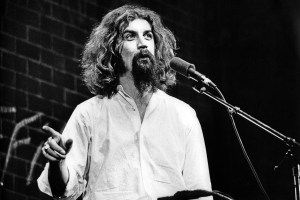
24. Billy Connolly
Image Credit: Brian Cooke/Redferns
With his Van Dyke, spectacles and shaggy gray hair, this Harley-riding Scot resembles a hippie Colonel Sanders. “The Big Yin,” as he’s known across the Atlantic, retired from stand-up at the end of the last decade. But at 83, he still consistently ranks as one of the best — if not the best — comedians of all time in U.K. polls. Connolly’s legacy as a comedian — which stretches back to the ‘70s and was preceded by a musical stint in The Stumblebums with Gerry Rafferty (“Baker Street”) — lives online and on streaming services. Connolly, who broke through in the States in the ‘90s, is a brilliant politically incorrect storyteller, who was slinging the f-word back when it was still shocking. Start with “Dwarf on a bus,” or “Colonoscopy,” and you’ll find yourself traveling down a blue, burr-filled rabbit hole.
23. Trevor Noah
Noah is another stand-up comedian who hosted The Daily Show, replacing Stewart from 2015 to 2022. Born in South Africa, his outside-looking-in observations about America and racism are scalpel-sharp, and in 2024 helped make him the No. 7 highest grossing comic of the year, according to Billboard Boxscore, earning $29.7 million and selling 392,000 tickets over 94 shows. In his 2023 Netflix special, Where Was I, he observed that America’s national anthem is like gangsta rap, or “a Michael Bay movie in a song,” full of bombs and rocket’s red glare: “The American anthem is the only anthem where you can put the word ‘b–ch’ at the end of every line, and the song still makes sense.”
22. Jim Gaffigan
Gaffigan has been at it since the 1990s, and blew up at the end of that decade after acing an appearance on Late Night with David Letterman. He subsequently became a favorite guest of his fellow Hoosier.
A clean comic, Gaffigan has built a career out of poking fun at his family, his weight and American eating habits, including his own. To wit, his extended bit on Hot Pockets (repeatedly punctuated by his singing the brand’s two-word theme song): “I was looking at a box of Hot Pockets. They have a warning on the side: ‘You just bought Hot Pockets! Hope you’re drunk or heading home to a trailer. You hillbilly, enjoy the next NASCAR event.’” This, of course, was followed by a self-critical inner voice imagining what members of his audience were likely thinking: “I like NASCAR. He’s a jerk.”
Gaffigan doesn’t do that inner voice as frequently these days, and though his family remains a theme, he’s lightened-up on the weight jokes after losing 50 pounds on a GL-1 drug. On his 2024 Hulu special, The Skinny, Gaffigan said his newly svelte form tended to provoke two reactions. The first: people approach his wife to ask if he’s sick because, “Obviously, Jim isn’t exercising and eating healthy. He must have cancer.” The second: they accuse him of taking an appetite suppressant like Ozempic. “And I’m not,” he said. “I’m on a different one. I’m on Mounjaro, which is better, because it sounds like an Italian restaurant. Welcome to Mounjaro. When you’re here, you’re not eating, because you’re a fat ass.”
21. Gabriel “Fluffy” Iglesias
When Iglesias, 49, first got into stand-up comedy in the late 1990s, he was less than solvent: his car was repossessed and he was evicted from his home. He’s traveled light-years since then. In 2022, he became the first comic to sell out Dodger Stadium, and the show was later released as the Netflix special, Stadium Fluffy. (Fluffy being his self-bestowed sobriquet, making fun of his girth.) And in June, Billboard Boxscore named him the No. 3 most successful comic of 2025 so far, having grossed $20 million performing for 275,000 fans over 50 shows.
The Mexican-American comic was raised by a single mother in low-income housing in Long Beach, Calif., and his sets tend to be cheerful riffs — heavy on the storytelling and peppered with DIY vocal sound-effects — on race and culture. In a bit on California cops, Iglesias talks about being asked to perform at a police benefit in Fresno. When he declines, he’s told he has an outstanding warrant there. At the performance, he encounters an unsettling scene: a roomful of cops drinking heavily. “If they get ghetto, who do I call?” he says.
In 2016, offered insight into the wide appeal of his comedy in an interview with the Bakersfield Californian publication: “Don’t talk about politics, don’t talk about religion,” he said. “Stay away from sports. Talk about things that are relatable to everyone. The more relatability you have, the bigger the fan base you’re going to have.” Misión accomplished.

 State Champ Radio